
 Mohammad Fahim
Hotel room mapping is how you match the same hotel room sold by different suppliers. Two suppliers can sell the exact same room. However, they name and describe it in different ways. As a result, your search can show the same room many times. Hotel room mapping fixes this. It links all those versions into one clean record.
This is one of the hardest parts of building a hotel platform. Moreover, it directly affects trust and bookings. In this guide, you will learn what hotel room mapping is, why it matters, and how to get it right.
What Is Hotel Room Mapping?
Hotel room mapping is the process of matching rooms across suppliers. It works at two levels: the hotel and the room. First, you match the property. Then, you match each room type inside it.
The goal is simple. One real room should appear once in your search. Behind that one room, you may hold many supplier rates. Therefore, the traveler sees a clean list, and you still show the best price.
This is a form of data matching, often called record linkage. It joins records that describe the same thing. In travel, that thing is a hotel room.
The Problem: One Room, Many Names
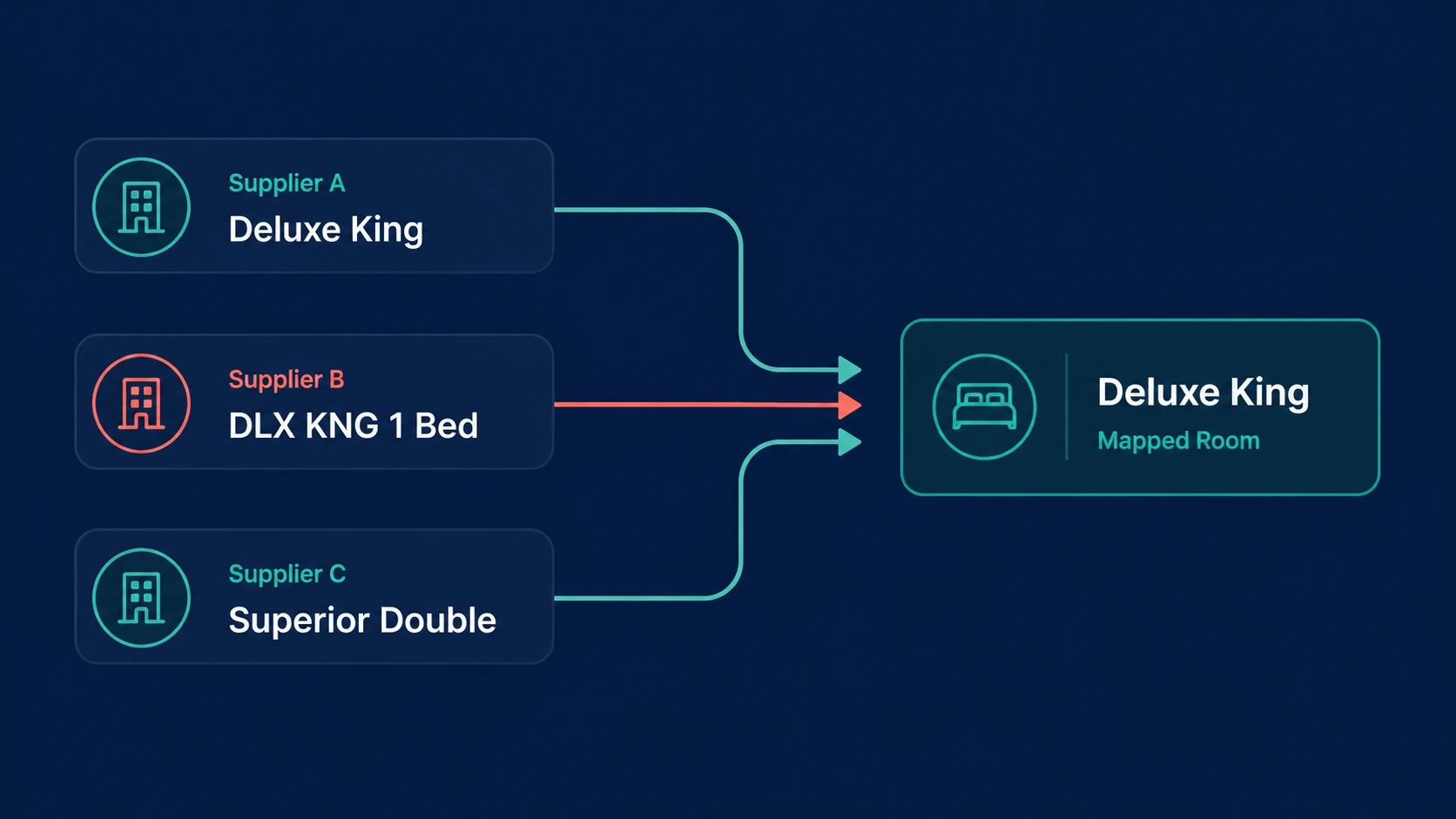
Here is the core problem. The same room can have very different names across suppliers. There is no single global ID that everyone uses.
| Supplier | Room name |
|---|---|
| Supplier A | Deluxe King Room |
| Supplier B | DLX KNG 1 Bed |
| Supplier C | Superior Double, 1 King Bed |
All three rows may be the same room. However, a simple text match will miss this. As a result, your search shows three rooms instead of one. This confuses the traveler. Worse, they may book the wrong rate.
Why Hotel Room Mapping Matters
Good hotel room mapping is not just tidy data. It drives real business results. Here is why it matters.
- Clean search: one room shows once, not three times.
- Best price: you compare all supplier rates for the same room.
- More trust: travelers see clear, correct results.
- Fewer errors: you avoid booking the wrong room or rate.
- Higher margin: you pick the cheapest source for each booking.
Without mapping, multi-supplier inventory becomes a mess. This is why mapping sits at the heart of hotel API integration. It turns raw supplier feeds into a clean product.
How Hotel Room Mapping Works
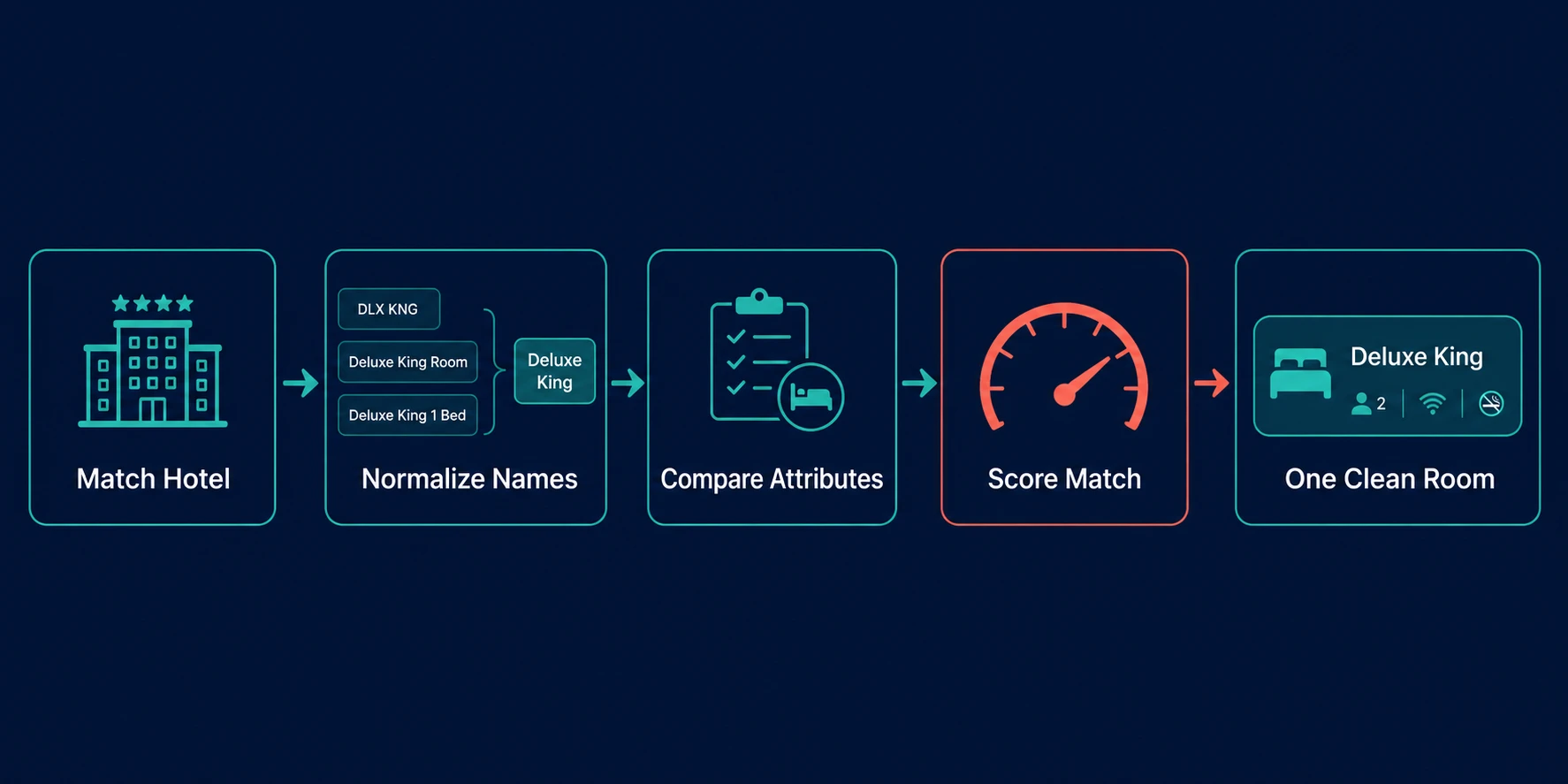
Mapping happens in clear steps. Each step adds more certainty to the match. Here is the basic flow.
- Match the hotel — use IDs, name, address, and geo-location to find the same property.
- Collect room data — gather room names, bed types, and codes from each supplier.
- Normalize the text — clean up short forms like “DLX KNG” into “Deluxe King”.
- Compare attributes — match bed type, view, board, and occupancy.
- Score the match — give each pair a confidence score.
- Group the room — link high-confidence matches into one clean record.
Good systems use hotel IDs and room codes where they exist. Then they add smart text matching for the rest. Therefore, the best results mix hard data with fuzzy logic.
This cleanup is part of wider travel data aggregation. Many feeds come in, and one clean feed comes out.
Common Challenges to Watch
Mapping is hard to get right. Here are the pitfalls that trip up most teams.
- No standard IDs: suppliers use different codes, or none at all.
- Messy room names: short forms, typos, and local languages.
- Vague descriptions: “Standard Room” can mean many things.
- False matches: two different rooms look the same on text alone.
- Constant change: hotels add and rename rooms over time.
The biggest risk is a wrong match. For example, you map a city-view room to a sea-view room. As a result, the traveler pays for the wrong product. Therefore, a confidence score and human review both help.
How to Get Hotel Room Mapping Right
You have two paths to clean room mapping. The right one depends on your size and team.
Option 1: Build it yourself
You can build your own mapping engine. This gives full control. However, it is very hard. You need data science, clean IDs, and constant tuning. Moreover, you must re-check matches as hotels change. This path suits large teams only.
Option 2: Use an aggregator
An aggregator does the mapping for you. It connects many suppliers and returns clean, deduplicated rooms. As a result, you skip months of hard data work. This is the same reason teams use one API for multi-supplier travel inventory.
Following common data standards also helps. The OpenTravel Alliance defines shared formats for travel data. Suppliers that follow them are easier to map.
Final Thoughts
Hotel room mapping turns messy supplier feeds into one clean product. It powers clean search, best-price logic, and trust. However, it is one of the hardest data problems in travel. Therefore, most platforms let an aggregator handle it.
Tripgic connects many hotel suppliers through one API, with room mapping built in. Want clean, deduplicated rooms without the data headache?