 Golam Shahrier
The Amadeus self-service API shut down on July 17, 2026. That day, self-service API keys were disabled and the developer portal closed, so any app still built on those keys now fails. This guide shows what broke, the main alternatives, and a step-by-step plan to migrate fast.
What the Amadeus API Shutdown Means
Amadeus closed its self-service developer portal on July 17, 2026, and disabled its API keys. Its developer site now states the portal “has been decommissioned” and that the site “is for Amadeus Enterprise API Portal only”. Search and booking calls made with a self-service key return errors.
Enterprise customers were not affected. Only self-service users had to act. Amadeus confirmed the change in a letter to developers, first reported by PhocusWire in February 2026, and the notice now appears on the Amadeus for Developers site itself.
Amadeus Shutdown Timeline: Key Dates
The shutdown came in three stages.
- February 2026: Amadeus announced in a letter to users that the self-service portal would close.
- The following month: new self-service registration was paused, so no new keys were issued.
- July 17, 2026: the self-service portal was decommissioned. Existing API keys were disabled and stopped returning data.
If your platform still calls the self-service API, its searches and bookings are failing now. The only fix is a new provider.
If Your App Is Down Right Now
A migration under pressure still has to be tested, or the first live booking is the test. Two things keep it short.
First, rebuild the calls your users hit most — flight search, pricing and booking — before seat maps, airport lookups and the rest. Second, use a provider with a free sandbox, so you can build and test today without signing anything first. With Tripgic, sandbox credentials are issued right after a short kick-off call, with no commitment to start. Our guide to free travel APIs compares what other providers offer for free.
Amadeus Self-Service API Alternatives
There is no single “correct” replacement. The right choice depends on your coverage needs, your team size, and how much supplier risk you want to carry. Here are the four main options.
| Alternative | Best for | Trade-off |
|---|---|---|
| Travel API aggregator (e.g. Tripgic) | Teams that want flights, hotels, and more from one API with supplier risk spread out | You rely on the aggregator’s supplier mix, but you migrate only once |
| Modern self-service flight API (e.g. Duffel) | Flight-only apps that want a fast, developer-friendly signup like the old Amadeus flow | Narrower content than a full aggregator or GDS |
| Direct airline NDC | High-volume platforms with engineering resources to manage each airline link | Heavy to build and maintain one connection per airline |
| Amadeus Enterprise portal | Larger businesses that can meet Amadeus enterprise requirements | Higher commitment and onboarding than self-service |
For a deeper look at flight-specific options, see our guide to Amadeus self-service API alternatives.
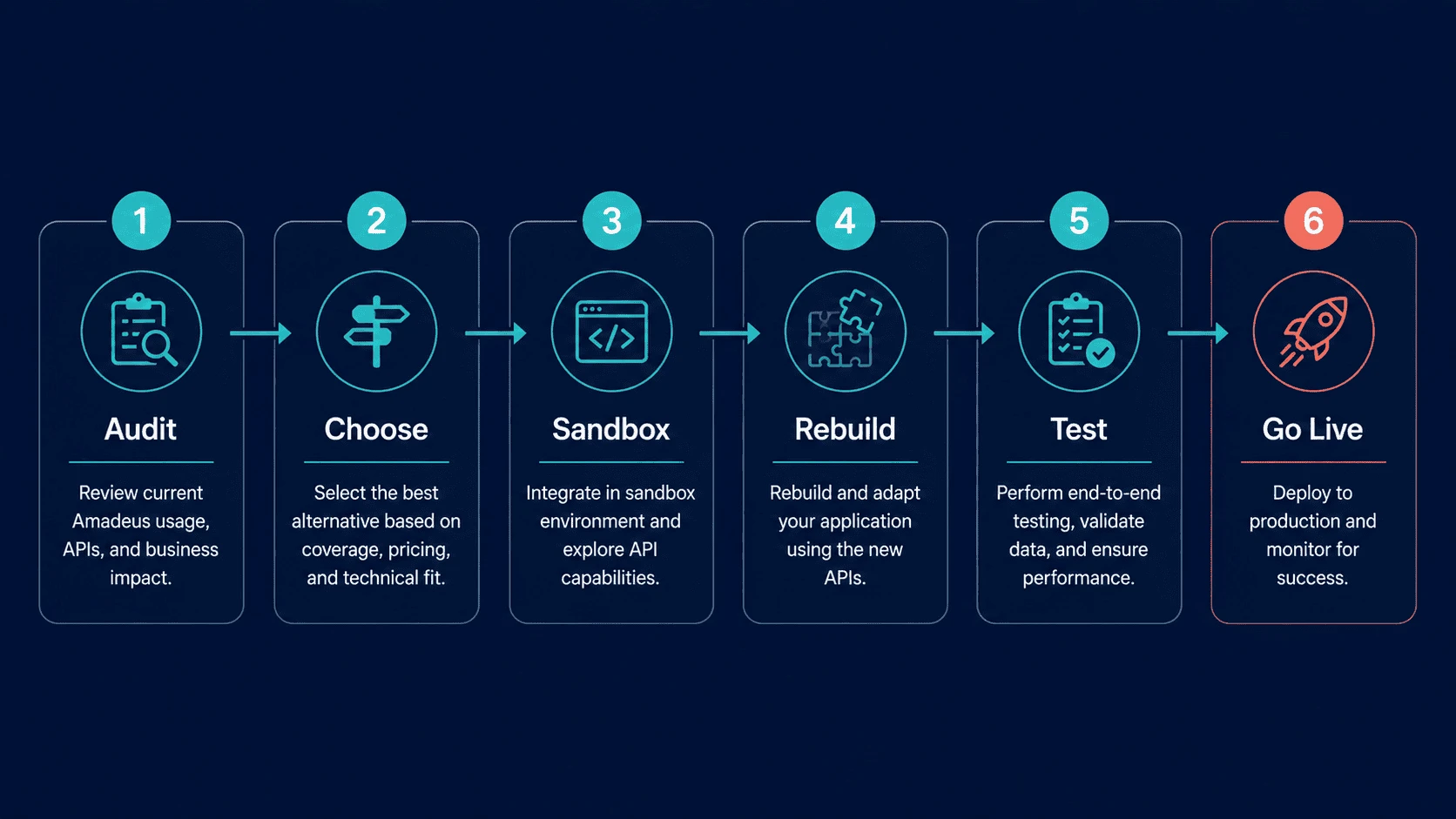
Step-by-Step Amadeus Migration Plan
- Audit your app. List every Amadeus endpoint you use.
- Choose a new provider. Pick one with wide coverage and fair pricing.
- Get sandbox access. Test the new API before you commit.
- Rebuild your calls. Map old fields to the new ones.
- Test end to end. Check search, pricing, and booking.
- Go live in stages. Move a small share of users first, then the rest once results match.
This plan pairs well with our travel API integration timeline. It shows how long each phase really takes.
How to Pick the Right Replacement
Do not just swap one supplier for another. Instead, think about long-term risk. A single supplier can change terms again.
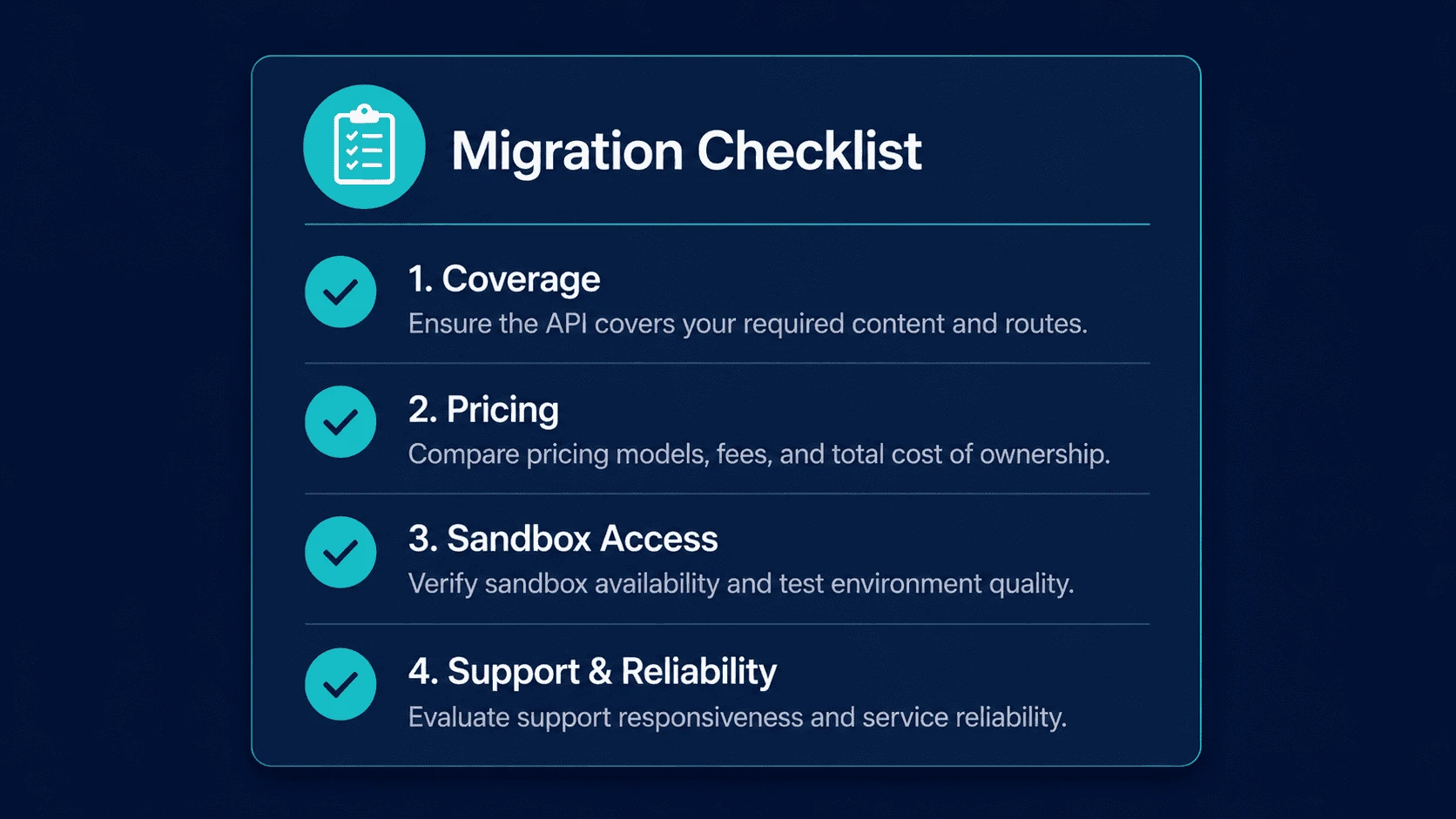
- Does it cover flights, hotels, and more?
- Is the pricing clear and pay as you go?
- Is there a sandbox and good documentation?
- Will support help during the migration?
For the full list of checks, see our guide on how to choose a travel API provider. Additionally, an aggregator can spread your risk across many suppliers.
Why an Aggregator Makes Migration Safer
An aggregator gives you one API for many suppliers. So if one source fails, others fill the gap. To learn how this works, read what a travel API aggregator is.
As a result, you migrate once and stay safe. You will not face another forced move when a single supplier changes its plan — which is exactly the situation the Amadeus shutdown created.
Common Amadeus Migration Pitfalls
Most migration problems come from a few mistakes. So watch for these before you go live.
- Field mismatches: the new API names fields differently. Map each one with care.
- Date and currency formats: small format gaps can break a booking.
- Error handling: the new API returns different error codes. Update your checks.
- Rate limits: test under heavy load before launch day.
Old vs New Request: A Simple Example
The shape of a search request often changes. Here is a simple before and after.
// Old Amadeus self-service style
{
 "originLocationCode": "DXB",
 "destinationLocationCode": "LHR",
 "departureDate": "2026-08-01",
 "adults": 1
}

// New aggregator style
{
 "origin": "DXB",
 "destination": "LHR",
 "depart_date": "2026-08-01",
 "passengers": { "adults": 1 }
}
The data is the same. However, the field names and structure differ. Therefore, you must map each field during the migration.
Final Thoughts
The Amadeus self-service API closed on July 17, 2026, and it is not coming back. Rebuild in a sandbox, test with your own searches, and pick a provider that lowers the risk of another forced move.
Tripgic connects you to many suppliers through one travel API. You can migrate fast and stay protected. Get free sandbox access to start your migration today.