 Golam Shahrier
Amadeus, Sabre and Travelport are the three major GDS (global distribution system) companies — the networks that connect travel sellers to airlines, hotels and car rental. Analysts usually rank them Amadeus, then Sabre, then Travelport. They differ in history, regional strength and, in 2026 more than ever, in how a new business gets access to them. Many sellers no longer pick one: an API such as Tripgic reaches all three through one connection, with NDC and 100+ low-cost carriers in the same search.
This guide compares the three side by side: origins and codes, where each is strongest, their APIs, how you get in, testing, certification and cost. It then shows which kind of seller each suits, and when one GDS, all three or none is the right answer. For the basics, see what a GDS is.
The Three at a Glance
| Amadeus | Sabre | Travelport | |
|---|---|---|---|
| Founded | 1987, by Air France, Iberia, Lufthansa and SAS | 1960, by American Airlines with IBM; open to agents from 1976 | Built from Galileo (2006) and Worldspan (2007), with Apollo |
| GDS code(s) | 1A | 1S | 1G (Galileo), 1V (Apollo), 1P (Worldspan) |
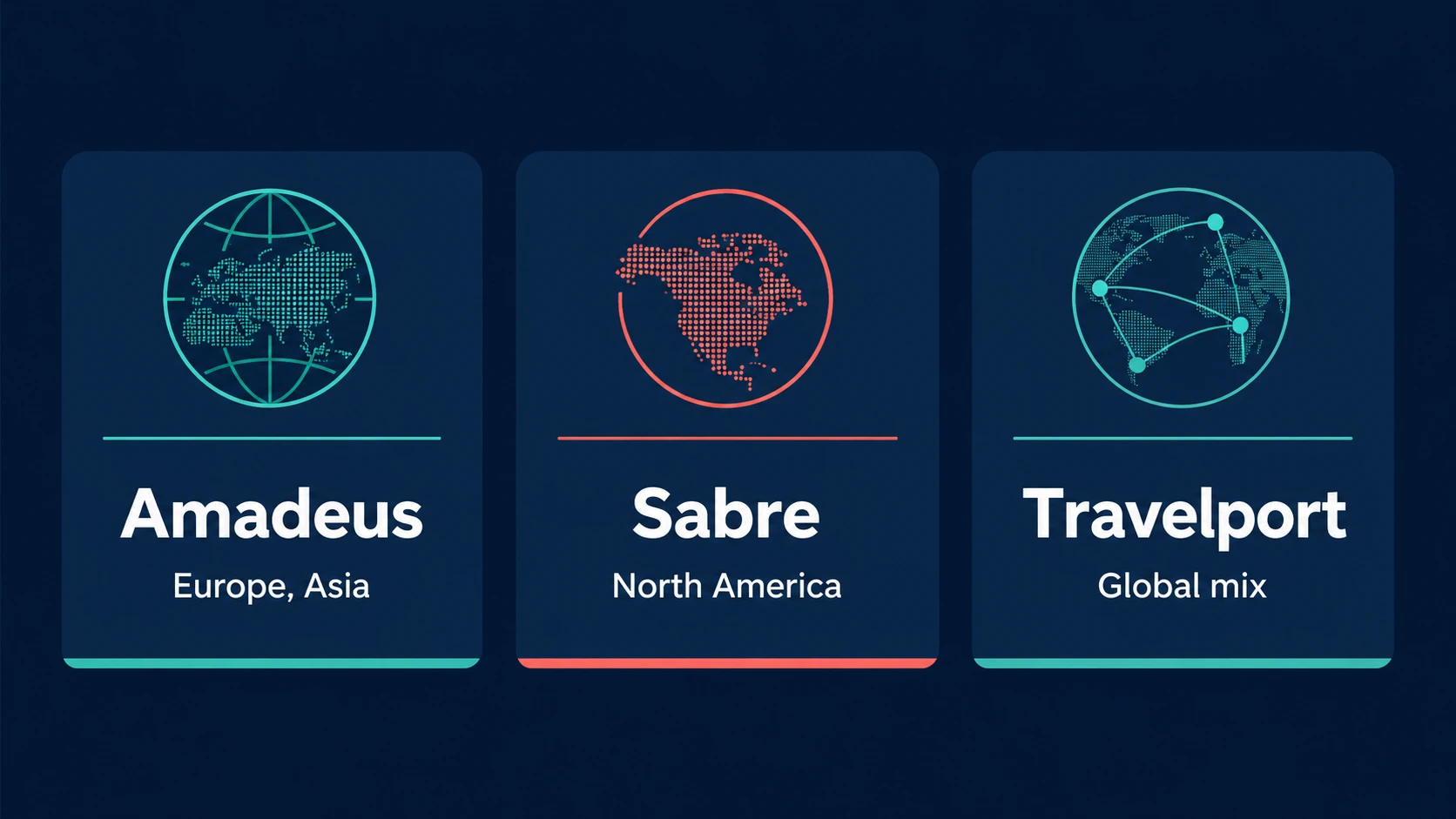
| Strongest in | Europe and much of the world | North America; former Abacus system in Asia-Pacific | Varies by brand and region |
| Usual rank | Largest | Second | Third, by revenue |
| Modern API | Enterprise APIs, mostly SOAP | REST and JSON for new products, large SOAP catalogue | TripServices: REST and JSON only |
| Free testing (2026) | Enterprise sandbox after approval; self-service closed 17 July 2026 | Free Developer Hub sandbox | Free TripServices trial credentials |
| Published price | None | None | $5,000 a year access fee, reported by AltexSoft (Feb 2026) |
A Short History of the Big Three
| Year | Event |
|---|---|
| 1960 | American Airlines and IBM build Sabre to manage seat inventory |
| 1976 | Sabre opens to travel agents |
| 1987 | Air France, Iberia, Lufthansa and SAS found Amadeus |
| 2006 | Travelport is formed around Galileo |
| 2007 | Travelport adds Worldspan; Apollo is already part of the family |
| 2026 | Amadeus closes its self-service APIs on 17 July; Travelport sells TripServices instead of the Universal API |
Each network grew out of airline reservation systems, which is why their content and their codes — 1S, 1A, 1G, 1V, 1P — still carry that history. The changes of 2026 matter most for new buyers: two of the three changed how a new business gets in.
Amadeus: The Largest, Now Enterprise-Only
Amadeus was founded in 1987 by four European airlines and is generally described as the largest GDS. Its strength is broad: Europe and much of the rest of the world, with deep airline, hotel and car content.
What changed in 2026 is access. Amadeus closed its free self-service APIs on 17 July 2026. New businesses now go through Amadeus Enterprise: a contact form, a consultant, a contract, and an Enterprise sandbox after approval. The Enterprise catalogue has over 100 APIs, many of them SOAP, and access usually expects IATA or ARC accreditation.
For a large, accredited agency, Enterprise is a powerful foundation. For a startup that relied on the old self-service tier, it is usually the reason to look elsewhere. Our Amadeus API guide and Amadeus self-service shutdown guide cover both paths.
Sabre: North America and Corporate Travel
Sabre began in 1960 as American Airlines’ reservation system, built with IBM, and opened to travel agents in 1976. It is strongest in North America and in corporate travel: Sabre’s own developer site says it holds 75% of North American managed business travel. It also runs the former Abacus system in Asia-Pacific.
Sabre is the easiest of the three to explore: a free Developer Hub account gives test credentials for its sandbox. Going live needs a contract, a pseudo city code (PCC), production credentials and a certification review that AltexSoft puts at four to eight weeks. Its catalogue mixes REST and SOAP, and its main air shopping API is Bargain Finder Max. See our Sabre API guide.
Travelport: Three Systems, One Modern API
Travelport brings together three older systems — Galileo, Apollo and Worldspan — which is why the market can look like more than three GDSs. Its strength varies by brand and region, and it is usually described as the smallest of the three by revenue.
Its API story is the clearest. New customers build on TripServices, which is REST and JSON only, covering Flights (content from 400+ airlines, including NDC and low-cost carriers), Stays and Pay. The older SOAP Universal API is no longer sold to new customers except in rare cases. A free trial needs no payment; certification needs at least 15 days’ notice. See our Travelport API guide.
Content: What Each Network Carries
All three carry most full-service airlines, plus hotels and car rental. The differences are in depth by region and in what each adds:
| Content | Amadeus | Sabre | Travelport |
|---|---|---|---|
| Full-service airlines | Broad, worldwide | Broad, deepest in North America | Broad, by brand and region |
| NDC content | Offered alongside traditional fares | Offered in air shopping alongside GDS and low-cost content | Included in TripServices Flights |
| Low-cost carriers | Some | Some | Included in TripServices Flights |
| Hotels | Yes | Yes | Stays: properties in 180 countries |
| Rail and other content | Varies by contract | Hotels, cars and rail in its catalogue | Varies |
The honest summary: no single GDS carries everything, and none carries all low-cost carriers. That gap is usually visible on short-haul and regional routes first, where budget airlines set the prices customers expect. The best network for you is the one with the best fares on your customers’ routes — which you can only find out by testing.
Access in 2026: How You Get In
| Step | Amadeus | Sabre | Travelport |
|---|---|---|---|
| First contact | Contact form and consultant | Free Developer Hub account | Request trial credentials |
| Free testing | Enterprise sandbox after approval | Try-it-out sandbox | TripServices trial |
| Contract | Negotiated Enterprise contract | Commercial terms and Sabre Store order | Commercial proposal |
| Credentials | After contract | PCC and production credentials | Pre-production and production credentials |
| Certification | “Weeks rather than days”, per AltexSoft | 4–8 weeks, per AltexSoft | At least 15 days’ notice; fixed test scenarios |
| Accreditation | Usually expected | Needed to ticket | Needed to ticket |
The pattern is the same for all three: testing is easy or free, going live is a contract, accreditation and a certification review — and the whole path takes 6–12 months per GDS, according to Tripgic’s GDS page.
For Agents: Terminals, Training and Habits
For agencies with staff who book all day, the GDS is also a workplace. That changes the comparison:
- Terminal formats. Each network has its own commands and screens. Agents trained on one take time to become fast on another.
- Hiring. In many markets, agents list the GDS they know on their CV. Choosing the network your local talent knows saves training.
- Scripts and tools. Mid-office tools, quality-control scripts and reports are built for a specific GDS and rarely move easily.
- Switching cost. Moving an established agency from one GDS to another is a project measured in months, not days.
For a new agency without staff habits yet, none of this applies — which is one reason new businesses are freer to choose an API-first route.
Servicing and Support After the Sale
How bookings are changed, refunded and supported differs less between the three than between content types:
| Classic GDS booking | NDC booking through a GDS | |
|---|---|---|
| Who services it | The GDS, through its procedures | Often the airline, through its own order process |
| Agent tools | Mature terminal and API functions | Newer, varying by airline |
| Refunds and exchanges | Well-established procedures | The airline’s order rules |
Travelport, for example, services classic GDS bookings itself, while NDC carriers handle ticketing and servicing for their own offers. Whichever GDS you choose, ask how it handles NDC servicing for the airlines you sell most.
Technology: SOAP, REST and Tokens
| Amadeus | Sabre | Travelport | |
|---|---|---|---|
| Style | Mostly SOAP, some REST | REST for new products; large SOAP catalogue | REST and JSON only (TripServices) |
| Authentication | Per Enterprise contract | OAuth tokens | OAuth 2.0; a new token every 24 hours |
| Developer tools | Enterprise portal | Developer Hub, SDKs | DevKits with Postman collections |
| AI tools | — | An MCP server for AI assistants | Positioned as “the platform for AI travel” |
For a team without GDS experience, the style matters: SOAP-heavy catalogues take longer to learn, while Travelport’s REST-only TripServices is closer to modern web development. Whichever you choose, map every booking step — search, price, book, ticket, change, cancel — to the API that handles it before you sign.
Cost: What You Pay
None of the three publishes full prices. What is known:
- Amadeus publishes no Enterprise prices on its developer site; terms are negotiated.
- Sabre’s developer pages list no production prices; they are set in the contract.
- Travelport charged a recurring annual API access fee of $5,000, according to AltexSoft in February 2026, with separate charges for some services.
On the other side of the market, GDS companies have traditionally charged airlines and hotels per booking made through their networks, and some airlines now add surcharges to GDS bookings. For the full picture, see our guide to GDS API cost.
The bigger cost for most sellers is not the fee but the work: building, certifying and maintaining each connection. A team of developers spending months on one network costs more than most access fees, and that cost repeats for every network you add. When you compare the three, put the engineering time next to the quoted fees, and ask each for the minimums and renewal terms that sit behind the headline price.
Which GDS for Which Seller?
| Seller | Often a good fit | Why |
|---|---|---|
| Corporate TMC in North America | Sabre | Its strength in managed business travel |
| Large agency in Europe | Amadeus | Its breadth in Europe and beyond |
| Agency inheriting a Galileo or Worldspan setup | Travelport | Continuity of PCCs, staff and processes |
| Developer team wanting a modern REST API | Travelport TripServices | REST and JSON only |
| New OTA or startup | An aggregator | All three plus NDC and low-cost, one build |
| Seller needing more than one network | An aggregator | One contract instead of three |
These are starting points, not verdicts. The deciding test is the same in every row: compare fares on your own busiest routes. A network that is strongest in a region may still be weaker on the two or three routes that make up most of your sales.
Running More Than One GDS: What It Takes
Some large agencies connect directly to two or all three networks. It can pay off — more content, better fares on some routes, negotiating leverage — but it carries real costs:
- Separate contracts, each with its own terms, minimums and renewal dates.
- Separate builds and certifications, one per network.
- Duplicate results: the same flight returned by two GDSs must be merged, or customers see it twice.
- Different data: fare rules, booking records and error messages differ by network and must be normalised.
- Split servicing: support teams must know which network holds each booking.
This is the work an aggregator does once for every seller. A seller that wants several networks but not several integrations usually chooses that route.
One GDS, All Three, or None?
- One GDS directly makes sense for a high-volume, accredited seller whose customers’ routes are strongest on that network, with a team that knows it.
- All three gives the widest content, but directly it means three contracts, three builds and three certifications. That is why most sellers who want all three use an aggregator.
- None directly is the choice of most new platforms: they reach GDS content through an aggregator and add NDC and low-cost content at the same time.
For the direct-versus-aggregator decision in depth, see travel API vs GDS.
A Worked Example: Choosing for a New Agency
A new online agency in the Gulf sells to residents flying to South Asia and Europe, and to visitors arriving from Europe.
- It lists its top routes: Dubai to Mumbai, Delhi, Karachi and Dhaka; Dubai to London and Paris.
- It tests content: full-service fares on the Europe routes are similar across networks; on the South Asia routes, the cheapest fares are from low-cost carriers that no single GDS shows completely.
- It weighs access: it has no IATA accreditation yet and no GDS-experienced developers.
- It decides: an aggregator that carries all three GDSs, NDC and low-cost carriers, with ticketing handled through the provider, and a direct GDS later if volume justifies it.
The answer for a large North American TMC would be different — probably Sabre directly. The method is the same.
Common Mistakes When Comparing GDSs
- Comparing market share instead of route content. The biggest network is not always the best on your routes.
- Ignoring access. In 2026, how you get in — Enterprise-only, free sandbox or free trial — matters as much as content.
- Forgetting low-cost carriers. None of the three carries all of them.
- Underestimating certification. It is where direct GDS timelines slip most.
- Signing for one when you need two. Each additional network is a new project.
- Trusting old guides. Amadeus self-service and Travelport’s Universal API both changed in 2026; guides written earlier describe products you cannot buy.
How to Test the Three Before You Sign
You can learn a lot before any contract, because two of the three offer free test access and the third offers an Enterprise sandbox after approval:
- List your twenty busiest routes, with dates and passenger mixes you actually sell.
- Search them in each test environment you can reach, and note which airlines and fares appear.
- Compare fare families and baggage, not only the cheapest price.
- Walk one booking end to end where the sandbox allows: search, price, book, ticket, cancel.
- Time the responses for your busiest routes.
- Write down what each network does not show — often low-cost carriers on short routes.
Then run the same twenty routes through an aggregator’s sandbox. If it returns the GDS content you need plus the gaps, you have your answer without three contracts.
Questions to Ask Each GDS
| Question | Why it matters |
|---|---|
| What content do I get on my top twenty routes? | The real test of a network |
| Which APIs and markets does the contract cover? | Adding more later means amendments |
| What accreditation do you require to ticket? | Decides who issues your tickets |
| How long does certification take, and what is tested? | The usual cause of delay |
| What are the access fees and any minimums? | Prices are not published |
| How is NDC content delivered through you? | Decides whether you see the airline’s full offer |
| Which low-cost carriers do you carry on my routes? | Fills or exposes a price gap |
How Tripgic Gives You All Three
Tripgic is a B2B travel API aggregator. For GDS content, here is what its own pages state:
- Amadeus, Sabre and Travelport in one API. One REST API for all three networks, with no GDS contract or per-GDS certification on your side, per its GDS page.
- Merged results. When the same flight appears in more than one GDS, it is returned once, at the best available price, in normalized JSON.
- NDC and low-cost beside the GDS. Airline NDC offers and 100+ low-cost carriers in the same search — 800+ airline and LCC connections in total.
- The full flight flow. Fifteen flight endpoints in the API docs: search, branded fares, validation, travellers, booking, extras, ticketing and cancellation.
- More than flights. 2M+ hotel properties and 8 product families in all, over 73 endpoints.
- Final prices, flat fee. Prices at validation and booking are final: the supplier net fare plus a flat Tripgic fee per passenger, never a percentage; figures on the pricing page.
- Test first. A free sandbox after a short call; activation for live use usually takes 3–5 business days.
Final Thoughts
Amadeus, Sabre and Travelport are all major networks with real strengths: Amadeus’s breadth, Sabre’s grip on North American corporate travel, Travelport’s modern REST API and its three historic brands. In 2026 the bigger differences are in access — and in what none of them carries on its own, low-cost carriers above all.
Compare them on your own routes, your team’s skills and your timeline. If the answer is “more than one” or “as soon as possible”, an aggregator that includes all three is usually the shorter road. Either way, the test on your own routes is what settles it.
Want Amadeus, Sabre and Travelport content through one API? Book a demo and get Tripgic sandbox credentials after a short call.