 Golam Shahrier
GDS API cost has two sides. GDS companies charge airlines and hotels per booking made through their networks, while a travel seller pays to connect: contracts, certification, usage fees and minimums, plus the developers who build each connection. Through Tripgic, one integration reaches Amadeus, Sabre and Travelport with no GDS contract or certification of your own.
There is no public GDS price list, and most articles that promise one give round numbers with no source. This guide does the opposite: it explains every part of the cost, says where each fact comes from, and shows how to estimate your own total. Facts about Tripgic come from its GDS page and pricing page, read on 26 October 2026.
What a GDS Is, and Why Access Costs Money
A global distribution system (GDS) is the network that connects travel sellers to airlines, hotels and car rental companies. The three major GDS companies are Amadeus, Sabre and Travelport. A travel agency, OTA or booking platform that connects to a GDS can search, book and ticket many suppliers through one network.
Running that network is a business, and the cost lands in two places. The suppliers pay to be distributed. The sellers pay to connect. Understanding both explains why a seller’s bill is rarely a single number, and why airline decisions about distribution can change what a seller pays for the same flight.
For the basics, read our guide to what a GDS is. For how a GDS compares with a modern travel API, see travel API vs GDS.
Who Pays GDS Fees? Airlines, Hotels and Sellers
According to Wikipedia’s article on global distribution systems, GDS pricing is based on transaction-based models that charge airlines and hotels per booking made through the network, rather than on fixed subscriptions alone. The same article notes that some GDS companies offer discounts to high-volume carriers and apply charges for changes, refunds or ancillaries.
That is the supplier side. The seller side is different: a seller connecting directly signs its own contract with each GDS, and what it pays depends on that contract. There is no single published rate card for sellers, which is why two agencies on the same GDS can pay very different amounts.
There is also an indirect cost. Airlines do not always absorb GDS costs quietly. Wikipedia records that Lufthansa Group announced in June 2015 an additional charge of 16 euros on bookings made through external GDS systems rather than its own channels, saying the cost of external systems was several times higher. Charges of this kind reach the seller as a higher price for the same seat.
The Seller’s Cost of a Direct GDS Connection
For a travel seller that connects to a GDS directly, the cost is made of six parts. Only some of them appear on a contract.
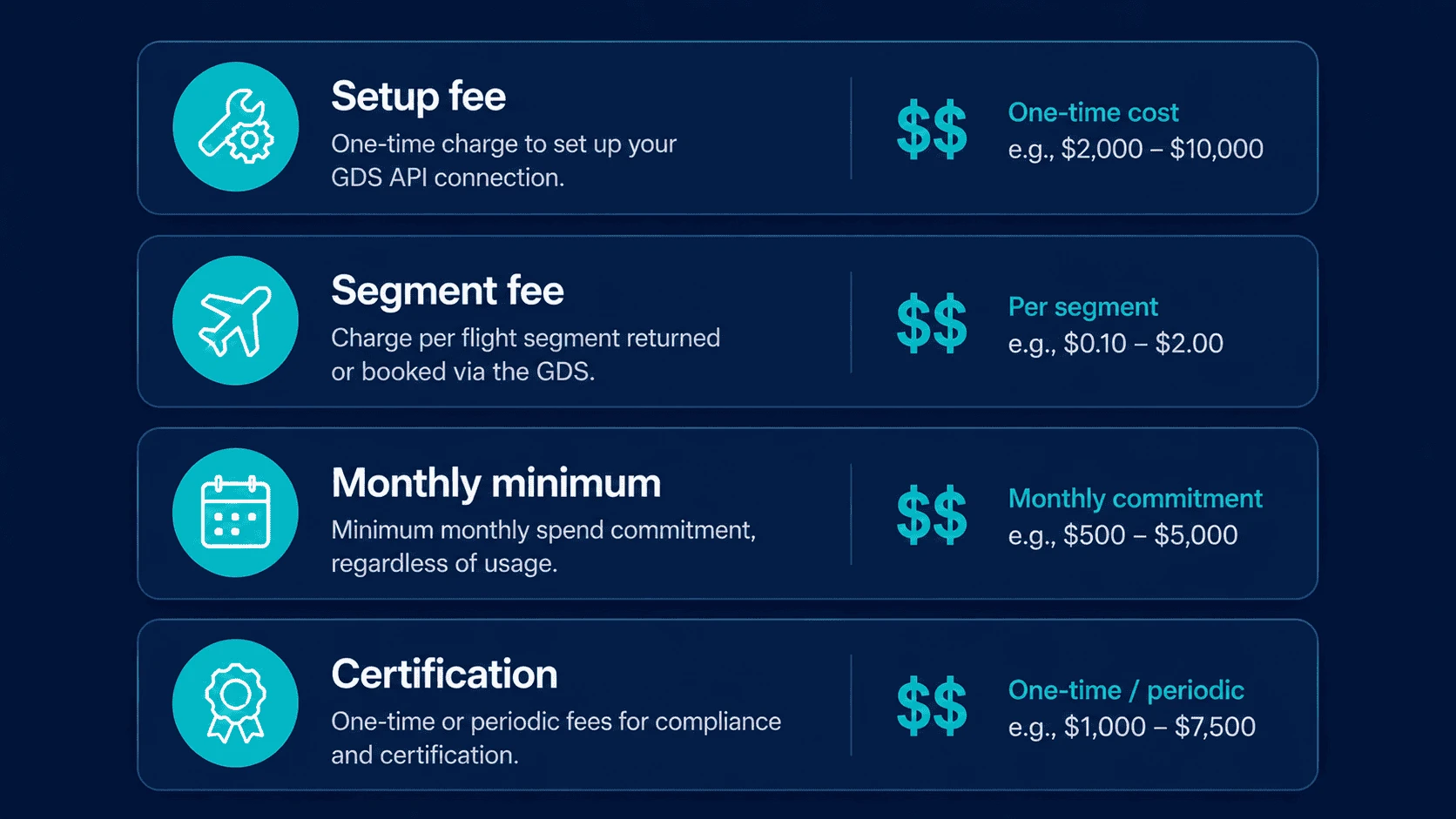
- Commercial contract. Each GDS sells access under a negotiated agreement. Terms can include setup charges, usage or transaction fees, minimum volumes or spend, and a contract length. Ask for every one in writing.
- Accreditation for ticketing. Issuing airline tickets usually needs an accreditation such as IATA, or ARC in the United States, or a partnership with an accredited consolidator. That has its own costs and requirements.
- Certification. Before a seller can go live, its integration is usually reviewed and certified by the GDS. Tripgic’s GDS page puts direct GDS integration at 6–12 months per GDS for certification and go-live.
- Development. Each GDS has its own formats and interfaces: EDIFACT, XML or SOAP, and REST, each with its own schema. Each one is a separate build.
- Maintenance. Version updates, deprecations and compliance changes continue after launch, for every GDS you connect.
- Deduplication. If you connect more than one GDS, the same flight can come back from several sources. Merging them correctly is work you own.
The visible fees are often smaller than the last four lines combined. A team of developers working for most of a year on one connection is a large cost, and it is paid before the first booking.
GDS Cost by Type of Business
The same GDS can cost very different amounts depending on who is connecting and why. The type of business changes which costs dominate.
A small travel agency. Many small agencies never build an API connection at all. They use a GDS terminal or a booking tool, often through a host agency or an airline consolidator that already holds the accreditation and the GDS relationship. Their costs are subscription and service fees from that partner, not a development project. Our guide to GDS for travel agents compares those routes.
An online travel agency. An OTA needs an API, not a terminal, and usually wants more than one GDS plus low-cost carriers. For an OTA, the build and certification time per GDS is the dominant cost, followed by the work of merging results from several sources into one clean list.
A corporate travel platform or TMC. Corporate sellers depend on negotiated corporate fares and on post-booking servicing, because business travellers change plans often. Their costs lean toward the servicing side: changes, refunds and reissues, and the support team that handles them.
A travel-tech startup. A startup has the least cash and the most uncertainty about volume. Fixed costs paid before launch, such as certification time and minimum commitments, hurt most. This is the group for which the closure of the free Amadeus self-service tier changed the most.
An airline or hotel. On the supplier side, the cost is the distribution fee per booking that the GDS charges, which is why airlines compare GDS costs with their own and NDC channels.
The Three GDSs at a Glance
Each GDS is a separate company with its own contract, interfaces and commercial terms, so connecting to all three means three of everything.
| GDS | Codes | Interfaces, per Tripgic’s GDS page | What it means for cost |
|---|---|---|---|
| Amadeus | 1A | EDIFACT and JSON APIs; Enterprise APIs mostly SOAP, per AltexSoft | Enterprise contract via a consultant since self-service closed |
| Sabre | 1S | REST and SOAP interfaces | Its own contract and certification |
| Travelport | 1G, 1V, 1P | Universal API (UAPI) and JSON | Runs Galileo, Apollo and Worldspan |
A note on the codes: Amadeus is 1A. Some websites print 1E, which is the code of a different system, so check the code against the GDS’s own documentation if it matters to your build.
Different interfaces mean different skills. A team that has built on Travelport’s JSON interface does not automatically know Amadeus’s SOAP Enterprise APIs. That is one reason the cost of a second and third GDS is not much lower than the first.
Common Mistakes When Budgeting for GDS Access
The same mistakes push GDS projects over budget again and again:
- Budgeting the fees and forgetting the time. Months of certification and build before the first booking are the largest cost for most sellers, and they rarely appear in the first estimate.
- Multiplying by bookings instead of segments. If any charge is per segment, long-haul and multi-city trips cost far more than a simple count of bookings suggests.
- Ignoring servicing. Changes, refunds and reissues carry their own costs and their own engineering, and corporate sellers have many of them.
- Assuming one GDS is enough. Airlines distribute differently across the three GDSs and across NDC. Content you cannot see is a cost too, paid in lost sales.
- Forgetting the minimums. A minimum volume or spend is cheap when you hit it and expensive when you do not, and a new seller rarely knows which it will be.
- Leaving out maintenance. Each GDS changes its interfaces over time, and every change is work for whoever owns the connection.
A realistic budget names each of these, with a number and an owner, before any contract is signed.
What Amadeus API Access Costs After Self-Service
Amadeus is the clearest example of how access costs changed in 2026. Until 17 July 2026, Amadeus ran a free self-service tier for developers. The Amadeus developer site now says the self-service portal has been decommissioned and that the site is for the Amadeus Enterprise API Portal only.
That leaves Amadeus Enterprise, which starts with a request and a conversation with a travel consultant. According to AltexSoft’s Amadeus integration guide, Enterprise is sold under a negotiated contract, typically a monthly fee with a free request quota and a charge per call above it, and the Enterprise APIs are mostly SOAP.
So for a startup or small agency, the cost of Amadeus content is no longer a free key and a pay-as-you-go bill. It is a contract, an accreditation question and a SOAP build. Our Amadeus API guide walks through the Enterprise path, and our Amadeus migration guide covers the alternatives for teams that relied on self-service.
Segments: Why “Per Booking” Is Not the Unit
GDS charges are tied to bookings, but they are often counted by segment, and the difference matters for any estimate.
A segment is one flight from takeoff to landing. A one-way direct flight is one segment. A one-way trip with a connection is two. A return trip with a connection each way is four. A family of four on that return trip is still four segments in the booking, but the passengers multiply other per-passenger charges.
If any part of a cost you are offered is quoted per segment, do not multiply it by your booking count. Look at the shape of the trips your customers actually book, from your own data if you have it, and multiply by the real segment count. For sellers of long-haul or multi-city trips, the difference between bookings and segments can be large.
Airline Distribution Costs and NDC
GDS costs also explain much of what airlines are doing with NDC, IATA’s New Distribution Capability. NDC lets an airline send richer offers through its own channel, and several airlines now keep some fares, branded fares or content for NDC channels, while others add charges to bookings made through traditional GDS channels.
For a seller, that changes the cost question. The fee you pay to connect is only part of the picture; the fares you can access, and the surcharges attached to them, matter as much. A seller with only a classic GDS connection may pay more for the same seat, or not see the lowest fare at all.
That is why many sellers now look for a connection that combines GDS content with NDC offers, rather than a GDS alone. Our guide to NDC aggregators explains how that works.
Direct GDS Connection vs an Aggregator
There are two ways to get GDS content into your platform. They differ most in time and fixed cost.
| Direct GDS connection | Aggregator | |
|---|---|---|
| Contracts | One per GDS | One, with the aggregator |
| Certification | Per GDS, typically 6–12 months each | Held by the aggregator |
| Formats to build | One per GDS: EDIFACT, SOAP, REST | One normalised API |
| Deduplication across GDSs | Your work | Done by the aggregator |
| Upfront cost | High: build and certification before revenue | Low: activation, then usage |
| Ongoing maintenance | Yours, per GDS | The aggregator’s |
| NDC and low-cost carriers | Separate connections | Often in the same API |
| Best for | Very large sellers with negotiated terms | Most OTAs, agencies and startups |
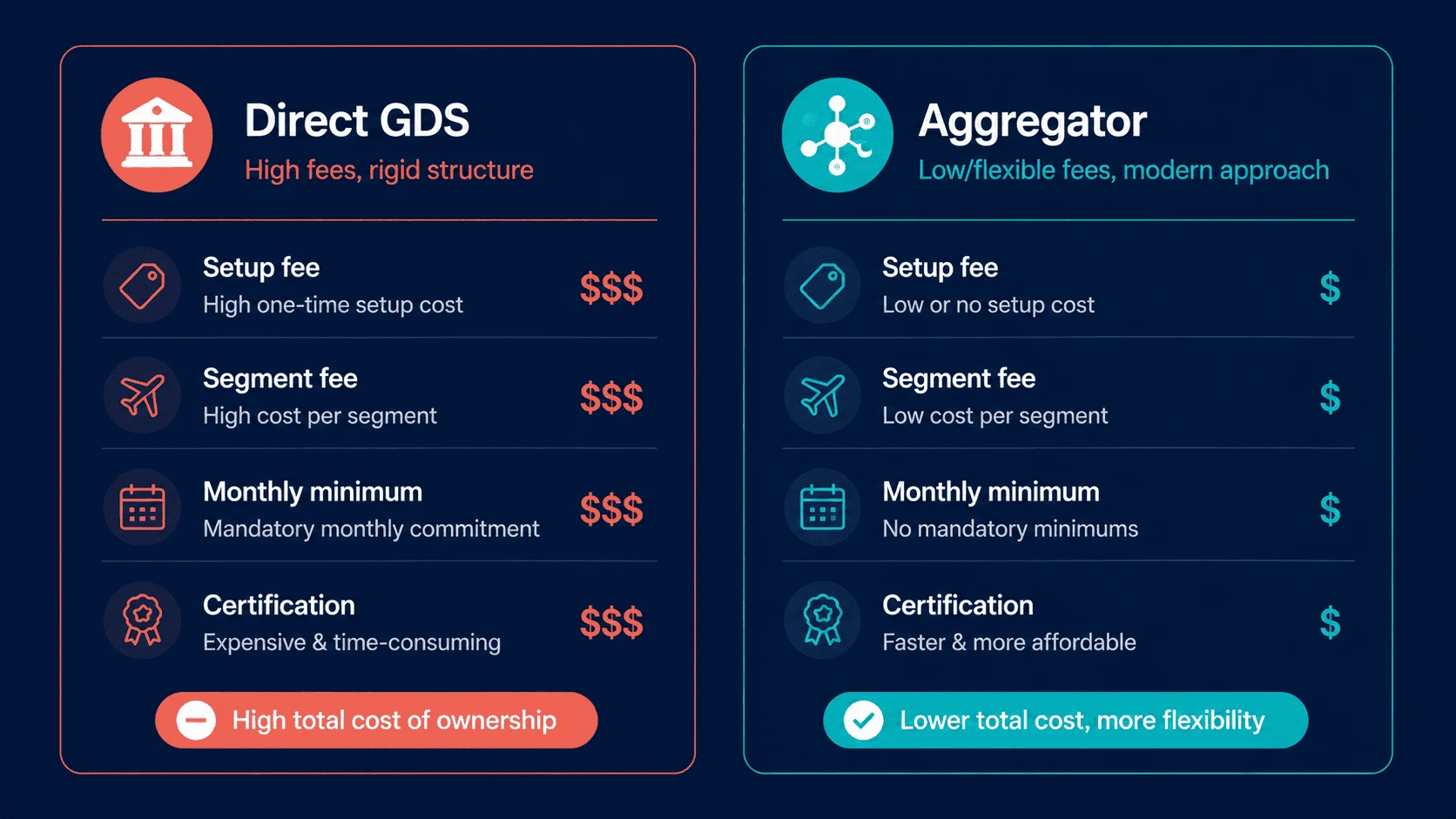
A direct connection can make sense for a very large seller with negotiated terms and a team that already works in a GDS. For most others, the fixed cost and the time to launch decide the question before the per-booking rates do. Our guide to what a travel API aggregator is explains the model in full.
Worked Example: Estimating the Real Cost
The fees in a GDS contract are negotiated, so this example uses invented, round numbers. The point is the shape of the calculation, not the figures.
Imagine a startup that wants content from all three GDSs and plans 300 bookings a month.
Going direct. Three contracts, three certifications, three builds. Suppose two developers spend most of a year on the connections, at a combined cost of 150,000. Add any setup fees, minimums and the accreditation question. The startup has no live bookings until the first certification passes, and it maintains three connections afterwards.
Through an aggregator. One integration, built in weeks against a sandbox. Suppose an activation charge of 2,000 and a fee of 4 per passenger, with 1.5 passengers per booking on average. At 300 bookings a month, usage fees are 1,800 a month, or 21,600 in the first year.
In this invented case, the direct route costs several times more in year one, before it earns anything, and the aggregator route is live months earlier. The direct route can win at very high volume, if the negotiated rates are low enough. Run the same calculation with real quotes and your own volume before you decide.
GDS Costs for Sellers in the Middle East and South Asia
For sellers in the Gulf and South Asia, the cost question has a regional twist. Much of the demand is on regional carriers and low-cost airlines, and each regional carrier has its own approach to GDS distribution, NDC and surcharges. A GDS connection that covers European and American carriers well may not show the fares your customers want on Gulf or South Asian routes.
That makes coverage, not only price, the first test. Before you compare costs, list the ten airlines your customers fly most and check how each one distributes: through which GDSs, through NDC, and whether it applies a GDS surcharge. Tripgic publishes NDC guides for several Gulf and South Asian carriers, and our guides to the UAE, Saudi Arabia and the wider Middle East cover each market.
How Tripgic Handles GDS Access
Tripgic’s GDS API is part of its Flight API. Here is what it means for cost and effort, from Tripgic’s own pages:
- All three GDSs in one integration. Amadeus, Sabre and Travelport, including Galileo, Apollo and Worldspan, accessed through one normalised REST API.
- No GDS contracts of your own. One commercial relationship with Tripgic covers all GDS networks, with no separate GDS contracts and no individual GDS certification.
- Parallel queries, one response. One search queries all three GDSs in parallel; results are normalised to one schema, deduplicated and ranked, and the same flight appears once, at the best price.
- Days, not months. Most teams move from sandbox to production in days rather than the 6–12 months per GDS of a direct integration.
- Zero GDS maintenance on your side. Tripgic handles GDS updates, version changes and compliance.
- NDC and low-cost carriers in the same response. Airline-direct NDC offers and 100+ low-cost carriers sit beside GDS fares: 800+ airline connections and 51,519 routes in total.
- A simple cost model. A one-time activation for a plan, then the supplier’s net fare plus a flat fee per transaction, never a percentage, with no monthly subscription. Which plans include GDS content, and the figures, are on the pricing page.
- Test before you pay. Free sandbox credentials after a demo, and a Live Rate Check Panel, after an NDA, to compare live fares with your current suppliers before any payment.
How to Estimate Your Own GDS Cost
A short process gives you a number you can defend in a budget meeting:
- Decide which content you need. One GDS, all three, or GDS plus NDC and low-cost carriers.
- Estimate bookings and segments per month for the first year, from your own data or a realistic forecast.
- Get written quotes for a direct connection from each GDS you need, including every fee and minimum.
- Estimate build and certification time, and the cost of the developers who will do it.
- Add maintenance for every connection, every year.
- Get an aggregator quote on the same volumes, and add its activation and usage fees.
- Compare twelve-month totals and the month you can start selling. The second number is often the one that decides.
Questions to Ask Before You Sign
Whichever route you choose, these questions show the real cost:
- What is the total annual cost at my volume, with every fee and minimum included?
- Is any charge per segment, per passenger or per booking, and what counts as each?
- What does certification involve, how long does it usually take, and who schedules it?
- Who issues tickets, and do I need my own accreditation?
- Are NDC and low-cost carrier fares included, or are they separate connections and separate fees?
- What do changes, refunds and reissues cost?
- What notice is needed to leave, and can I export my booking history?
For pricing models across travel APIs in general, read our guide to travel API pricing.
Final Thoughts
GDS access costs more than any single fee. GDS companies charge suppliers per booking, airlines pass some of their distribution costs back through fares and surcharges, and a seller going direct pays in contracts, certification, development and maintenance for every GDS it connects.
For most travel sellers, the largest cost is time: 6–12 months per GDS before the first live booking. An aggregator that already holds the connections removes that, and turns a large fixed cost into a usage-based one. Whichever route you take, compare twelve-month totals with real quotes, not headline rates.
Tripgic gives you Amadeus, Sabre and Travelport, plus NDC and low-cost carriers, through one API with no GDS contract of your own. Book a kick-off call to get free sandbox access and compare live fares.