 Mehedi Ahsan Ashif
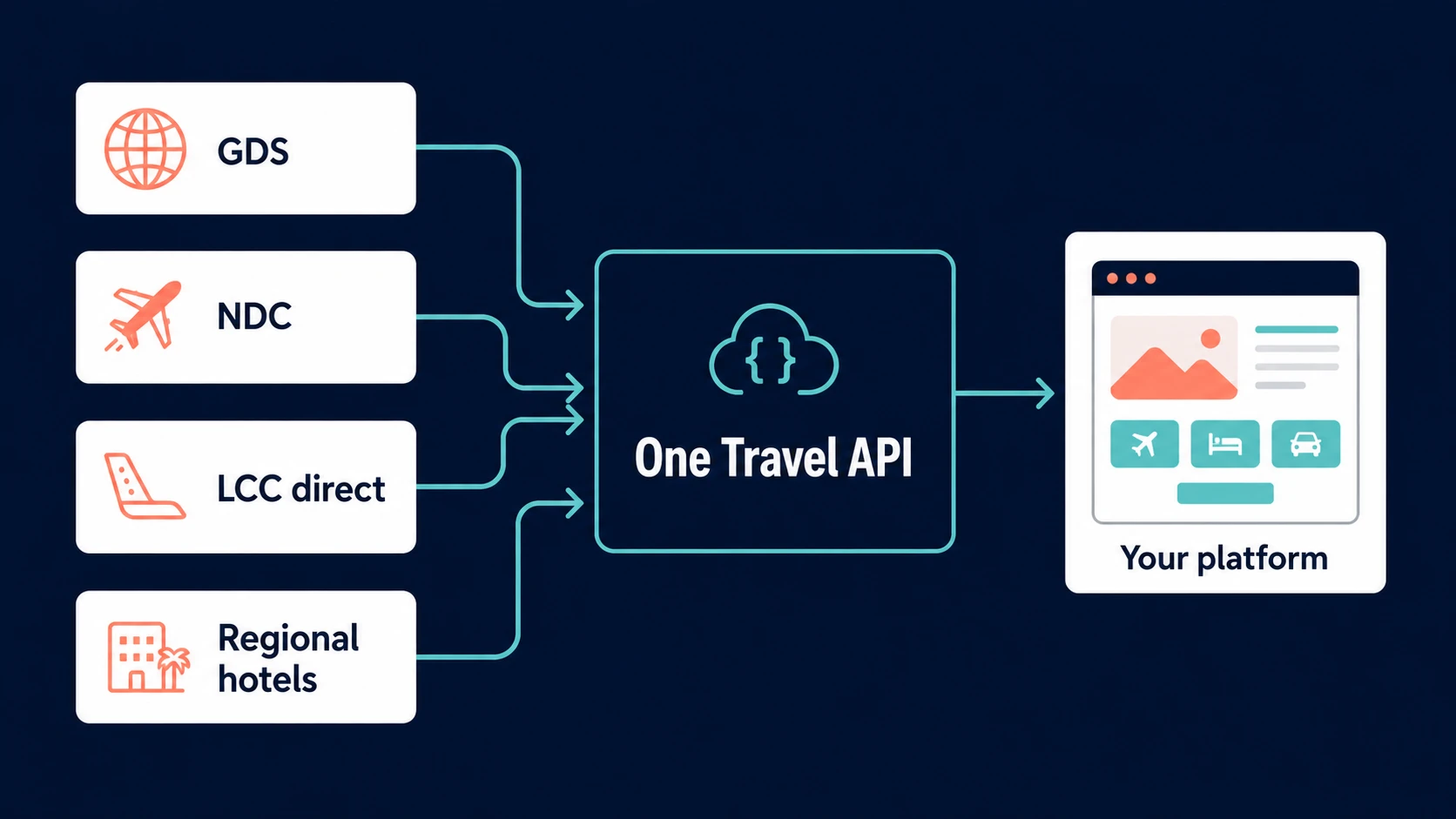
A Middle East travel API connects your booking platform to the supply this region actually sells: the Gulf’s full-service carriers, its fast-growing low-cost airlines, hotels in Dubai, Riyadh, Jeddah, Doha and beyond, plus the transfers, activities, eSIM and visas that complete a trip — all through one integration and one data format. Tripgic, for example, carries regional low-cost carriers such as flydubai, Air Arabia and flynas alongside GDS and NDC content in one API.
This guide is for travel agencies, OTAs, corporate travel tools and startups selling in or into the Middle East. It covers the market numbers, the airline picture, what an API must handle here that a European checklist misses, payments and language, peak seasons, a launch plan and the mistakes to avoid. For country detail, see our UAE travel API and Saudi Arabia travel API guides. Every Tripgic detail here comes from its own pages, linked as we go.
The Market in Numbers
The region’s growth is not a forecast; it is in the official counts.
| Market | Figure | Source |
|---|---|---|
| Dubai | 18.72 million international overnight visitors in 2024, up 9% on 2023 | Dubai Department of Economy and Tourism data |
| Dubai hotels | 154,016 rooms across 832 establishments at the end of 2024 | Same release |
| Dubai International (DXB) | 92.3 million guests in 2024 | Same release |
| Saudi Arabia | 116 million tourist trips in 2024: 29.7 million inbound and 86.2 million domestic | Ministry of Tourism report, via Arab News |
| Saudi 2030 target | 150 million visitors a year: 70 million international and 80 million domestic | Same source |
Two things stand out for anyone building a booking platform. First, the volume is real and still rising. Second, the markets differ: Dubai is a global hub for inbound and transfer traffic, while Saudi Arabia’s largest market by count is domestic travel. One API has to serve both shapes of demand.
Why the Region Is Different for Travel Sellers
Three forces shape how travel sells here.
- Geography. The Gulf sits between Europe, Asia and Africa, so its hubs carry very large transfer flows. A traveller from South Asia to Europe, or Europe to Southeast Asia, often connects in the Gulf.
- Investment. Governments treat tourism as an economic pillar, so new destinations, events and hotels keep arriving — and with them new demand.
- A young, mobile-first population. Customers expect fast mobile booking, local payment methods and content in Arabic as well as English.
For your platform, this means demand is strong, competition is arriving fast, and the winners will be the ones with the widest, freshest supply presented in the way local customers buy. That starts with the API.
The Airline Picture: Hubs, Low-Cost Carriers and Corridors
Full-service hub carriers
The region is home to some of the world’s largest long-haul hub carriers — Emirates in Dubai, Qatar Airways in Doha, Etihad in Abu Dhabi, Saudia in Jeddah and Riyadh — and the newer Riyadh Air in Saudi Arabia. These carriers are generally sold through the GDSs and increasingly through NDC, each with its own programme. Tripgic publishes plain-English guides to several of them: Qatar Airways NDC, Etihad NDC, Saudia NDC and Oman Air NDC. Before you choose a provider, ask exactly which of these carriers’ fares appear on your routes, and through which channel.
Low-cost carriers
Low-cost carriers carry a large share of the region’s short-haul and medium-haul traffic, and many of them sell largely outside the classic GDS. Miss them and your prices look wrong to local customers, who know what flydubai or Air Arabia charges. Tripgic’s low-cost carrier list of 100+ carriers includes these regional airlines:
| Carrier | Base |
|---|---|
| flydubai | Dubai, UAE |
| Air Arabia | Sharjah, UAE |
| Air Arabia Abu Dhabi | Abu Dhabi, UAE |
| Air Arabia Egypt, Air Arabia Jordan | Egypt and Jordan |
| flynas | Saudi Arabia |
| Jazeera Airways | Kuwait |
| SalamAir | Oman |
Tripgic also publishes a flydubai NDC guide that explains how that airline distributes to travel sellers. Our low-cost carrier API guide explains why low-cost content needs its own connection at all.
The corridors that feed the Gulf
Much Gulf demand runs on a handful of corridors: South Asia to the Gulf, the Gulf to Europe, intra-Gulf trips, and Turkey and the Levant. The carriers on those corridors matter as much as the Gulf airlines themselves. The same Tripgic low-cost list includes IndiGo, Air India Express and Akasa Air on the India routes, and Pegasus Airlines on the Turkey routes — so a platform selling to workers and families travelling between South Asia and the Gulf can price those flights in the same search.
Country Snapshot: Where to Start
Most platforms start with one or two countries. The Gulf markets differ in currency, carriers and the kind of traveller you will serve:
| Country | Currency | Hub and home carriers | What sells most |
|---|---|---|---|
| United Arab Emirates | AED | Dubai (Emirates, flydubai), Abu Dhabi (Etihad, Air Arabia Abu Dhabi), Sharjah (Air Arabia) | Inbound leisure, stopovers, hotels, activities |
| Saudi Arabia | SAR | Jeddah and Riyadh (Saudia, flynas, flyadeal, Riyadh Air) | Domestic flights and hotels, inbound business and leisure |
| Qatar | QAR | Doha (Qatar Airways) | Transfer traffic, events, hotels |
| Kuwait | KWD | Kuwait City (Kuwait Airways, Jazeera Airways) | Outbound leisure |
| Oman | OMR | Muscat (Oman Air, SalamAir) | Inbound leisure, regional trips |
| Bahrain | BHD | Manama (Gulf Air) | Regional and business travel |
Start where your customers already are. A platform with Indian or Pakistani customers in the Gulf will want the South Asia corridors on day one; a European OTA will want Dubai hotels and stopovers first. Our UAE and Saudi Arabia guides go deeper on the two largest markets.
What a Middle East Travel API Must Cover
Judge any provider on these six points. The first four are about supply; the last two are about selling.
| Need | Why it matters here | What to check |
|---|---|---|
| GDS + NDC + low-cost content | Regional low-cost carriers often sit outside the GDS | Run your top routes and count which carriers appear |
| Hotel depth in the main cities | Dubai alone had 154,016 rooms at the end of 2024 | Search Dubai, Abu Dhabi, Riyadh, Jeddah and Doha for your dates |
| Transfers and activities | Visitors book airport transfers, desert and city experiences | Check the cities you sell, not just the global total |
| eSIM and visas | Visitors need data on arrival and, depending on nationality, a visa | Check which countries each product covers |
| Currencies | Customers expect AED, SAR, QAR, KWD or their home currency | Every price should carry a currency code; test conversion and rounding |
| Peak-season speed | Ramadan, Eid and school holidays compress demand into weeks | Ask for response-time data from the last peak |
Hotels: Where the Rooms Are
Hotels are where much of a Middle East platform’s margin sits, and coverage varies a lot by city. Tripgic’s Hotel API page lists Dubai among its busiest destinations, with an indicative count of more than 7,900 bookable properties there, inside a catalogue of 2M+ properties from 50+ suppliers in 190+ countries.
Three hotel points are specific to the region:
- Apartments matter. Families and longer stays often book serviced apartments and aparthotels, not only hotel rooms. Check that the API returns them, with bedroom counts and kitchen information.
- Board and policies. Breakfast and half-board are common in resort areas; cancellation deadlines need to be shown clearly in local time.
- Events move prices. Big exhibitions, sports events and holidays can change hotel availability for a whole city. Never cache a hotel price as if it were stable.
For how a hotel booking works call by call, see our hotel API integration guide.
Selling the Extras: Transfers, Activities, eSIM and Visas
Flights and hotels bring the customer; the extras raise the value of each booking. In the Gulf, four extras matter most:
- Airport transfers. Large airports and long distances to hotels make a pre-booked transfer an easy add-on, especially for families and first-time visitors. See our airport transfer API guide.
- Activities. City tours, desert experiences, theme parks and events are a large part of a visit to Dubai, Abu Dhabi or Riyadh. See the tours and activities API guide.
- eSIM. Visitors want mobile data the moment they land, without roaming charges. A data plan sold at checkout is a natural fit — see the eSIM API guide.
- Visas. Rules depend on the traveller’s nationality and change over time. A visa product helps — but check which destinations and nationalities it covers before you promise anything.
Each of these is far easier to add when it arrives through the same API as your flights and hotels: one booking pattern, one invoice, one support view.
Payments, Currencies and Language
Supply is half the job. The other half is selling it the way the region buys.
- Currencies. Display and charge in the customer’s currency. Forcing USD at checkout reduces conversion with local customers.
- Payment methods. Local cards and wallets — such as mada in Saudi Arabia — sit beside international cards. The travel API stays payment-neutral; your payment stack must match the market.
- Settlement with your supplier. Know how you pay the API provider: deposit, wallet or credit. Tripgic, for example, runs on a prepaid wallet; the supplier net fare plus its flat fee is deducted as each booking or ticket is processed, and you collect from your own customers in whatever way suits your market.
- Arabic content. Right-to-left layouts and Arabic text are your front end’s job, but the API should return clean, structured data that is easy to translate and display — names, amenities and policies as fields, not paragraphs.
- Working week and time zones. The regional weekend and time zones differ from Europe and the US. Confirm your provider’s support hours match yours.
Peak Seasons: Plan for Them Before They Arrive
Demand in the region moves with the calendar more sharply than in many markets.
| Period | What happens | What to prepare |
|---|---|---|
| Ramadan | Travel patterns shift; evening activity rises | Content and promotions that fit the month |
| Eid holidays | Short, intense peaks for outbound and regional travel | Capacity and response-time testing in advance |
| Summer and school holidays | Large outbound family travel | Family room types, multi-room search, child ages |
| Winter season | Peak inbound leisure to the Gulf | Hotel depth and transfers in Dubai and Abu Dhabi |
| Hajj season | Very high demand around the holy cities, sold through licensed channels | Clear rules on what your platform does and does not sell |
The lesson is the same for each row: test the API under the load you expect before the season, not during it. Ask your provider for response times from the last peak.
A Note on Hajj and Umrah
Religious travel is a large part of the region’s travel economy, and it is regulated. Hajj and Umrah packages are sold through licensed operators and official channels, with rules that change by country and by season. A general travel API may supply the flights and hotels that such a trip uses, but a package is a separate, licensed product.
If you plan to sell Hajj or Umrah packages, check your provider’s licence and your own obligations first.
Questions to Ask a Middle East Travel API Provider
| Question | What a good answer looks like |
|---|---|
| Which Gulf full-service carriers appear on my routes, and through which channel? | Named carriers, with GDS or NDC stated |
| Which regional low-cost carriers do you carry? | A published list you can check, not “most of them” |
| How many hotels do you return in Dubai, Riyadh, Jeddah and Doha for my dates? | Real sandbox results, not a global total |
| Which currencies can I price and settle in? | Explicit currency codes on every price, and a clear conversion rule |
| How do I pay you? | Deposit, wallet or credit terms in writing |
| What were your response times during the last Eid peak? | Numbers, not “we scale” |
| Which countries and nationalities does your visa product cover? | A list you can show your customers |
| Do you sell Hajj or Umrah packages, and under what licence? | A clear yes with a licence, or a clear no |
The last row protects you as much as your customers. A vague answer to a regulated question is a reason to stop and check.
Who Needs a Middle East Travel API?
| Business | What it needs first |
|---|---|
| Regional OTAs | Low-cost and GDS flights side by side, local currency, mobile speed — see travel API for OTAs |
| Travel agencies moving online | Net prices to mark up, flights and hotels in one place |
| Corporate travel platforms | Policy-ready flights and hotels for GCC companies — see corporate travel API |
| Startups in Riyadh, Dubai or Cairo | Supply without supplier contracts — see travel API for startups |
| Global platforms | Gulf content for inbound tourism and transfer traffic |
How to Launch With a Middle East Travel API
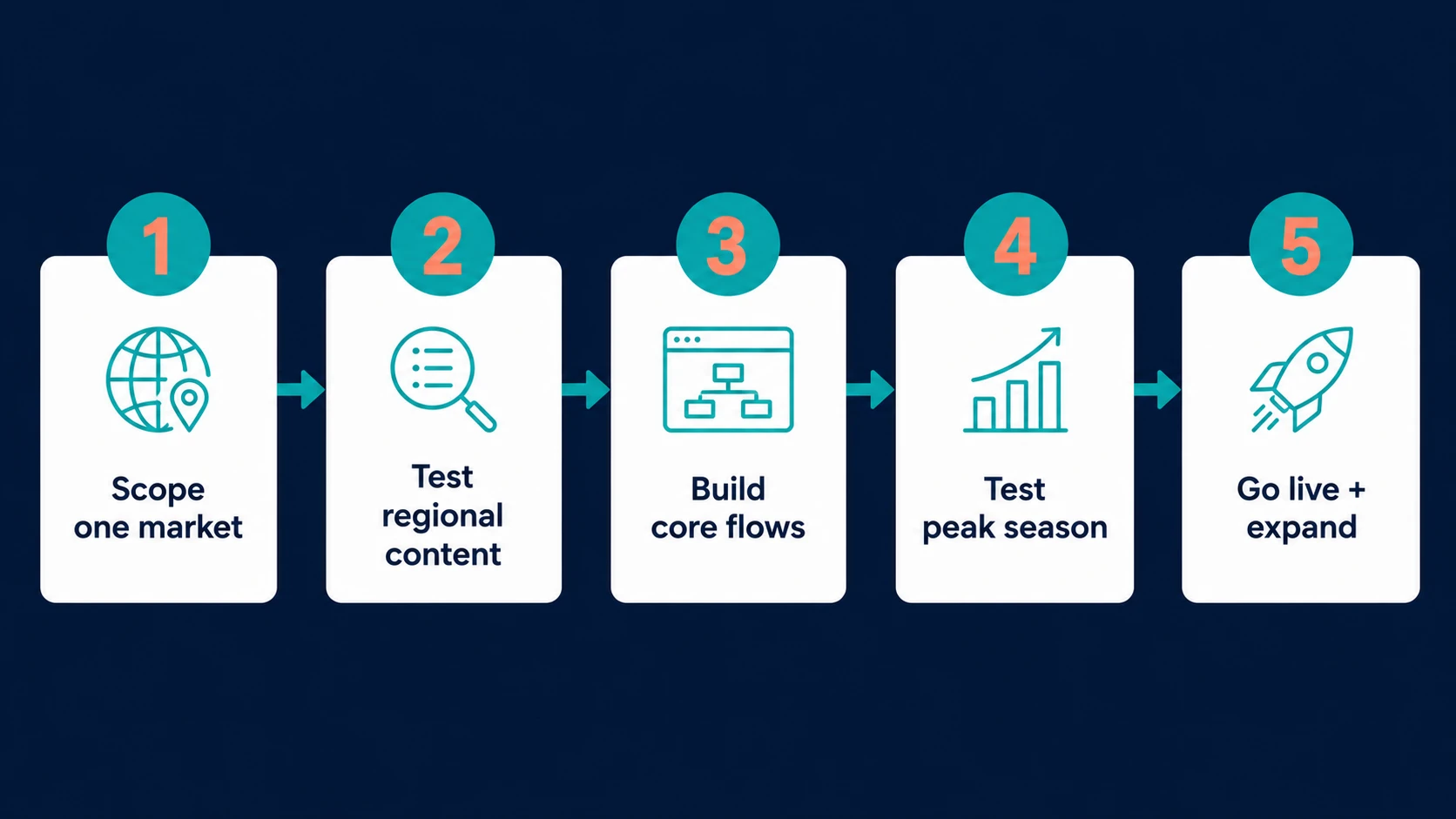
- Scope one market. Pick one country and one product first — for example UAE flights, or Saudi domestic flights and hotels.
- Test regional content in the sandbox. Search your real routes. Confirm the low-cost carriers and the hotels you expect actually appear, in the currency you sell in.
- Build the core flows. Search, validate, book, issue and cancel — with local-currency display and clear cancellation times.
- Test peak behaviour. Run your expected peak load in the sandbox and ask for live response-time data from the last Eid.
- Go live and expand. Add countries and products through the same API as volume grows: transfers, activities, eSIM, visas.
Building direct GDS connections takes 6–12 months each; through one aggregator you build once. The regional work — currencies, payments, Arabic, peaks — is planning and testing time, not months of integration.
Common Mistakes in the Region
- Launching with GDS-only content. Local customers notice missing low-cost fares at once and shop elsewhere.
- USD-only pricing. Local-currency display is a trust signal, not a nice-to-have.
- Forgetting the corridors. South Asia–Gulf traffic is huge; a platform without IndiGo-style low-cost content on those routes looks expensive.
- Underestimating peak load. Eid traffic can multiply normal volume. Confirm the API scales before the season.
- Selling regulated products without a licence. Hajj and Umrah packages need licensed sources. Do not let a general API’s flights and hotels be presented as a package.
- Copying a European product. Payment methods, language and trip patterns differ. Localise from day one.
How Tripgic Serves Middle East Travel Sellers
Tripgic is a B2B travel API aggregator. For a platform selling in or into the Middle East, here is what its own pages state:
- Flights from every channel. GDS content from Amadeus, Sabre and Travelport, NDC, and 100+ low-cost carriers including flydubai, Air Arabia, Air Arabia Abu Dhabi, flynas, Jazeera Airways and SalamAir — 800+ airline and LCC connections in total. When the same flight appears in more than one GDS, its GDS page says it is returned once, at the best available price.
- Hotels at depth. 2M+ properties from 50+ suppliers in 190+ countries, with Dubai among its busiest destinations; structured rate plans and cancellation policies.
- The rest of the trip. Activities, tour packages, trains, transfers, eSIM in 175+ countries and visas, in the same API: 8 product families over 73 endpoints, listed in the API docs.
- Final prices and a flat fee. Prices at validation and booking are final; the fee is a flat amount per transaction, never a percentage — details on the pricing page.
- Prepaid settlement. A wallet you top up, with costs deducted as each booking or ticket is processed.
- Test first. Sandbox credentials at no charge after a short call; activation for live use usually takes 3–5 business days.
What to ask on the call: which Gulf full-service carriers appear on your routes and through which channel, which currencies you can price in, and which countries the visa product covers for your customers’ nationalities.
Final Thoughts
The Middle East rewards platforms that respect how the region travels: low-cost-heavy short-haul, huge hub traffic, deep hotel markets, local currencies and sharp seasonal peaks. The right Middle East travel API brings that supply through one integration, so your team builds the product instead of the plumbing.
Test it on your own routes, in your own currency, at your own peak — and keep regulated products with licensed sources.
Start small and specific: one country, one or two products, your twenty busiest routes and cities. When those return the carriers, hotels and prices your customers expect, add the next market through the same connection. That is how a regional platform grows without rebuilding its supply layer each time it expands.
Want to see your Gulf routes and cities in the Tripgic sandbox? Book a demo and get sandbox credentials after a short call.
 Akhirul Islam
 Mohammad Fahim