 Akhirul Islam
The Skyscanner API is a partner-only metasearch API: approved sites show prices and send travellers elsewhere to book. To book and ticket flights under your own brand, the closest Skyscanner API alternative is the Tripgic Flight API. It searches, books and tickets GDS, NDC and low-cost-carrier fares through one integration. Duffel and the GDSs are other booking routes.
This guide is for online travel agencies (OTAs), travel agencies, travel-tech startups and developers. They looked at the Skyscanner API and found it closed to them, or not built for selling. It explains what Skyscanner’s API allows, compares the alternatives by what they can actually do, and shows the access gate on each route. Every fact about another company is that company’s own public claim, read on its own website on 15 November 2026 and linked in the sources at the end. The grouping into kinds is ours. No provider is scored; Tripgic, which publishes this guide, is listed first.
Skyscanner API Alternatives at a Glance
The table answers one question for each provider: can your customer buy the ticket on your site? The booking routes in it are Tripgic, Duffel, Travelport, Expedia’s XAP Flight APIs and Mystifly. KAYAK and Travelpayouts pay a referral. SerpApi, FlightAPI.io and Ignav return prices only.
| Provider | Type | Books and tickets? | How you get access |
|---|---|---|---|
| Tripgic | Booking API (aggregator) | Yes. Create-booking makes the reservation and issue-ticket issues the e-ticket over the API | Sales contact, NDA, sandbox at no charge |
| Duffel | Booking API | Yes. Offers airline content “using our accreditation and ticketing authority” | Self-serve |
| Travelport (TripServices) | GDS | Yes. Its guides cover “search, booking, and ticketing for flights” | Trial credentials or sales inquiry |
| Expedia XAP Flight APIs | Shopping and booking APIs | Yes, through the XAP Booking API: Expedia bookings “transacted without requiring the customer to leave the partner site”. Partners can also link off to an Expedia website | Apply for access; after a brief review of your site, Expedia sets up a test API key. The Links API is by invitation only |
| Mystifly | Multisource air platform | Yes. “Shop and book flights and ancillaries” with “integrated ticketing and fulfillment” | Through its contact page (“Connect With Us Today”) |
| KAYAK Affiliate Network | Affiliate network: API, deeplinks, widgets, white label | Referral. KAYAK calls it a “meta-search affiliate network”; partners earn “through clicks, bookings and ad revenue” | Application |
| Travelpayouts (Aviasales) | Affiliate APIs | No. On Buy, you generate “a link to purchase on the agency/airline website” | Token, or audience threshold |
| SerpApi Google Flights | Scraper API | No. It is built to “scrape Google Flights information” | Self-serve |
| FlightAPI.io | Price-tracking API | No. “You cannot book flights using our API” | Self-serve |
| Ignav | Price and booking-link API | No. It “does not issue tickets or manage bookings” | Self-serve |
| Skyscanner (reference) | Metasearch Travel API | No. Bookings cannot be made “via our API” | Application and agreement |
In Expedia’s case, the booking is an Expedia booking. Kiwi.com’s Tequila platform is not in this table, because its status today is about who can get in; the access table below covers it.
What Is the Skyscanner API, and Why Do Teams Look Elsewhere?
Skyscanner is a metasearch site: it compares prices from airlines and online travel agents, then normally sends the traveller to one of them to book. Its developer portal lists Flights, Car Hire and Stays APIs, each with live and indicative prices. It also lists Geo, Culture, Autosuggest, Carriers and an Affiliates Link API for “deep links to Skyscanner pages”. Flights Live Prices is described as “real-time flight prices across global supply partners”, and Indicative Prices as “estimated flight prices for SEO and browse pages”. Our guide to how a travel metasearch engine works and earns explains the business model behind it. This guide covers the flights side. For hotels and car hire, our guides to hotel API providers and the car rental API compare the routes that book.
Who Skyscanner Accepts
Skyscanner’s partner page says: “If you’re an established business with a large audience, you can apply for our Travel API.” Its Travel API application page is more exact. The API “is available for commercial use only”, for established businesses with a large audience and strong alignment with Skyscanner’s brand and values.
Skyscanner’s application page also lists who it cannot give access to:
- students and other individuals working on a non-commercial basis;
- start-ups without a robust business plan and pre-developed product;
- businesses with low-traffic websites (“minimum of 100K monthly active users”);
- web development agencies.
Access is “available through a commercial agreement only”, and an application is “subject to approval by the Skyscanner Partners Team”. The outcome arrives by email within 2 weeks.
What Skyscanner’s API Does Not Do
Skyscanner’s support centre is direct about booking: “we do not have the possibility of taking payment details or allowing bookings to be made via our API.” Instead, each price comes with a booking deeplink, a link that opens the seller’s own booking page. Partners are paid on a revenue share basis, “where you will receive commissions for bookings that you generate.”
Skyscanner’s usage guidelines follow from that referral model. Partners must display “Powered by” followed by the Skyscanner logo. Live pricing calls are made only when the exact origin, destination and travel dates are known. Skyscanner “would expect between 5% and 20% of all user-generated live pricing create sessions to result in an end-user booking deeplink”. And it does not allow partners to cache, resell, repackage or redistribute its data.
Skyscanner’s Own Answer for Price-Only Users
Skyscanner’s API exists to send bookings to its supply partners, so it is not offered for price data alone. Its developer FAQ says so plainly: “we can only offer you our API if the searches result in end user bookings.”
Skyscanner’s FAQ adds: “We only have permission to distribute our supply partners (airline and online travel agents) pricing data for the purpose of generating bookings for them. If you require the prices only, please get in touch with our Data Products team. Alternatively, we would suggest using a GDS (Global Distribution System) instead.”
So Skyscanner itself points price-only users to its Data Products team or to a GDS. A fare-alert tool or a pricing dashboard has no booking to generate, so it does not fit the API. When you also need to sell the ticket yourself, the route is a booking API.
Tripgic: A Skyscanner API Alternative That Books and Tickets
Tripgic is a travel API aggregator: one B2B integration that searches, prices, books and tickets flights, so the sale happens on your site instead of on someone else’s. Skyscanner aggregates prices. Tripgic aggregates inventory you can sell.
The way in is different too. Skyscanner’s API starts with an application, reviewed case by case, with a minimum of 100K monthly active users. Tripgic’s onboarding starts with a request form or a 30-minute call, an NDA and sandbox credentials at no charge. You build and test before you pay the one-time activation.
Tripgic’s flight page names who uses a flight booking API. The list covers online travel agencies, travel management companies (TMCs) and corporate booking tools, and B2B agent portals. It also covers apps, super-apps and loyalty programmes that run flight booking under their own brand. In each case the booking is made inside the business’s own product, and the business sells to its own customers.
What One Integration Reaches
- 800+ airlines, reachable through one REST API.
- Amadeus, Sabre and Travelport content, with the same flight from several GDS sources shown once.
- NDC (New Distribution Capability) airline-direct offers, blended with GDS results in one response. Carriers on Tripgic’s NDC list include Lufthansa Group, British Airways, Emirates and Qatar Airways.
- 100+ low-cost carriers in the connected network, with dozens listed by name in the low-cost carrier directory.
- 51,519 commercial routes across 1,619 airports, browsable in the route directory before you sign anything.
Every source comes back in the same normalized JSON. As Tripgic’s NDC page puts it: “Your application does not need to know which source provided the fare.” You build one booking flow, not one per supplier.
Search to Ticket on One API
The flight endpoints follow one lifecycle. Every call is a POST with a JSON body, and the search returns a tracking_id that you carry into each step after it.
- Search GDS, NDC and LCC content by route, date, travellers, cabin, carrier, non-stop and baggage preference.
- Branded fares: read the fare families an airline offers for that flight.
- Validate the itinerary. The validated price is final.
- Travellers: add names, documents and contact details.
- Extras: baggage, seat maps and meals, each with read and update calls.
- Create booking: the reservation is made.
- Issue ticket: the e-ticket is issued over the API, with no manual ticketing step on your side.
- Retrieve or cancel: a booking-details call and a cancel call.
Validation, booking and ticketing are the steps a Skyscanner integration never reaches; on Skyscanner, the traveller leaves after the search.
The example search in Tripgic’s API documentation is a one-way, one-adult economy trip from Dhaka (DAC) to Dubai (DXB), sent as a POST to /flight/search:
{
  "journey_type": "OneWay",
  "segment": [{
    "departure_airport_type": "AIRPORT",
    "departure_airport": "DAC",
    "arrival_airport_type": "AIRPORT",
    "arrival_airport": "DXB",
    "departure_date": "2026-03-30"
  }],
  "travelers_adult": 1,
  "travelers_child": 0,
  "travelers_infants": 0,
  "non_stop_flight": "any",
  "baggage_option": "any",
  "booking_class": "Economy",
  "partner_id": "1",
  "language": "en"
}
A successful response carries "status": "success" and the tracking_id that the validate call needs next.
What You Do Not Need
You do not need a GDS contract or certification of your own. Tripgic holds the airline NDC connections and the GDS credentials, and supplies flight content through its own supplier connections, so you integrate one REST API.
Tripgic’s page on a direct GDS connection versus one API sets the two paths side by side:
- Contracts: a separate agreement with each GDS, against one Tripgic agreement.
- Certification: per GDS, before you can go live, against no per-GDS certification.
- Data format: different schemas per network (EDIFACT, SOAP/XML, REST), against one normalized JSON response.
- Time to first booking: typically 6–12 months on the direct path, and that is before NDC and low-cost carriers are added.
With Tripgic, live credentials usually follow plan activation within 3–5 business days.
How the Money Works
On Skyscanner, you earn a commission when a traveller you referred books somewhere else. With a booking API, you sell the ticket, so you set your own price and keep your own margin.
Tripgic’s model has two charges, and nothing else recurring: a one-time activation, then a flat markup per transaction on the supplier net fare. It is never a percentage of the fare, and there is no monthly subscription. Settlement runs on a prepaid wallet: the net fare plus the markup is deducted as each booking or ticket is processed. Your customers pay you, never Tripgic. Our guide to travel API pricing models compares this with percentage and subscription pricing.
Who Tripgic Is Not For
Tripgic is not a consumer booking site and does not sell to travellers directly. Its pricing FAQ names who integrates it instead: OTAs, travel agencies, TMCs, corporate booking platforms and travel-tech companies. They build it into their own products and sell to their own customers.
Tripgic’s own site names two groups that should not use it. The first is “Consumers looking to book a trip (Tripgic is B2B infrastructure only)”. The second is “metasearch sites that need affiliate deep links rather than bookable content.”
That second group matters here. If your business works the way Skyscanner’s does, showing many sellers’ prices and earning on the click, an affiliate programme is the right fit. The routes below cover those options too.
Other Alternatives to the Skyscanner API, by Kind
The other alternatives fall into three kinds. Booking APIs complete the sale. Metasearch and affiliate APIs show prices and send the traveller on. Price-data and scraper APIs return fares and nothing else. Tripgic’s own page sets out booking vs search vs data APIs side by side, and our flight API guide compares every type in depth. Flight-status APIs, which return schedules and live status but no fares, are not alternatives for selling at all.
Booking APIs
Duffel is a self-serve booking API with NDC, GDS and LCC content, where sign-up “takes about 1 minute”. It offers airline content “using our accreditation and ticketing authority”.
Travelport issues TripServices credentials at provisioning, offers trial credentials, and asks non-customers to send a Sales Inquiry form. Our Travelport API guide covers that route. Sabre offers agency developers “modern APIs, intelligent cache, and unified workflows”; our Sabre API guide explains access. Amadeus archived its Self-Service developer tools on 17 July 2026, and says its Enterprise APIs “remain fully available”. Our guide to the Amadeus Self-Service shutdown lists what developers moved to.
Expedia’s XAP Flight APIs let a partner shop Expedia flight inventory. The partner then books through the XAP Booking API, “without requiring the customer to leave the partner site”, or deeplinks to an Expedia website. Mystifly offers multisource air content covering NDC, LCC, GDS and a consolidator marketplace, with integrated ticketing, through an API or an agent portal.
Three more B2B supply routes are joined by registration. Travelfusion is an LCC and NDC distribution platform with a tfFlight API. PKFARE supplies air and hotel content to B2B clients. TBO offers APIs for agents and enterprises.
Metasearch and Affiliate APIs
KAYAK’s Affiliate Network gives approved partners deeplinks, widgets, a search box, white label and an API with “live pricing and availability for flights, hotels, and cars”. Partners earn through clicks, bookings and ad revenue. Sandbox access is available on request, and production API keys follow approval.
Travelpayouts runs two Aviasales flight APIs. The Data API serves prices “from the cache based on the user’s search history from Aviasales websites”, stored for 7 days, and Travelpayouts recommends it for static pages. The real-time Search API has an audience threshold, and when the user clicks Buy, you generate “a link to purchase on the agency/airline website”. Our guide to free travel APIs covers more affiliate options.
Kiwi.com moved its Tequila platform to invitation only for new partnerships in May 2024. Existing partners keep their tools, and Travelpayouts offers a second door with its own threshold.
Skyscanner’s affiliate programme is separate from its API and runs on impact.com. One of its application guidelines reads: “The website does not book tickets on behalf of their customers.” An agency that sells tickets does not fit this programme either.
Price-Data and Scraper APIs
SerpApi’s Google Flights API returns Google Flights results as JSON, scraped from Google Flights. An identical query can be served from SerpApi’s cache, which expires after one hour. FlightAPI.io tracks prices and states plainly: “You cannot book flights using our API.” It offers free testing after sign-up. Ignav is a “REST API for live flight prices and booking links”, and it “does not issue tickets or manage bookings”. Its API key is self-serve.
Price-data and scraper APIs suit fare alerts, dashboards and research tools. Each one returns a price and, at most, a link to the seller; none returns a booking reference or a ticket. Scraping is a terms-of-service and data-rights question, and it gives you no supply agreement behind the prices. Our Google Flights API guide covers that route in detail.
Access Gates: What Each Route Asks of You
Every route has a gate. Some ask for an audience, some for a contract, some only for an email address. The table lists the booking routes first, then the referral and invitation-only routes, then the data APIs, so you can see where your business already qualifies.
| Route | What it asks of you |
|---|---|
| Tripgic | Request form or 30-minute call, NDA, Live Rate Check Panel, sandbox credentials at no charge, then a one-time activation |
| Duffel | Self-serve sign-up and a test access token |
| Travelport TripServices | Trial credentials, or credentials at provisioning; a Sales Inquiry form if you are not a customer |
| Amadeus | Enterprise APIs only (“remain fully available”); Self-Service tools archived on 17 July 2026 |
| Skyscanner Travel API | Application, approval and a commercial agreement; a minimum of 100K monthly active users |
| Skyscanner affiliate programme | More than 5,000 unique visitors per month, via impact.com; the site must not book tickets for customers |
| KAYAK Affiliate Network | Application; production API keys after approval as a full affiliate integration |
| Aviasales Search API (Travelpayouts) | At least 50,000 monthly active users, “and we do not make exceptions” |
| Kiwi.com Tequila | New partnerships by invitation only since 30 May 2024; through Travelpayouts, at least 50,000 monthly active users |
| Aviasales Data API, FlightAPI.io, Ignav, SerpApi | Self-serve sign-up or an API token |
Across these routes, the pattern is plain. The routes that pay you per referral ask for an audience first. The routes that let you sell ask for onboarding instead: a contract, a sandbox and an integration.
What the Skyscanner API Returns vs a Bookable Offer
A price on a screen and a price you can charge are different things. Skyscanner explains why its API results can differ from its own website in a few edge cases. It has “contractual restrictions with some of our supply partners”, and it leaves itineraries without prices out of the API. Its indicative prices come from earlier searches, stored “for a few days if deemed accurate”.
| Data | Example | How fresh | Can you sell on it? |
|---|---|---|---|
| Validated bookable offer | Tripgic /flight/validate |
Final at validation | Yes. Booking and ticketing follow on the same API |
| Live display price | Skyscanner Flights Live Prices; Aviasales Search API | Live, for one user search | No. The traveller is sent to an airline or agent |
| Scraped price | SerpApi Google Flights | At the request, or from a cache of up to one hour | No |
| Cached or indicative price | Skyscanner Indicative Prices; Aviasales Data API | Stored for days; the Data API keeps data for up to 7 days, and some of its methods return prices found in the last 48 hours | No |
Only a validated offer, such as the response from Tripgic’s /flight/validate, is a price you can charge. Tripgic’s validated fare is the supplier net fare plus the flat markup, and Tripgic’s documentation says the amount “can be shown to your customers as-is”. If a rate has moved since search, the response says so, and your code searches again and re-validates before booking.
Cached, live and scraped prices are useful in their place. A cached price builds an SEO page or a fare calendar. A live display price fills a comparison grid. Neither one becomes a ticket on your site.
After the Search: What Skyscanner’s Redirect Never Does
When a Skyscanner partner’s user clicks a deeplink, the partner’s part is over. The airline or travel agent re-checks the price, takes payment, creates the booking and issues the ticket. When you sell the ticket yourself, three jobs move to your side before the ticket is issued:
- Price re-check: validate the fare before you take payment.
- The booking record: create the reservation, the passenger name record (PNR) that airlines and agents work from.
- Payment and settlement: you charge your customer, and the supplier side is paid from your prepaid balance.
The diagram shows where the sale ends on each route: on a redirect it ends at the search, and on a booking API it ends with the ticket on your own site.
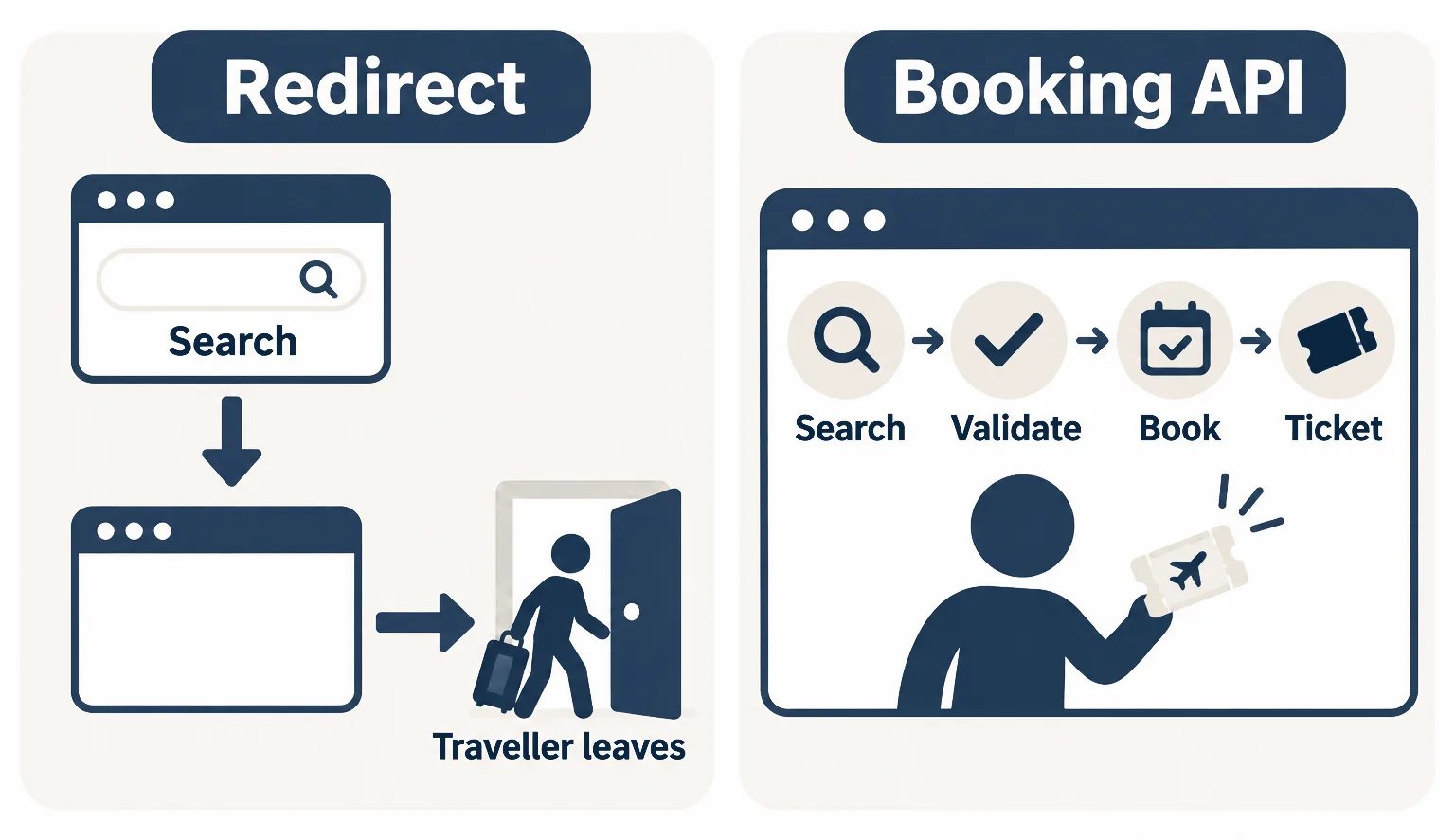
With Tripgic, you call issue-ticket and need no GDS contract or certification of your own. Our airline ticketing API guide explains how the ticketing step works. Whether your business also needs its own accreditation in the markets you sell in is a separate question, and our IATA accreditation guide answers it.
Booking API, Skyscanner or Data API: Which Fits Your Project?
The right route depends on what you sell and how many people already visit you. Find the row that describes your business; the last column names the route to shortlist first.
| You are | What you need | Route |
|---|---|---|
| An OTA or travel agency | Sell and ticket under your own brand, keep the margin | A booking API such as Tripgic, or a direct GDS connection |
| A travel-tech startup without a large audience | A bookable API you can test now | A booking API with a sandbox, such as Tripgic or Duffel |
| A corporate travel tool or travel management company (TMC) | Bookings inside your own tool | A booking API |
| A business adding hotels and more later | One integration across products | A multi-product API; Tripgic covers 8 product families |
| A high-traffic metasearch or content site | Referral revenue from your audience | Skyscanner’s Travel API, KAYAK or Travelpayouts |
| A price tracker or fare-alert tool | Prices, no sales | A data API such as FlightAPI.io or Ignav, or the Aviasales Data API |
| A traveller | Cheaper flights | A metasearch website or app, not an API |
For the first two rows, our guides on the travel API for startups and the travel agent API go deeper into stages, staffing and costs.
From “Skyscanner Said No” to a Live Booking Flow
If Skyscanner turned your application down, or you never had the audience to apply, here is the path on a booking API. Only one piece carries over from a Skyscanner design: its search call maps to Tripgic’s /flight/search. Everything after search is new.
- Request access. Send the request form or book a 30-minute call. The team maps your use case to a plan.
- Sign the NDA and check rates. You then get the Live Rate Check Panel, to compare real-time rates with your current suppliers before any payment.
- Build in the sandbox. Sandbox credentials are issued at no charge, and you integrate against the full API documentation.
- Build validate, book and ticket. Branch on the
statusfield in every response, not on the HTTP code. A business failure can arrive as HTTP 200 with a status of “failed” and a reason. - Fund the wallet. Each booking and ticket is then deducted from it.
- Activate and go live. Pay the one-time activation. Live credentials usually follow within 3–5 business days.
Tripgic’s pricing page sets out its onboarding steps, from first contact to live bookings.
Before You Switch from the Skyscanner API: Questions to Ask
Whichever route you shortlist, these questions show what changes when you leave Skyscanner’s model:
- Does the traveller stay on your site to pay, or leave on a link?
- Is the gate an audience (monthly active users or visitors), or onboarding (a contract and a sandbox)?
- May you cache its prices for SEO pages and fare calendars, or only show live results?
- Is the returned price final, or only indicative?
- Who issues the ticket, and do you need a GDS contract or certification of your own?
- Do you earn a commission, or set your own margin?
- What look-to-book ratio (searches allowed per booking) applies to your search traffic? Tripgic provisions throughput to your volume and the look-to-book ratio set in your agreement.
Our guide on how to choose a travel API provider turns these questions into a full checklist.
The Short Version
Skyscanner’s API is built for sites with a large audience that send travellers to airlines and travel agents. It is free to use on a revenue share, gated by approval, and it never takes a booking.
Skyscanner itself sends price-only users to its Data Products team or a GDS. If you need referral revenue, an affiliate programme whose threshold you meet is the match. If you need to sell and ticket flights under your own brand, you need a booking API. Tripgic is built for that: GDS, NDC and low-cost carriers through one integration, with no GDS contract of your own.
For a wider comparison across products, see our shortlist of travel APIs.