
 Mehadi Hassan
Every time a traveler compares flight or hotel prices across sites before booking, a travel metasearch engine is usually doing the work behind the scenes. Skyscanner, Kayak, Trivago, and Google Flights are the names people know — but the model underneath them is the same, and it is a model any travel platform can build.
This guide explains what a travel metasearch engine is, how it works, how it differs from an OTA (Online Travel Agency), how these platforms make money, and — most importantly for a travel business — what you actually need to build or power one.
What is a travel metasearch engine?
A travel metasearch engine is a price-comparison platform that aggregates real-time rates for flights, hotels, car rentals, and other travel products from many sources — airlines, hotels, and OTAs — and shows them side by side. Instead of completing the booking itself, it sends the user to the chosen supplier or OTA to finish the transaction.
The word “meta” is the key. A metasearch engine does not have its own inventory to sell. It searches other search results — it queries many booking sources at once and merges what they return into a single, comparable list. This is why it is sometimes called a travel aggregator or price-comparison site.
Three traits define a travel metasearch engine:
- It owns no inventory. It does not contract rooms or seats; it reads live prices from those who do.
- It usually does not complete the booking. It hands the user off to the supplier or OTA at the final step.
- Its value is comparison. The product is a fast, unbiased view of who has what, at what price, right now.
How does a travel metasearch engine work?
A travel metasearch engine works by sending each user search to many supplier APIs at once, then normalizing and deduplicating the responses into one ranked result set in real time. The user sees a clean comparison; the complexity is hidden in the data layer.
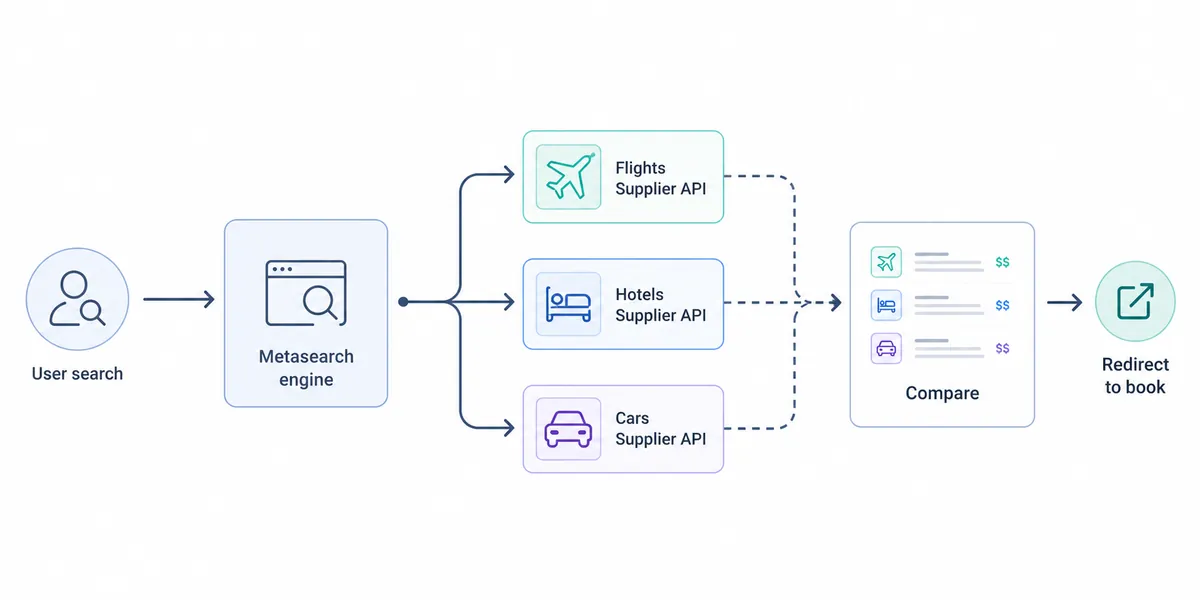
A typical search follows four steps:
- Query. The user enters a route, dates, and travelers. The engine fans that single request out to every connected source — airline APIs, hotel wholesalers, OTAs, and GDS (Global Distribution System) content.
- Collect. Each source returns its own prices and availability in its own format, on its own timing.
- Normalize and deduplicate. The engine converts every response into one common structure, matches the same flight or room coming from different sources, and removes duplicates so the user does not see the same option five times.
- Rank and redirect. Results are sorted (by price, duration, or relevance) and displayed. When the user picks one, the engine redirects them to that supplier or OTA to complete the booking.
Steps two and three are where most of the engineering lives. Every supplier has a different API format, authentication method, and data schema, so the raw responses do not line up. Rates, taxes, cancellation policies, and room or fare descriptions all arrive in different shapes and have to be reconciled before anything can be compared. Doing this fast matters: a slow metasearch loses users, so speed and caching strategy are as important as coverage. This is the same infrastructure challenge that any travel booking software faces when it connects to more than one supplier.
Metasearch engine vs OTA vs aggregator
These three terms get mixed up constantly, but they describe different roles in the booking chain.
| Metasearch engine | OTA | API aggregator | |
|---|---|---|---|
| Holds inventory? | No | Yes (contracted) | No — it connects you to it |
| Completes the booking? | No — redirects | Yes | Provides the booking capability |
| Who it serves | Travelers comparing prices | Travelers buying | Businesses building a platform |
| Revenue model | Advertising (CPC / CPA) | Booking commission | Per-transaction markup or fee |
| Examples | Skyscanner, Kayak, Trivago | Booking.com, Expedia | Tripgic |
In plain terms: an OTA sells you the trip; a metasearch engine helps you find who sells it cheapest and sends you there; an aggregator or booking extranet is the supply layer a metasearch engine or OTA connects to in order to reach all that inventory through one integration. A single business can play more than one role — Kayak and Google, for example, have added “book on our site” features that blur the line between metasearch and OTA.
Examples of travel metasearch engines
The best-known travel metasearch engines specialize by product type:
- Skyscanner — flights first, with strong global route mapping and a “search everywhere” feature; also covers hotels and cars.
- Kayak — broad flight, hotel, and car comparison with price-prediction and history tools.
- Trivago — focused almost entirely on hotel rate comparison across OTAs and hotel sites.
- Google Flights and Google Hotel Ads — Google’s own comparison surfaces, integrated with Search and Maps. Note that Google Flights is a consumer product, not something you can pull data from — we explain why in our guide to the Google Flights API.
- Momondo and regional players — many markets have their own comparison brands built on the same model.
Different names, one pattern: none of them own the inventory. They all depend on pulling live data from suppliers and OTAs, comparing it, and passing the click along.
How travel metasearch engines make money
Travel metasearch engines earn revenue from advertising models, not booking commission. Because they do not complete the sale, they charge suppliers and OTAs for visibility and traffic instead. The common models are:
- CPC (cost per click) — suppliers pay each time a user clicks through to their site. This is the dominant model.
- CPA (cost per acquisition) — the supplier pays only when the click turns into a booking.
- CPM (cost per thousand impressions) — payment for display, used less often.
- Hybrid — a mix of CPC and CPA to balance risk between the engine and the advertiser.
This advertising model is why the market is large and growing. The global travel metasearch market was valued at roughly $4.8 billion in 2025 and is projected to reach about $10.1 billion by 2034, a compound annual growth rate of 8.6%, according to market research from Dataintelo. As more travelers research before booking, the comparison step — and the advertising spend around it — keeps expanding.
What you need to build or power a travel metasearch engine
Whether you are building a full metasearch site or adding price comparison to an existing travel platform, the front end is the easy part. The real requirement is on the supply side.
To show competitive, trustworthy comparisons you need:
- Broad supplier coverage. A comparison is only useful if it includes enough sources. Thin coverage means users see a better price elsewhere and leave.
- Real-time pricing and availability. Comparing stale prices produces booking failures and lost trust. Data has to be live.
- Normalized, deduplicated data. Prices, policies, and product descriptions from different suppliers must be reconciled into one clean format before they can be compared.
- Reliability at speed. The engine must return results in seconds even when some suppliers are slow, which means fallback logic and caching.
Building all of that by connecting to each airline, hotel, and OTA directly is impractical for most teams. Every direct connection has its own format and must be maintained separately as suppliers change or deprecate their APIs, and onboarding a single GDS or airline integration can take months. The same problem shows up whenever a platform needs many sources at once — it is why most teams choose an aggregator over raw connections, a trade-off we cover in travel API vs GDS.
A travel API aggregator solves this by giving you one integration that reaches many suppliers. You build once; the aggregator handles supplier routing, data normalization, and deduplication on the other side — the exact data layer a metasearch engine depends on. For example, Tripgic provides a single API covering 8 product families across 73 endpoints — flights, hotels, activities, tour packages, trains, transfers, eSIMs, and visas — so a platform can pull real-time, normalized inventory for comparison from one connection instead of dozens. If your comparison focuses on flights, our guide to the flight consolidator model explains how consolidator and multi-source fares reach a platform.
The bottom line
A travel metasearch engine is a comparison layer, not a booking platform. Its value is showing travelers the best available price across many sources — and its hard part is the data layer that pulls, normalizes, and deduplicates supplier inventory in real time. The market is large and growing precisely because that comparison step now sits at the center of how people book.
If you are building a metasearch or comparison feature, the deciding factor is supply: how many suppliers you can reach, how fresh the data is, and how much integration work it takes to get there. That is exactly what a travel API aggregator is for.
Tripgic gives you one API to search and compare real-time inventory across flights, hotels, activities, transfers, and more — the supply layer a metasearch product runs on. Book a demo to see how it fits your platform.



 Mehedi Ahsan Ashif
 Akhirul Islam