 Md Sozibul Islam
Travel data aggregation is the process of collecting data from many travel suppliers — airlines, hotels, wholesalers, transfer and activity providers — and combining it into one consistent data set that a booking platform can search, compare and sell from. Tripgic does this as a service: 8 product families from many suppliers, returned through one API in one JSON format.
This guide explains the kinds of travel data, the steps every aggregation pipeline follows, why normalisation and mapping are hard, how to measure data quality, and when to build or buy.
What Is Travel Data Aggregation?
To aggregate means to bring separate things together into one whole. In travel, the separate things are supplier feeds. Each airline, hotel supplier and activity provider sends its data in its own format, with its own codes, names and rules. Aggregation turns all of them into one data set with one shape.
The result is what travellers see on a booking site: one list of hotels, one list of flights, one price per option — even though the data came from dozens of sources.
For the business model behind this, see what a travel API aggregator is.
The Four Kinds of Travel Data
| Kind | Examples | How often it changes | How it is collected |
|---|---|---|---|
| Dynamic | Prices, availability, seat counts, room allocations | Constantly | Live, per search |
| Static content | Hotel descriptions, photos, amenities, activity details | Occasionally | In batches, refreshed on a schedule |
| User-generated | Reviews, ratings | Daily | Licensed feeds or your own collection |
| Reference | Airport, city, country, currency and airline codes | Rarely | From standard lists |
Each kind needs a different approach. Treating prices like static content — collecting them once a day — leads to failed bookings. Treating static content like prices — fetching it on every search — makes search slow and expensive.
Dynamic data
Prices and availability change by the minute. They are fetched at search time from each supplier and checked again before booking. Caching is possible for display — for example “from” prices — but a price must be confirmed live before payment.
Static content
Descriptions, photos, amenities, policies, coordinates. This data is downloaded in bulk, stored and refreshed regularly. It is where most of the mapping work happens, because it is what tells you two supplier records describe the same hotel.
Reviews and ratings
Reviews are owned by the sites that collect them. Aggregate them through licensed review feeds, or collect your own from travellers after their trips. Copying reviews from other sites usually breaks their terms and, in many markets, consumer rules on genuine reviews.
Reference data
Codes that everyone shares: IATA codes for airlines, airports and cities; ISO country codes; ISO 4217 currency codes. Using standard codes is the first step to making many feeds agree. The OpenTravel Alliance also publishes shared code lists, such as amenity codes, that many suppliers use.
The Aggregation Pipeline
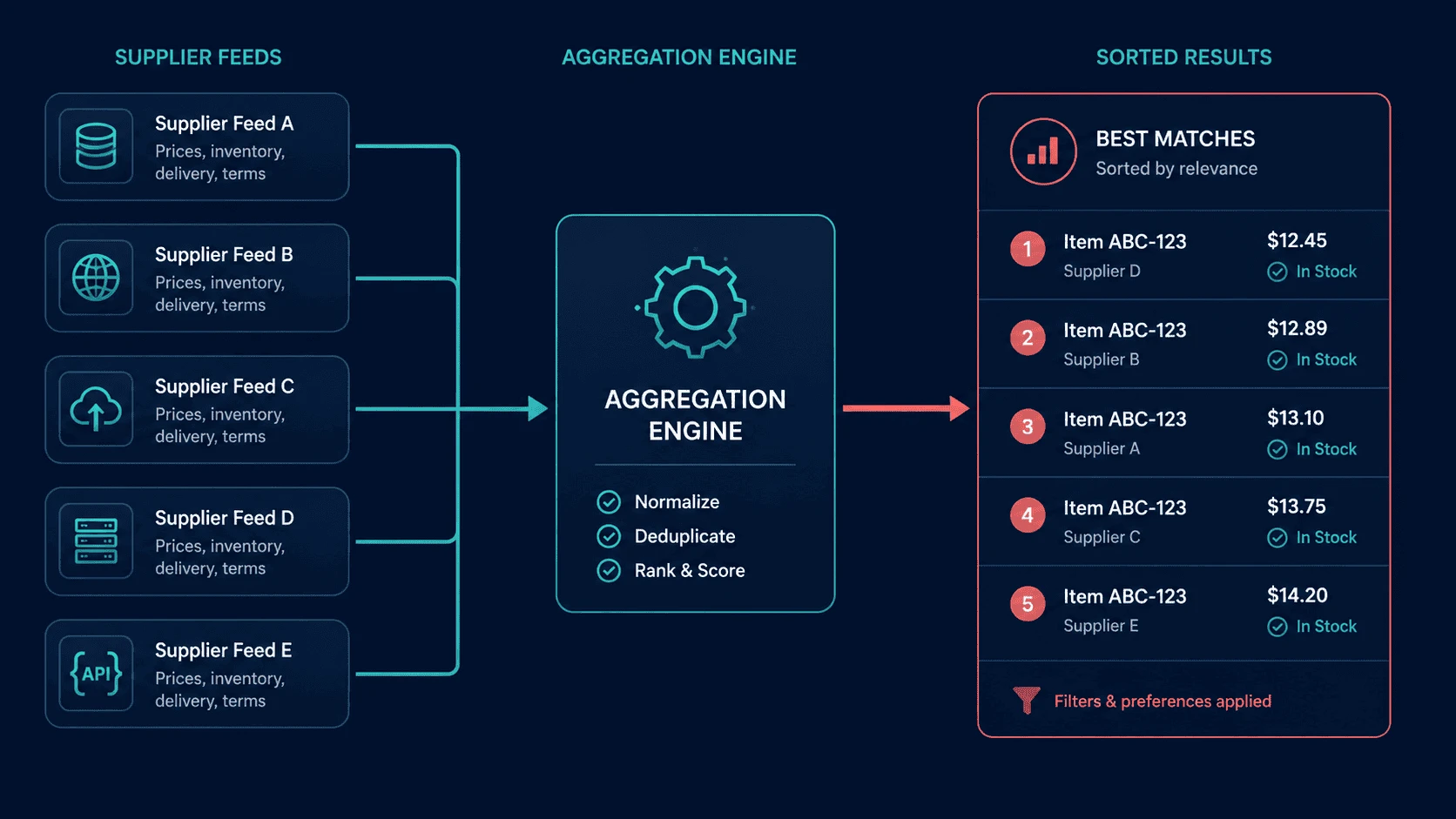
Every aggregation system follows the same steps, whether it serves a small OTA or a global platform.
1. Collect
Connect to each supplier: APIs for live data, file downloads for content, partner feeds for reviews. Each connection has its own authentication, limits and schedule.
2. Normalise
Convert every supplier’s data into one internal model — one way to describe a hotel, a room, a flight, a price, a tax, a cancellation rule.
3. Map
Decide which records from different suppliers describe the same thing: the same hotel, the same room type, the same activity.
4. De-duplicate
Merge mapped records so the traveller sees one hotel with several prices, not several copies of the hotel.
5. Enrich
Add what suppliers do not send: standard codes, coordinates, translated descriptions, your own categories and tags.
6. Validate
Check data quality: missing fields, impossible values, prices out of range, broken images.
7. Store and cache
Keep static content in your own database. Cache dynamic data briefly where safe.
8. Serve
Return the clean data to the website, app or partner through your own API, fast.
Normalisation: Making Many Formats One
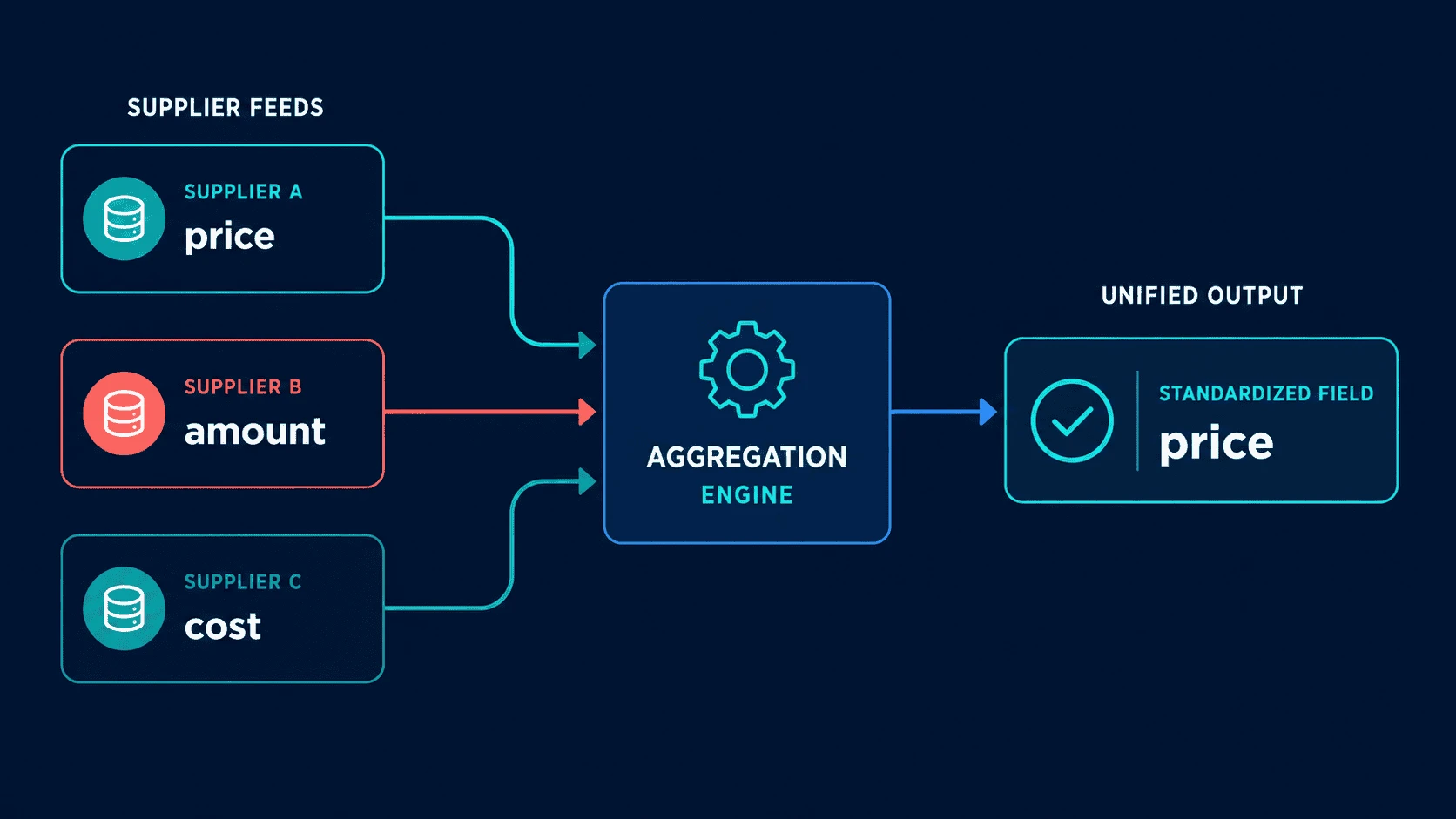
Normalisation is where most of the engineering lives. Examples of what differs between suppliers:
| Field | How suppliers differ |
|---|---|
| Price | Called price, amount, total or rate; with or without taxes; per night or per stay |
| Taxes and fees | Included, listed separately, or partly included |
| Currency | Different currencies, different rounding |
| Dates and times | Different formats and time zones |
| Room names | Free text in many languages |
| Board | Room only, breakfast, half board — under many names and codes |
| Cancellation | Free text, dates, percentages or penalty amounts |
| Fare rules | Different structures for changes, refunds and baggage |
A normalised price
A good internal model separates what the traveller pays from how it is built:
| Field | Meaning |
|---|---|
| Total | What the traveller pays, including all mandatory charges |
| Base | Price before taxes and fees |
| Taxes and fees | Itemised where the supplier provides them |
| Pay at property | Charges collected later, such as some city taxes |
| Currency | One ISO currency code |
| Price type | Per stay, per person, per night |
Getting this wrong produces the most visible errors: two hotels compared on different price bases, or a total that grows at checkout.
Mapping: The Hardest Problem
There is no global ID for hotels or rooms. Each supplier uses its own. Mapping decides, with evidence, that two records are the same:
| Signal | Strength |
|---|---|
| Coordinates | Strong, if precise |
| Name | Medium — names vary and chains repeat names |
| Address and postcode | Strong when clean |
| Phone number | Strong |
| Star rating and chain | Supporting |
Good systems score each candidate match and send uncertain ones for review. Mapping rooms within a hotel is harder still; our hotel room mapping guide covers it in detail.
Flights are easier — but not trivial
A flight is identified by airline, flight number and date, so matching the same flight across sources is straightforward. What differs is the offer: fare, baggage, rules and conditions. Aggregating flights is less about mapping and more about comparing offers on equal terms.
A Worked Example: One Hotel Through the Pipeline
A beach hotel in Bali is sold by three suppliers.
- Collect. Supplier A calls it “Ocean View Resort Bali” with coordinates. Supplier B calls it “Oceanview Resort & Spa”, with an address but rough coordinates. Supplier C lists “Ocean View Bali Resort” with a phone number.
- Normalise. All three records are converted to the internal model: name, address, coordinates, phone, star rating, amenities in standard codes.
- Map. Coordinates from A and the address from B point to the same spot; the phone number from C matches the hotel’s own. The match score is high, so the three records are linked to one internal hotel.
- De-duplicate. The results page will show one hotel, not three.
- Enrich. The best photos come from A, the fullest description from B, the amenity list from all three combined and checked for contradictions.
- Validate. A broken image link from C is dropped; a missing check-in time is flagged.
- Search. A traveller searches Bali. Live prices come back from all three suppliers for the same room type and conditions: 92, 88 and 95 per night.
- Serve. The traveller sees one hotel card, “from 88”, with the other offers and their conditions one click away.
Without aggregation, the traveller would have seen three hotels with three names, and might have booked the most expensive one by mistake. Multiply that by thousands of hotels in a city and the value of the pipeline is clear.
Designing the Internal Data Model
The internal model is the contract between every supplier feed and every screen. A few principles:
- Keep identity separate from offers. A hotel is one record; each supplier’s price for a room on a date is an offer linked to it. The same holds for flights and their fares.
- Use standard codes wherever they exist — IATA for airports and airlines, ISO for countries and currencies.
- Keep the supplier’s original values next to the normalised ones, for support and debugging.
- Model conditions as data, not text: refundable or not, free cancellation until a date, breakfast included or not. Free text cannot be filtered or compared.
- Version the model. It will change as you add products; plan for that from the start.
| Product | Identity record | Offer record |
|---|---|---|
| Hotel | Property, rooms | Rate for a room, dates and party |
| Flight | Flight segments | Fare with baggage and rules |
| Activity | Product and options | Price for a date, time and age group |
| Transfer | Route and vehicle type | Price for a date and party |
Data Quality: How to Measure It
| Measure | What it shows |
|---|---|
| Coverage | Share of searches that return results, by destination |
| Duplicate rate | How often the same hotel appears twice |
| Mapping accuracy | Share of merges checked as correct |
| Content completeness | Share of hotels with photos, descriptions, coordinates, amenities |
| Price accuracy | How often the price at booking matches the price shown |
| Booking failure rate | Bookings that fail after a successful price check |
| Freshness | Age of static content; age of cached prices |
Price accuracy and booking failure rate are the measures travellers feel. Coverage and duplicates are the ones they see.
Static Content Management
Static content deserves its own process:
- Download in bulk from each supplier on a schedule.
- Choose the best content per field — the best photos from one supplier, the fullest description from another.
- Keep the supplier’s original for support staff.
- Translate where needed, starting from the richest description.
- Check images: broken links, duplicates and low resolution.
- Refresh — hotels renovate, change names and close.
Watching Supplier Feeds Change
Supplier feeds are not fixed. They change without much warning, and each change can quietly break part of an aggregation pipeline:
| Change | What breaks | How to catch it |
|---|---|---|
| New field or renamed field | Normalisation drops data | Schema checks on every download |
| New room or board codes | Rooms map wrongly or not at all | Alerts on unknown codes |
| Hotel renamed or closed | Duplicates or dead listings | Compare content between downloads |
| API version retired | Searches fail | Track supplier notices and deadlines |
| Slower responses | Results drop out of search | Response-time monitoring per supplier |
| Price format changes | Totals shown wrongly | Price accuracy checks against bookings |
Build these checks into the pipeline rather than relying on someone noticing. A drop in results for one destination, or a rise in booking failures for one supplier, is usually the first sign that a feed has changed. The more suppliers you aggregate, the more often this happens — which is one of the strongest reasons platforms hand the work to an aggregator whose job is to absorb these changes.
Real-Time vs Batch
| Real-time aggregation | Batch aggregation | |
|---|---|---|
| Used for | Prices, availability | Content, reviews, reference data |
| When | At every search | Daily or weekly |
| Main challenge | Speed and supplier limits | Volume and change detection |
| Failure effect | A search returns fewer results | Content goes out of date |
A real-time search sends requests to many suppliers in parallel, waits up to a time limit, and returns what has arrived. Suppliers limit how many searches you send for each booking — the look-to-book ratio — so caching static data and avoiding repeat searches matter.
Aggregating Tours, Activities and Packages
Searches about “multi-source aggregation” for tours and activities point to a real gap: activities are harder to aggregate than hotels.
- Products differ more. A “city tour” can be a walk, a bus or a boat.
- Availability is by date and time slot, not by night.
- Options vary: languages, pick-up points, group sizes.
- Few shared codes exist for activities.
Aggregating them needs a richer model — product, option, date, time, capacity, price per age group — and more manual mapping. See our tours and activities API guide. Packages add another layer: combining aggregated flights and hotels into one priced trip, covered in our dynamic packaging guide.
Legal and Licensing Questions
- Supplier terms decide how you may store, show and cache their data.
- Content rights — photos and descriptions are licensed for display, often only alongside the supplier’s rates.
- Reviews are licensed, not free.
- Scraping websites instead of using licensed feeds can break terms of service and is a weak base for a business.
- Personal data in bookings is governed by privacy law; see our travel API security guide.
Using Aggregated Data Beyond Search
Once data from many sources sits in one shape, it serves more than the results page:
- Pricing decisions — comparing supplier prices for the same product shows where margins can be raised or lowered.
- Supplier management — coverage, price and failure rates per supplier show which sources earn their place.
- Demand insight — search patterns by destination and date show what travellers want before they book.
- Content gaps — destinations with thin coverage or poor content are easy to spot.
- Reporting — one booking record format makes finance and operations reporting simpler.
Search and booking data includes personal data when it is tied to a traveller. Analyse it in aggregate, and follow your privacy notice and the law.
Aggregated Data and AI Assistants
AI travel assistants depend on aggregated data even more than websites:
- One format keeps the assistant’s tools simple and its answers consistent.
- No duplicates, or the assistant offers the same hotel twice as two choices.
- Conditions as data, so it can explain what a price includes.
- Live, final prices, so what it quotes can be booked.
See our AI travel agent API guide for how assistants use travel APIs.
Common Mistakes
- Fetching static content on every search, making search slow and costly.
- Caching prices too long, causing failed bookings.
- Merging on names alone, joining two different hotels.
- Dropping the supplier’s original data, so support cannot check what was sold.
- Storing conditions as free text, so they cannot be filtered or compared.
- Copying content or reviews without a licence.
- No quality measures, so problems are found by travellers first.
Key Terms
| Term | Meaning |
|---|---|
| Normalisation | Converting each supplier’s data into one internal format |
| Mapping | Deciding which supplier records describe the same thing |
| De-duplication | Merging mapped records so each appears once |
| Static content | Descriptions, photos and amenities that change rarely |
| Dynamic data | Prices and availability that change constantly |
| Canonical model | The single internal data model every feed is converted into |
| Look-to-book ratio | Searches sent for each booking made |
Build or Buy?
| Build your own aggregation | Use an aggregator | |
|---|---|---|
| Supplier contracts | One per supplier | One |
| Integrations | One per supplier, maintained forever | One |
| Normalisation and mapping | Your team | Done upstream |
| Control | Full | Through the provider’s model |
| Time to launch | Long | Short |
| Best for | Very large platforms with unique needs | Most OTAs, agencies and travel apps |
Most platforms buy supply aggregation and build what makes them different: ranking, display, pricing rules and customer experience. See our build vs buy guide and multi-supplier inventory guide.
How Tripgic Aggregates Travel Data
Tripgic is a travel data aggregator delivered as one API:
- 8 product families across 73 documented endpoints, listed in the API documentation.
- Hotels — 2M+ properties from 50+ suppliers in 190+ countries through the Hotel API.
- Flights — 800+ airline and LCC connections across GDS, NDC and 100+ low-cost carriers.
- One JSON envelope for every product — the same
status,messageandtracking_id— so a platform’s code reads every product the same way. - Final prices at validation and booking, which the documentation says can be shown to customers as they are.
Your platform receives normalised data and spends its effort on what travellers see. Testing starts in a free sandbox, and the fee model is on the pricing page.
Final Thoughts
Travel data aggregation turns many inconsistent supplier feeds into one data set a platform can trust. The pipeline is the same everywhere — collect, normalise, map, de-duplicate, enrich, validate, store, serve — and the hard parts are always normalisation and mapping. Measure quality by what travellers feel: prices that hold at booking, no duplicates, complete content. And plan for change: supplier feeds move constantly, so aggregation is not a project that ends but a service that has to be run every day.
If you would rather receive aggregated, normalised travel data than build the pipeline, book a demo with Tripgic and test it in the sandbox first.