 Akhirul Islam
Build vs buy a travel API is one of the first big decisions for a travel platform. To build is to connect to each supplier yourself — GDSs, airlines, hotel wholesalers — and maintain those connections for years. To buy is to use an aggregator’s API, such as Tripgic, which has already connected many suppliers and returns them in one format. Both work. They differ in cost, time, control and risk — and most platforms end up doing some of each.
This guide sets out what building really involves, a cost worksheet you can fill in with your own numbers, what buying costs and risks, the hybrid path most platforms take, and a framework for deciding. It also covers the second build-or-buy question — the booking front end — and ends with what Tripgic offers for teams that decide to buy.
Two Decisions, Not One
Platforms face build-or-buy at more than one layer:
| Layer | Build means | Buy means |
|---|---|---|
| Supply connections | Contracts and integrations with each GDS, airline and hotel source | One aggregator API |
| Booking engine / front end | Your own search, checkout and account screens | A white-label platform |
| Operations | Your own servicing, ticketing and settlement processes | The provider’s processes and tools |
You can build one layer and buy another. The most common combination for a new business is: buy supply, build the front end. This guide focuses on supply, with a section on the front end later.
What Building Really Involves
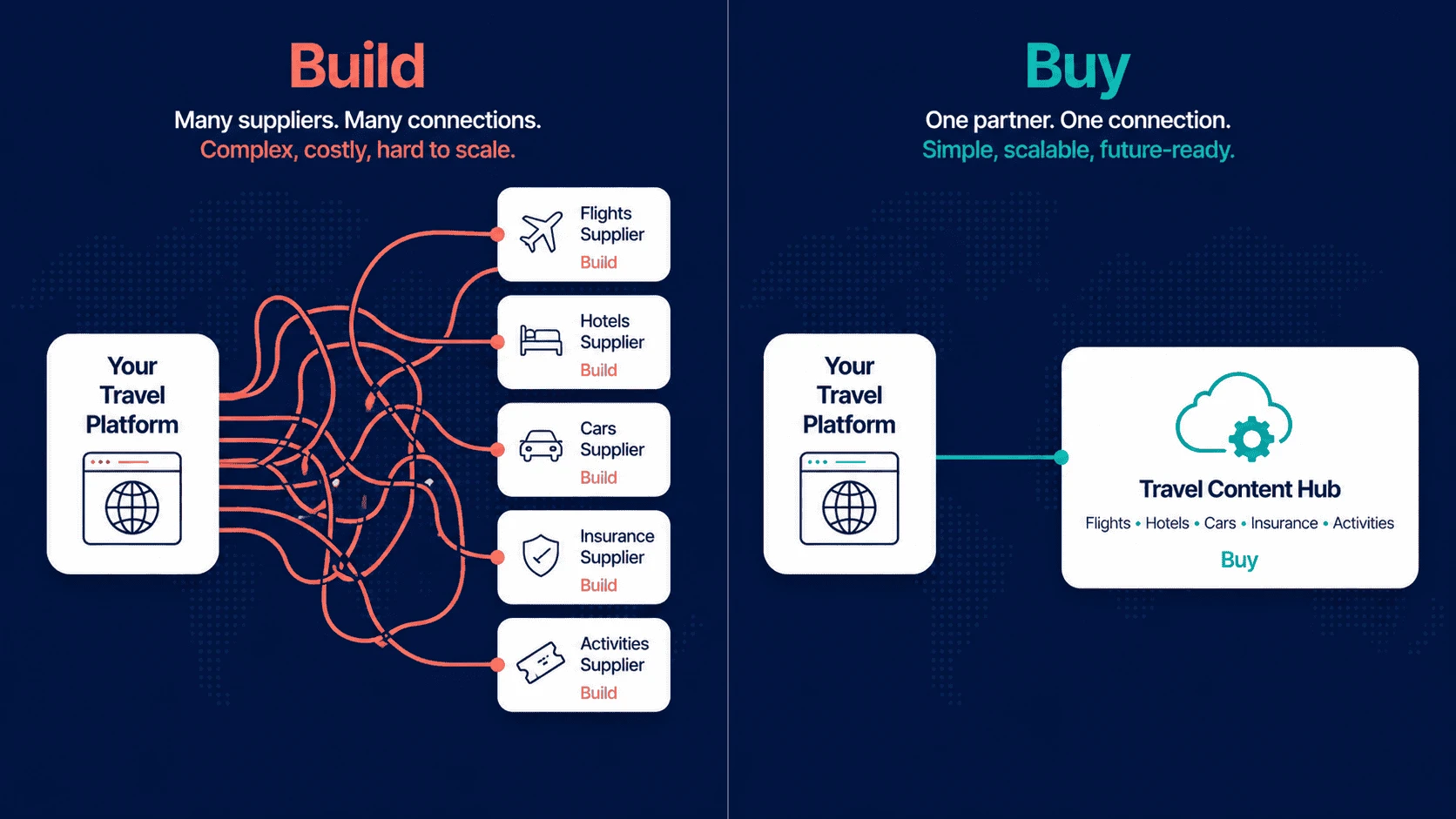
Building supply connections is not one project but a set of them — one per supplier — each with the same stages:
- Commercial agreement: terms, minimums, sometimes deposits.
- Accreditation and ticketing authority: IATA or ARC, or a host agency or consolidator.
- Integration: learning the supplier’s API, data model and rules.
- Certification: many GDSs and some airlines review your flows before live data.
- Mapping: converting each supplier’s data into your own format.
- Merging: removing duplicates when two suppliers sell the same flight or hotel.
- Servicing: changes, cancellations, refunds, schedule changes — per supplier.
- Monitoring and on-call: someone notices and fixes it when a connection breaks.
- Upgrades: suppliers retire versions; you rebuild parts of the integration.
- Security and compliance: credentials, audits and data protection for every connection.
A direct GDS connection alone takes 6–12 months, according to Tripgic’s GDS page. Low-cost carriers and NDC airlines add more projects on top, because many sell outside the GDS.
What Building Looks Like for One Supplier
Take a single direct GDS connection as an example of what “build” means in practice:
- Weeks 1 and onward — the business side. An intake form, a sales conversation, a commercial agreement, a decision on which APIs and markets the contract covers, and an accreditation or host-agency arrangement for ticketing. GDS developers report that this stage alone can take months.
- The build. Your developers learn the GDS’s data model — often a mix of REST and older SOAP services — and build search, pricing, booking, ticketing and servicing against its test environment.
- Certification. The GDS reviews your flows before live data. Sabre’s certification typically takes four to eight weeks, according to AltexSoft; Travelport asks for at least 15 days’ notice and a fixed set of test scenarios.
- Go-live and after. Monitoring, on-call, version upgrades and servicing continue for as long as the connection exists.
That is one GDS. A platform that also wants a second GDS, NDC airlines and low-cost carriers repeats a version of this for each. Our Sabre, Travelport and Amadeus guides describe each network’s path in detail.
A Cost Worksheet for Building
Instead of trusting anyone’s headline figure, fill this in with your own numbers:
| Cost item | One-off or ongoing | Multiply by |
|---|---|---|
| Engineering time to integrate | One-off | Number of suppliers |
| Certification time and fees | One-off, repeated on major changes | Number of suppliers that certify |
| Mapping and merging logic | One-off plus ongoing | Number of suppliers |
| Servicing flows (change, cancel, refund) | One-off plus ongoing | Number of suppliers |
| Access fees and minimums | Ongoing | Per contract |
| Monitoring and on-call staff | Ongoing | Number of connections |
| Version upgrades | Ongoing | Per supplier, per year |
| Security and compliance work | Ongoing | Per connection |
| Accreditation and financial guarantees | Ongoing | Once, if you ticket yourself |
Two lines are usually underestimated: on-call and upgrades. They never end, and they grow with every supplier you add. When you compare build with buy, compare the whole worksheet over three to five years, not just the first build.
The Case for Buying
- Speed. One integration instead of many; the aggregator’s contracts and certifications are already in place.
- Breadth. GDS, NDC, low-cost carriers, hotels and extras from day one.
- One format. Every supplier’s data arrives in the same shape, so your code and your interface are simpler.
- Merged results. Duplicates across sources are often removed for you.
- Maintenance absorbed. Supplier changes are mostly the aggregator’s problem.
- Servicing through the same API. Changes and cancellations follow one pattern for every product.
- Predictable cost. A per-booking fee you can model, instead of open-ended engineering.
What Buying Costs and Risks
Buying is not free of trade-offs:
| Trade-off | What it means | How to manage it |
|---|---|---|
| Per-booking fee | The aggregator earns on each booking | Prefer a flat fee per transaction to a percentage on high-value bookings |
| Less control | You do not hold each supplier relationship | Keep direct links for the few suppliers that matter most |
| Dependence | If the provider is down, so is your supply | Check uptime commitments; plan graceful failure |
| Coverage gaps | A large total can still miss your routes | Test your own top routes in the sandbox |
| Feature limits | One format may not expose every supplier quirk | Check the features you truly need |
| Lock-in | Switching later takes work | Keep your own booking records and IDs |
None of these is a reason not to buy. Each is a reason to buy carefully. Test coverage, read the fee terms and keep your data, and most of the risk disappears.
How the Fee Model Changes the Maths
When you buy, the fee model decides how your cost grows:
- A percentage of the booking grows with the fare. A long-haul business-class ticket worth five times an economy ticket costs five times as much in fees, even though it took the same work.
- A flat fee per transaction stays the same whatever the fare. Your cost per booking is known in advance, and high-value bookings keep more of their margin.
- An activation or subscription fee is fixed; it matters most at low volume.
- Search limits — a look-to-book ratio — matter most for search-heavy products such as comparison sites.
Run your own booking mix through each model. A platform selling mostly short economy trips sees little difference; one selling long-haul, premium or multi-night hotel stays can see a large one. Our guide to travel API pricing works through the models.
Side-by-Side Comparison
| Build | Buy | |
|---|---|---|
| Time to first booking | 6–12 months per GDS, plus other suppliers | Your own build time, once |
| Upfront cost | High: engineering per supplier | Low: one integration, sometimes an activation |
| Ongoing cost | Maintenance, on-call, upgrades per supplier | Per-booking fees |
| Content breadth | What you connect | What the aggregator carries |
| Control | Full, per supplier | Through the provider |
| Data format | Yours to design and maintain | One format from the provider |
| Servicing | Built per supplier | One set of API calls |
| Best for | High volume on a few suppliers; owned rates | Most OTAs, agencies, B2B platforms and startups |
When Building Makes Sense
Build supply connections when most of these are true:
- A few suppliers dominate your volume, so per-booking fees on them outweigh the cost of maintaining direct links.
- You hold negotiated rates or private content that no aggregator can sell for you.
- The supplier relationship is the product — for example, a specialist seller built around one airline group or hotel chain.
- You have a team with experience in GDS or supplier integrations, and budget to keep it for years.
- You are accredited, or have a ticketing partner, for the products you sell.
When Buying Makes Sense
Buy when most of these are true:
- Time to market decides whether the business exists.
- You need breadth: many airlines, hotels and extras, including low-cost and NDC content.
- Your team is small or new to travel integrations.
- Your volume per supplier is modest, so building each connection would not pay back.
- You want to test markets before committing to suppliers.
For most new platforms, this list describes them better than the first.
The Hybrid Path: Buy First, Build Later
The path most successful platforms take:
- Buy. Launch on an aggregator with broad content.
- Measure. Learn which suppliers, routes and products drive your bookings and margin.
- Identify candidates. Look for suppliers with high volume, negotiated rates or content gaps.
- Build selectively. Add direct connections only for those suppliers.
- Merge. Combine direct and aggregator results, remove duplicates and keep one booking record.
- Review yearly. Volumes and fees change; so should the mix.
Building first means guessing which suppliers matter before you have data. Buying first gives you the data. After a few months of real bookings you will know which airlines, hotels and routes carry your margin — and whether any of them is big enough to deserve a direct connection at all. Often the answer is none, and the team spends that time on the product instead.
A Decision Framework
Score each question from 1 (strongly buy) to 5 (strongly build):
| Question | 1 = buy … 5 = build |
|---|---|
| How much of your volume sits with three or fewer suppliers? | Little … most |
| Do you hold negotiated rates or private content? | None … central to the business |
| How experienced is your team with supplier integrations? | None … deep |
| How soon must you sell? | This quarter … next year is fine |
| How many products and regions do you need? | Many … few |
| Are you accredited to ticket? | No … yes |
A total under 15 points usually means buy; above 22, build may pay; in between, start with buy and plan the hybrid path.
Three Scenarios
A new OTA. Needs flights, hotels and extras across several markets, has five developers and wants to launch this quarter. Buy supply, build its own front end, and revisit direct connections after a year of data.
A large corporate travel company. Most of its volume sits with a few airlines and hotel chains where it holds negotiated rates, and it has an experienced integration team. Build or keep direct connections for those, and buy an aggregator for long-tail content, low-cost carriers and NDC airlines it does not connect directly.
A B2B portal for agents. Agents expect every product, at net prices, in one place. Buy supply for breadth; build the portal and the markup engine, which are what agents actually see. See our B2B travel platform guide.
Building or Buying the Front End
The second decision is the booking engine — the search, results, checkout and account screens:
| Build on an API | White-label platform | |
|---|---|---|
| What you build | Every screen, on top of the API | Branding and configuration |
| Time to launch | Your development time | Fast |
| Control and differentiation | Full | Limited to what the platform allows |
| Best for | Teams for whom the experience is the product | Teams that need to sell quickly |
Many start white-label and move to their own front end once they know what their customers need. See our white-label travel API guide.
Questions to Answer Before You Decide
| Question | Why it matters |
|---|---|
| Which suppliers will carry most of our bookings in year one? | If you do not know, you cannot justify building |
| Do we own any rates or content no one else can sell? | The strongest reason to build |
| Who in our team has built supplier integrations before? | Inexperience multiplies build time |
| How soon must we take real bookings? | Building pushes this out by months per supplier |
| What will the fee model cost at our expected mix? | Compare like with like over three to five years |
| Who will be on call when a connection breaks at night? | The cost most plans forget |
Common Mistakes
- Comparing the first build with the first year of fees. Building keeps costing after launch; compare multi-year totals.
- Building before you have data. You may build connections to suppliers your customers rarely book.
- Ignoring servicing. Changes and refunds per supplier can cost more than the original integration.
- Underestimating certification. It is where direct timelines slip most.
- Buying without testing coverage. A large catalogue can still miss your key routes.
- Letting the provider own your data. Keep your own records from the first booking.
Avoiding Lock-In When You Buy
Buying should not mean you can never leave:
- Keep your own booking records — references, prices, statuses and customer data — in your systems.
- Map, do not replace, the provider’s IDs with your own, so another provider can be added later.
- Isolate the integration behind your own service layer, so a second provider plugs into the same interface.
- Read the contract for notice periods, data export and fee changes.
- Test a second source once a year, even if you do not switch.
These habits cost little at the start and keep the build-or-buy question open for the future.
Signs It Is Time to Revisit the Decision
Whichever path you took, review it when any of these appear:
- One supplier passes a large share of your bookings, and its fees through the aggregator start to rival the cost of a direct connection.
- You win negotiated rates with an airline or hotel group that your aggregator cannot apply.
- Customers ask for content your provider does not carry on routes that matter to you.
- Your direct connections need more upkeep than they earn, and an aggregator could replace the weakest of them.
- Your team changes, and the people who built and maintain direct links move on.
A yearly review against the worksheet and the decision framework keeps the mix honest. The best-run platforms treat build versus buy as a portfolio they rebalance, not a door they walk through once.
The Team You Need for Each Path
| Role | Build | Buy |
|---|---|---|
| Integration developers with supplier experience | Several, permanently | One or two during the build |
| Supplier and contract manager | Yes, per supplier | One provider relationship |
| On-call engineers for connections | Yes | Provider’s responsibility |
| Ticketing and settlement staff | Yes | Depends on the provider’s model |
| Product and front-end team | Yes | Yes |
The difference in permanent headcount is often the deciding factor for a growing business.
How Tripgic Helps Teams That Decide to Buy
Tripgic is a B2B travel API aggregator. For teams choosing to buy supply, its own pages state:
- One API, many products. 8 product families over 73 endpoints — flights, hotels, activities, tour packages, trains, transfers, eSIM and visas — on one base URL, in the API docs.
- Flights from every channel. Amadeus, Sabre and Travelport, NDC and 100+ low-cost carriers — 800+ airline and LCC connections — with duplicate flights across GDS sources returned once at the best available price.
- Hotels at scale. 2M+ properties from 50+ suppliers in one schema.
- No GDS contract or certification on your side. The direct-GDS projects in the worksheet above are already done.
- Final prices, flat fee. Prices at validation and booking are final: the supplier net fare plus a flat amount per transaction, never a percentage, after a one-time activation; figures on the pricing page.
- Security for procurement. Encryption, audit logs, IP whitelisting and rotatable keys, per its security page.
- Test first. A free sandbox after a short call; activation for live use usually takes 3–5 business days.
Final Thoughts
Build vs buy is not a one-time verdict. Building gives control over a few suppliers at the cost of a permanent integration team; buying gives breadth and speed at the cost of a per-booking fee and some dependence. For most platforms the right answer changes over time: buy first, learn from real bookings, and build only where the numbers prove it.
Fill in the worksheet with your own figures, score the framework honestly, and test the buy option on your own routes before you commit either way. Then review the choice once a year, because both your volume and the market will have moved.
Want to see what buying looks like in practice? Book a demo and get Tripgic sandbox credentials after a short call.