 Akhirul Islam
Travel API pricing comes in six common shapes: per-call, percentage commission, subscription, freemium, a flat fee per booking, and net rates with your own markup. The model matters more than the headline rate, because it decides how your cost grows with search volume and fare size. Tripgic uses a one-time activation plus a flat fee per transaction, never a percentage.
This guide explains each model, shows how each one behaves at different volumes with worked examples, lists the costs that do not appear on a rate card, and gives a checklist for your next sales call. Facts about Tripgic come from its pricing page, read on 26 October 2026. The worked examples use round, illustrative numbers to show how each model scales; they are not any provider’s prices.
Why the Pricing Model Matters More Than the Rate
Two travel businesses can sign with the same provider and pay very different amounts per booking. The reason is rarely the API itself. It is how the pricing model meets their traffic.
Three numbers decide what any travel API really costs you:
- Your look-to-book ratio. How many searches you run for each booking. Consumer sites search far more per booking than B2B tools with clear intent.
- Your average booking value. A short economy flight and a long business-class trip cost the provider about the same to process, but some models charge them very differently.
- Your monthly volume and how steady it is. Seasonal businesses and new launches have very different needs from established sellers with flat traffic.
The same rate card can be cheap for one platform and expensive for another. That is why the right question on a sales call is not “what is your rate?” but “what will I pay per year at my numbers?”
The Six Common Travel API Pricing Models
Most travel API pricing falls into six shapes. Each one moves risk between you and the provider in a different way.
| Model | How you pay | Who carries the risk | Grows with |
|---|---|---|---|
| Per-call | A fee for each API request | You, for searches that never book | Search volume |
| Percentage / revenue share | A share of each booking’s value | Shared; you pay only when you sell | Fare size |
| Subscription | A fixed monthly or yearly fee | You, in quiet months | Nothing, until you hit a cap |
| Freemium | Free up to a cap, then paid tiers | The provider, up to the cap | Usage above the cap |
| Flat fee per booking | A fixed amount per booking, passenger or night | Shared; you pay only when you sell | Number of bookings |
| Net rate with your markup | You buy at net and set your own price | You, on the margin | Your own pricing |
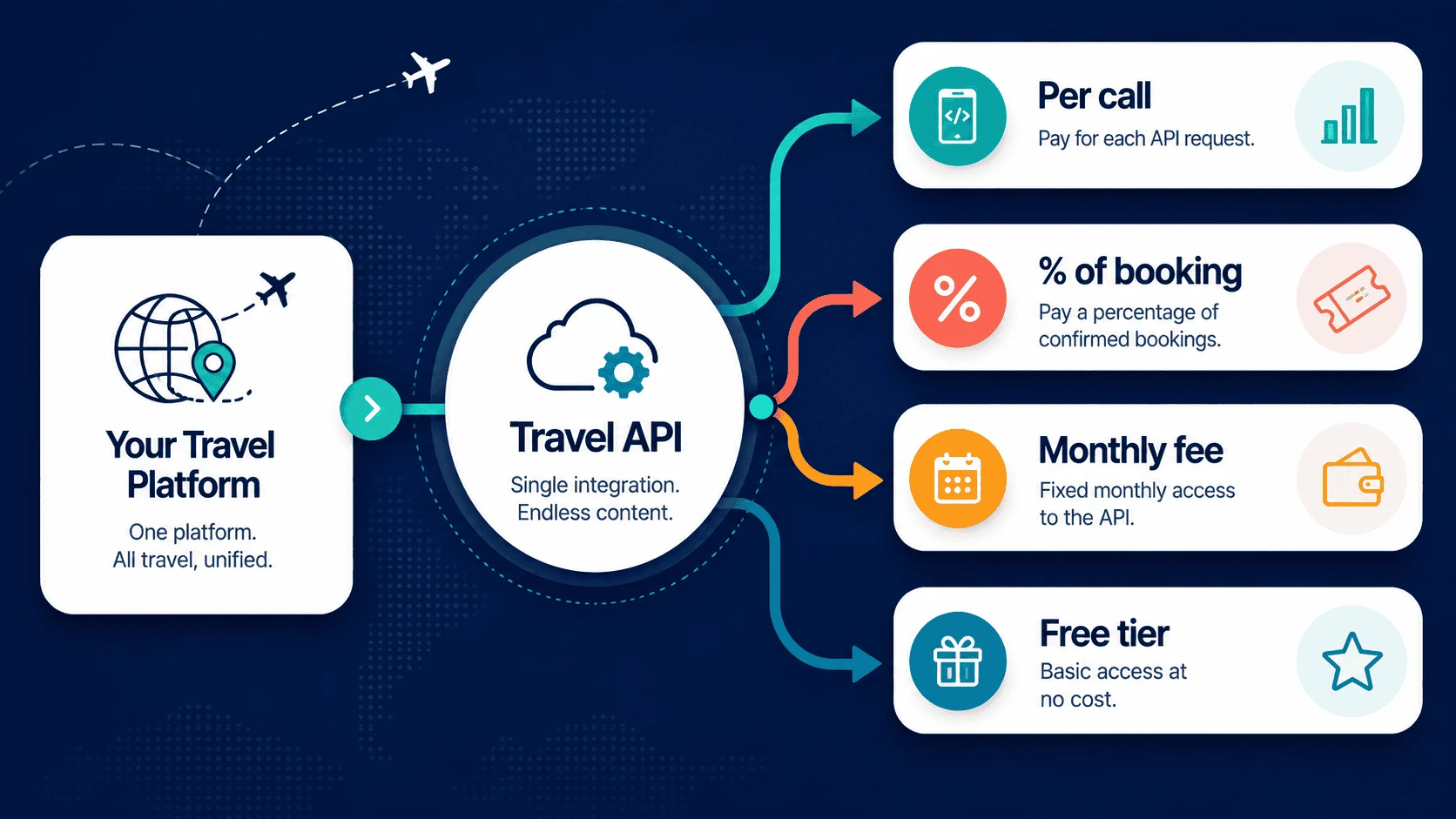
Many providers combine two or more. A common combination is a one-time setup or activation charge plus one of the usage-based models above. Some charge differently per product, for example one model for flights and another for hotels.
Per-Call (Pay-Per-Request) Pricing
In a per-call model, you pay for each API request: every search, every price check and every booking call.
How it behaves. Cost follows search volume, not sales. A platform that searches many times per booking pays for every search that does not convert. A B2B tool where each user searches with clear intent pays far less per booking than a consumer site where people browse.
Illustration. Suppose a provider charged 0.5 cents per call and your platform made 200 calls for each booking. Each booking would carry 1.00 in API fees before you earned anything, and a booking with a thin margin could lose money.
Who it fits. Platforms with low, predictable search volume and high intent, such as internal booking tools.
Who it hurts. Consumer sites with many searches per booking, and metasearch-style products that fan out queries to many suppliers. If you face per-call pricing, caching common searches and avoiding a search on every keystroke are the first levers.
Percentage Commission and Revenue Share
In a percentage model, the provider takes a share of each booking’s value, or pays you one, depending on the arrangement.
How it behaves. You pay only when you sell, which helps cash flow at launch. But the cost grows with the fare, even though the provider’s work does not. A booking that costs twice as much carries twice the fee.
Illustration. Suppose a 3% share. On a fare of 600, the fee is 18. On a fare of 1,500, it is 45, for the same booking work. A seller who moves toward premium cabins or longer trips sees its cost rise with every success.
Who it fits. Early-stage sellers with little upfront cash and modest average booking values.
Who it hurts. Sellers of high-value trips and businesses with thin margins, where a percentage takes a large share of the profit.
Subscription and Tiered Pricing
A subscription charges a fixed monthly or yearly fee, often for a set allowance of calls or bookings, with overage fees above it.
How it behaves. Easy to budget, and the unit cost falls as volume rises. But you pay the full fee in quiet months, and a new launch pays before it has customers.
Illustration. Suppose a subscription of 1,000 a month. At 100 bookings a month, that is 10 per booking; at 1,000 bookings, it is 1 per booking. The same contract is expensive early and cheap at scale.
Who it fits. Established sellers with high, steady volume. Tiers often bundle support levels and service terms, which can be worth as much as the allowance itself.
Who it hurts. Seasonal businesses with big swings, and launches that cannot forecast volume yet.
Freemium and Free Tiers
A freemium model gives a free allowance each month, then charges for usage above it or for paid tiers with more features.
How it behaves. It removes the cost of getting started and lets a team test data quality and coverage before committing. But free allowances are usually small, and the paid tiers above them follow one of the other models.
Be careful to separate a free sandbox from a free production tier. Many travel APIs give free test access but charge on every live booking. Our guide to free travel APIs compares what each free option actually allows, and where the free part ends.
Flat Fee per Booking
A flat-fee model charges a fixed amount for each booking, passenger or room night, usually on top of the supplier’s net price.
How it behaves. You pay only when you sell, and the fee does not grow with the fare. The same booking work costs the same whether the trip is cheap or expensive, so selling higher-value trips improves your margin rather than your provider’s.
Illustration. Suppose a flat fee of 4 per passenger. On a fare of 600, the fee is 4; on a fare of 1,500, it is still 4. Compare that with the 18 and 45 in the percentage example above.
Who it fits. Most OTAs, agencies and booking platforms, especially those selling a mix of fare levels or moving toward premium trips.
What to check. What counts as one transaction (a booking, a passenger, a night), and whether post-booking changes carry separate fees.
Net Rates With Your Own Markup
In a net-rate model, the provider sells you travel at a net price and you set your own selling price on top. This is how bedbanks and many B2B travel APIs work, often combined with a flat fee or a setup charge.
How it behaves. You control your margin and can price differently by market or channel. You also carry the pricing decision: set the markup too high and you lose sales, too low and you lose margin.
What to check. Whether the net price can change between search and booking, and whether the price you confirm before payment is final. A price that changes at the last step leaves you absorbing the difference.
Worked Example: One Seller, Three Models
The models only make sense against real numbers. Take an illustrative seller with 500 flight bookings a month, an average fare of 700 and 1,000 searches per booking. The numbers below are invented for the example, chosen to be easy to follow.
| Model | Illustrative rate | Monthly cost | Cost per booking |
|---|---|---|---|
| Per-call | 0.1 cent per search | 500 | 1.00 |
| Percentage | 2% of fare | 7,000 | 14.00 |
| Flat fee per passenger | 4 per passenger (one per booking) | 2,000 | 4.00 |
With these invented rates, per-call wins for this seller, because each search is cheap. Change one input and the answer changes. At 5,000 searches per booking, per-call rises to 5.00 per booking. At an average fare of 2,000, the percentage model rises to 40 per booking while the flat fee stays at 4. The lesson is not which model wins here, but that you should run this table with your own numbers and each provider’s real rates before you sign.
Pricing by Product: Flights, Hotels and Ancillaries
Providers rarely price every product the same way, because the products are sold in different units. Knowing the unit for each product prevents surprises when you add a second one.
Flights are usually charged per passenger or per segment. A return trip for a family of four can therefore count as four transactions, or eight segments, depending on the provider’s definition. Airline content adds its own layer: some airlines treat bookings through traditional GDS channels differently from bookings through their NDC channels, which can affect what reaches your price.
Hotels are usually charged per room night, as a percentage of the stay, or built into a net rate. Long stays make the unit matter: a fee per night on a ten-night stay is ten fees, while a fee per booking is one.
Activities, transfers and other ancillaries are usually charged per booking. Their values are lower, so a percentage model takes little in absolute terms, while a flat fee per booking can be a larger share of a cheap ticket. Check whether the provider prices ancillaries in the same way as flights and hotels or on a separate schedule.
Post-booking services such as voids, refunds, reissues and changes are often priced separately per ticket. For sellers with many changes, such as corporate travel, these fees can add up to more than the booking fees themselves.
Ask for the unit and the rate for every product you plan to sell in the next two years, not only the first one.
Budgeting Your First Year
A simple budget avoids the most common pricing mistake: comparing providers on the first month instead of the first year.
- Estimate monthly bookings for each product, for month one, month six and month twelve. Most launches grow, so the year is not twelve copies of month one.
- Estimate your look-to-book ratio from your own analytics, or from a sandbox test with realistic traffic.
- Estimate your average booking value per product, and how it may change as you add premium options.
- Add the one-time costs: setup or activation, and your own integration time.
- Add the recurring costs: usage fees under each model, any subscription or minimum, post-booking fees, payment processing and support time.
- Compare providers on the twelve-month total, then on the cost per booking in month twelve, which is the number that will matter most as you grow.
This takes an hour with a spreadsheet and often reverses the ranking you would get from the rate cards alone.
Costs That Do Not Appear on the Rate Card
The headline rate is only part of the bill. These costs are often missing from a first comparison:
- Setup or activation charges. A one-time charge to open the account and provision suppliers. Ask whether it is refundable and what it covers.
- Monthly minimums. A fee you pay whether or not you sell.
- Post-booking fees. Charges for voids, refunds, reissues and name changes, on top of any airline penalty.
- Search limits. A look-to-book limit in the contract, with fees or throttling if you exceed it.
- Seats and support tiers. Charges for extra API credentials, priority support or a dedicated account manager.
- Your own costs. Payment processing to collect from your customers, and the time your team spends on customer support. No provider pays these for you.
Ask every provider for a total annual cost at your expected volume with all of these included. A low per-unit rate with a high minimum can cost more than a higher rate with none.
Tripgic Pricing: The Model in Plain Terms
Tripgic is a B2B travel API for OTAs, travel agencies, TMCs and booking platforms. Its pricing page describes the model, which in plain terms is:
- One-time activation per plan. A charge paid once when you activate a plan. It covers account setup, supplier credential provisioning, sandbox and live environments, and integration support. It is not a subscription.
- No monthly subscription. Nothing recurring after activation.
- Net fares plus a flat fee per transaction. Tripgic returns supplier net fares and adds one fixed fee per transaction: per passenger for flights, per night for hotels and per booking for other products. It is never a percentage of the fare.
- Plans by product scope. Plans differ by which products they include, from extras and ground services up to the full stack of flights, hotels and everything else; train and visa can be added on request. The current plans are on the pricing page.
- Upgrade for the difference. Moving to a higher plan costs only the difference in activation charge, and the integration stays intact.
- Post-ticketing fees are published. Voids, refunds, reissues and name changes on flight tickets carry a stated per-ticket fee, separate from airline penalties.
- Test before you pay. Sandbox credentials are issued at no charge after a demo, and a Live Rate Check Panel, after an NDA, lets you compare live rates with your current suppliers before any payment.
- A prepaid wallet. The net fare plus the fee is deducted from a prepaid wallet as each booking is processed; your customers pay you, never Tripgic.
The current figures for each plan, the per-transaction fees and the post-ticketing fees are on the pricing page, because they change from time to time. For the content behind the price, see the API documentation: 73 endpoints across 8 product families.
Which Pricing Model Fits Your Business?
Use your stage and your numbers as the starting point, then model the real rates.
| Situation | Model to look for | Why |
|---|---|---|
| Testing an idea | A free sandbox or free tier | Validate data quality before paying anything |
| Launching with little cash | Usage-based: flat fee per booking or a small percentage | Pay only when you sell |
| Selling higher-value trips | Flat fee per booking | The fee does not grow with the fare |
| High searches per booking | Avoid per-call, or negotiate caching rights | Every search would otherwise cost money |
| High, steady volume | Subscription or negotiated volume rates | Unit cost falls as volume rises |
| Several products | One provider, one model across products | Fewer contracts and simpler reconciliation |
Two kinds of product need extra care. AI travel assistants can run many searches for a single conversation, as the assistant explores options on the traveller’s behalf, so their look-to-book ratio can be far higher than a normal booking site’s. Comparison and inspiration features, such as a fare calendar or a “cheapest dates” view, also generate searches that rarely book on the same visit. For both, avoid per-call pricing where you can, cache aggressively, and confirm the look-to-book limit in writing before launch. Our AI travel agent API guide covers what such a product needs from a booking API.
You can change models as you grow, but switching providers to do it means a migration. Choosing a model that still works at three times your current volume saves that later.
What to Ask Before You Sign
Pricing terms are often negotiable in the first year. These questions get the answers that matter:
- Total cost: what will I pay in a year at this many bookings, this average fare and this many searches?
- Transaction definition: is the fee per booking, per passenger, per segment or per night?
- Price certainty: is the price confirmed before payment final, or can it change?
- Search limits: what look-to-book limit applies, and what happens if I exceed it?
- Post-booking fees: what do voids, refunds, reissues and changes cost?
- Caching: may I cache search results, and for how long?
- Exit terms: what notice is needed to leave, and can I export my booking history?
Get every answer in writing. Before you sign, run through our checklist on how to choose a travel API provider, and if you are still deciding what you are buying, read what a travel API aggregator is.
Final Thoughts
Travel API pricing is a margin decision, not a line item. Per-call pricing punishes high search volume, a percentage grows with your fares, a subscription charges you in quiet months, and a flat fee per booking stays the same whatever the trip costs.
Model each option with your own look-to-book ratio, average fare and monthly volume, and add the costs that are not on the rate card. The cheapest provider on paper is often not the cheapest in your first year.
Tripgic charges a one-time activation, then the supplier’s net fare plus a flat fee per transaction, never a percentage and with no subscription. Book a kick-off call to see live rates for your market before you pay anything.