 Md Sozibul Islam
Multi-supplier travel inventory means sourcing the same kind of product — flights, hotels, transfers, activities — from several suppliers at once, and showing customers one combined set of results. It gives more choice, real price competition and resilience when one source fails. It also brings work: searching many sources quickly, merging duplicates, deciding which source to book through and keeping score of which suppliers perform. Tripgic, for example, brings GDS, NDC and 100+ low-cost carriers and 2M+ hotel properties from 50+ suppliers into one API.
This guide is about managing many suppliers well: why one is not enough, how many you need, how the search fans out and merges, how to route bookings, how to plan for failure, and how to measure suppliers. For the basic aggregator model, see what a travel API aggregator is.
Why One Supplier Is Not Enough
| Problem | What it means for your platform |
|---|---|
| Thin choice | Customers do not find the flight, hotel or date they want |
| No price competition | You show one supplier’s price, even when another is cheaper |
| Weak regions | Every supplier is stronger in some markets than others |
| Single point of failure | When the supplier is slow or down, your platform is too |
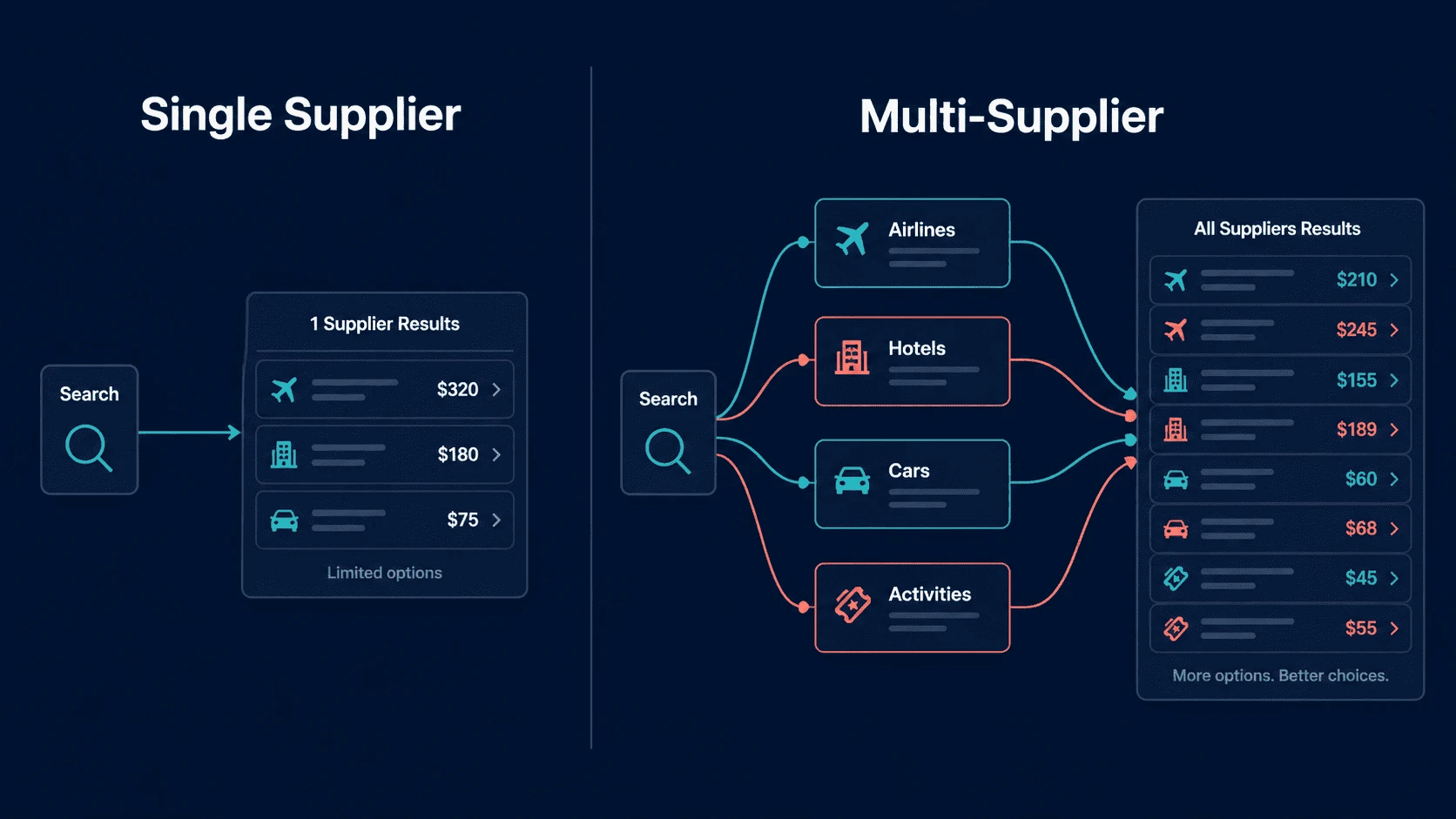
The second row is the one that hurts revenue most quietly. Customers compare prices across sites; if a cheaper source exists and you do not have it, they book elsewhere. The fourth row hurts loudly: when a single supplier has an outage during a busy evening, every search on your site returns nothing, and customers rarely come back to check whether it has recovered. Several sources turn that outage into a slightly thinner results page instead of an empty one.
Who Needs Multi-Supplier Inventory
| Business | Why several sources matter |
|---|---|
| OTAs | Customers compare prices across sites; the cheapest source wins |
| B2B portals | Agents expect every option in one place at net prices |
| Corporate tools | Policy needs the right fares, wherever they come from |
| Metasearch and comparison sites | Comparison is the product |
| Tour operators and DMCs | Packages need coverage in every destination |
| Travel apps | Users leave when the search comes back thin |
For all of them, the question is not whether to have several sources, but how many and how to manage them.
Where Multiple Suppliers Matter Most
Flights
No single source carries every airline. GDSs carry most full-service airlines, NDC carries airlines’ own offers, and many low-cost carriers sell through their own channels. A complete flight search needs all three. See NDC vs GDS and our low-cost carrier API guide.
Hotels
Hotel rates come from wholesalers, bedbanks, channel managers and chains, each with different hotels, rates and conditions. The same hotel often appears from several sources at different prices. See hotel API providers.
Transfers and activities
Ground products are highly local; one supplier is strong in one city and weak in the next. Multiple sources fill the gaps.
How Many Suppliers Do You Need?
There is no magic number. The right test is coverage on your own searches:
- List your top searches — routes, cities and dates customers actually ask for.
- Run them through each source you have or are considering.
- Measure coverage: how often each source returns a result, and how often it is the cheapest.
- Add sources until additional ones rarely add a new result or a better price.
Beyond that point, more suppliers add cost and complexity without much benefit. Through an aggregator, this test is simpler: one sandbox, many sources. Repeat the test every few months: routes, customers and supplier strength all change, and a source that added little last year may matter more now.
How a Multi-Supplier Search Works
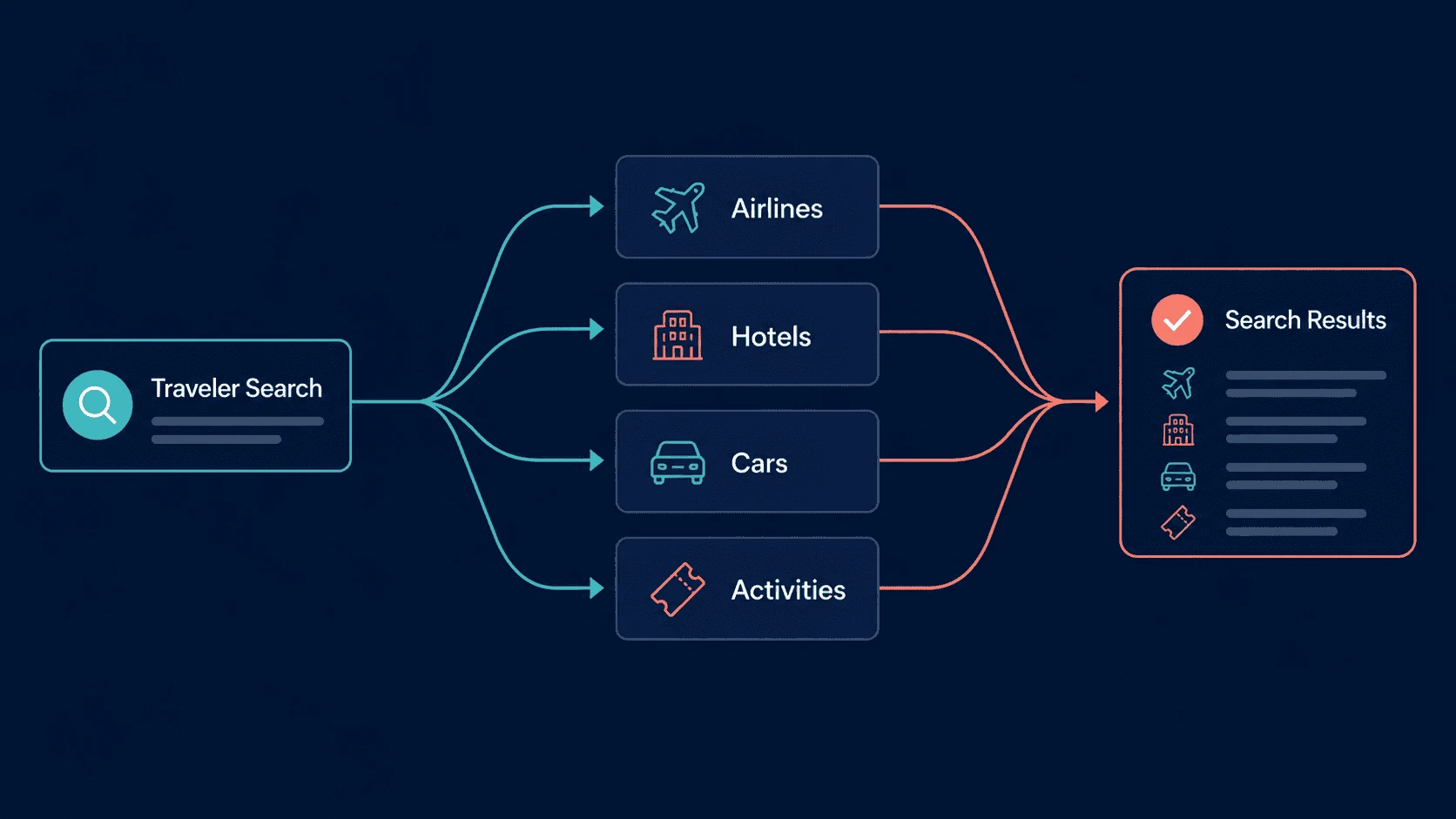
- One request comes from the customer.
- Fan out in parallel: the same search goes to every relevant source at once, not one after another.
- Time out the slow ones: sources that do not answer within your limit are left out of this result.
- Normalise: every answer is converted to one format.
- Merge duplicates: the same flight or hotel from two sources becomes one result.
- Rank: by price, relevance or your own rules.
- Return one list to the customer.
Step 3 matters more than it looks. Waiting for the slowest supplier makes every search slow. Set a time limit, show what has arrived, and decide whether late answers update the page or wait for the next search.
Merging Duplicates
The same product often arrives from several sources:
| Product | How duplicates are detected |
|---|---|
| Flights | Same airline, flight numbers, dates and times |
| Hotels | Same property by IDs, name, address and coordinates — then the same room type |
| Transfers | Same route, vehicle class and time |
| Activities | Same activity, date and time slot |
Once merged, a product should show once, with every source’s offer behind it. For hotels this is a discipline of its own; see our hotel room mapping guide. For flights across GDS sources, Tripgic’s GDS page says the same flight is returned once, at the best available price.
Price Differences Between Sources
The same flight or room often carries different prices from different sources. Common reasons:
- Net rates differ between wholesalers and channels.
- Fees and surcharges: some airlines charge more for bookings made through the traditional GDS than through NDC.
- Conditions: a cheaper rate may be non-refundable or exclude breakfast.
- Currency: suppliers price in different currencies and convert at different rates.
- Timing: one source may have updated its price more recently than another.
Compare like with like — same product, same conditions, same currency — before deciding which is cheaper. A merged result that hides different conditions behind one price creates complaints later.
Routing: Which Supplier Gets the Booking?
When a merged product is available from more than one source, someone must choose where to book it. That choice — routing — is where margin is made.
| Routing factor | Why it matters |
|---|---|
| Price to the customer | The lowest price wins the click |
| Your margin | Net rates differ; the cheapest price is not always your best margin |
| Reliability | A supplier with failed bookings costs more than it saves |
| Conditions | Better cancellation terms or included extras can justify a higher price |
| Contracts | Volume commitments and incentives with certain suppliers |
| Servicing | How easily changes and refunds are handled |
A common rule set: show the lowest price; among equal prices, book the source with the best margin; exclude sources whose recent failure rate is above a threshold; honour contract targets where they apply.
Caching With Many Suppliers
Caching saves time and search costs, but with many sources it needs clear rules:
- Cache static content — hotel descriptions, images, airport and city data — and refresh it on a schedule.
- Do not treat cached prices as final. A cached price can show a “from” figure; the price check must be live.
- Watch look-to-book limits. Every search sent to many sources counts against each supplier’s limits; caching static data and avoiding duplicate searches keeps you inside them.
- Expire search results quickly. Results older than a few minutes should be refreshed before a customer acts on them.
Good caching makes a multi-supplier platform feel fast without letting stale prices reach checkout. The rule to remember is simple: cache what describes the product, never what you are about to charge for it.
Fallback: Planning for Supplier Failure
Suppliers fail: slow responses, outages, failed bookings, price changes at the last step. Multi-supplier inventory lets you plan for it:
- At search: a slow or failed source simply drops out; others still return results.
- At price check: if the chosen source’s price has changed or the product is gone, offer the same product from another source if available.
- At booking: if booking fails, check whether it actually succeeded before trying another source — never book twice.
- Afterwards: record the failure against the supplier and feed it into routing.
This is the resilience that single-supplier platforms lack: one supplier’s bad day does not become yours. It does need clear rules, written in advance, for when to switch source and when to stop and ask the customer — especially at the booking step, where money has already been taken. A good default is to offer the alternative to the customer with its price and conditions, rather than switching silently.
Normalisation: One Format for Many Sources
Every supplier describes its products differently — field names, codes, currencies, baggage, rate conditions. Normalisation turns them into one structure your platform understands:
| Area | What must be normalised |
|---|---|
| Identifiers | Your own IDs mapped to each supplier’s |
| Prices and currencies | One currency for comparison, original kept for settlement |
| Conditions | Refundability, change rules, cancellation deadlines |
| Content | Names, descriptions, images, amenities |
| Status codes | Booked, ticketed, cancelled — one set of meanings |
| Errors | One error message per kind of problem |
Normalising directly connected suppliers is a large, ongoing job. An aggregator does it once for all its sources; Tripgic’s Hotel API page, for example, describes hotel responses as “the same shape regardless of which underlying supplier fulfilled it”.
Choosing the Best Content
When several suppliers describe the same hotel or activity, you can choose the best content for each part:
- Photos: the most and highest-quality images, from any source.
- Descriptions: the fullest and clearest text, in the customer’s language.
- Amenities: the most complete list, checked for contradictions.
- Location: the most precise coordinates.
Keep each supplier’s own content available to support staff, because a booking’s details come from the supplier it was booked through.
Settlement and Reconciliation
Every supplier sends its own invoices, statements or deductions. With many suppliers, finance needs:
- One booking record with the source and the cost for each component.
- Daily reconciliation at first, then weekly, against each supplier’s statement.
- Refund tracking across sources, since refunds arrive at different speeds.
- Currency handling for suppliers that bill in different currencies.
Through one aggregator, most of this collapses into one statement — one of the less obvious reasons platforms choose that route.
Costs of Adding Suppliers
| Cost | How it grows |
|---|---|
| Integration and certification | Per directly connected supplier |
| Search load | Every search goes to more sources; look-to-book limits may apply |
| Latency | More sources can mean slower searches without parallel calls and timeouts |
| Mapping and merging | More sources, more duplicates to manage |
| Servicing | Each supplier’s change and refund rules |
| Contracts and settlement | Per supplier, unless one aggregator covers many |
The aim is the smallest set of sources that gives your customers the coverage and prices they expect — not the largest possible list.
Servicing Bookings From Many Suppliers
After the sale, each booking stays with the supplier it was made through. That shapes support:
- Store the source with every booking, with the supplier’s own reference and rules.
- Route changes and cancellations to the same source; a booking cannot move between suppliers.
- Show support one view of the booking, whatever its source, with the original supplier details one click away.
- Track servicing performance by supplier: how long refunds take, how often changes fail.
A platform with many direct suppliers needs servicing knowledge for each. Through one aggregator, servicing follows one set of calls, even when the supplier behind each booking differs.
Multi-Supplier Data for AI Assistants and Apps
AI travel assistants and app builders depend on consistent data even more than websites do:
- One format keeps an assistant’s tools small and its answers reliable.
- Merged results stop it presenting the same hotel twice as two options.
- Clear conditions let it explain what each fare or rate includes.
- Final prices at validation let it quote a price it can actually book.
For more, see our AI travel agent API guide.
Measuring Suppliers: A Scorecard
| Measure | What it tells you |
|---|---|
| Coverage | Share of searches where the supplier returns results |
| Price leadership | Share of merged results where it is the cheapest |
| Response time | Whether it slows your searches |
| Price-check failures | How often its search prices change before booking |
| Booking failures | How reliable its booking step is |
| Servicing time | How quickly changes and refunds are completed |
| Margin | What you earn per booking through it |
Review the scorecard monthly. It tells you which suppliers to favour in routing, which to renegotiate with and which to drop. Share it with your account managers at each supplier; numbers make commercial conversations shorter.
A Worked Example: One Hotel, Three Sources
A customer searches for a hotel in Dubai for three nights.
- The search fans out to three hotel sources in parallel; one answers slowly and is cut off at the time limit.
- Two sources return the same hotel, which is merged into one result with both offers behind it.
- Both sell the same room with the same refundable conditions, at slightly different prices.
- Routing picks the lower price, which also has the better margin and a clean reliability record.
- At the price check, the chosen source confirms the price; booking succeeds.
- Had the price check failed, the platform would have offered the same room from the second source.
The customer saw one hotel, one room, one price — and never knew three suppliers were involved. That invisibility is the goal: the complexity stays in your platform, and the customer sees only a clean choice and a booking that works.
Direct Connections vs One Aggregator
| Many direct connections | One aggregator | |
|---|---|---|
| Integrations | One per supplier | One |
| Normalisation | Yours to build and maintain | Done by the aggregator |
| Merging | Yours | Often done for you, at least in part |
| Routing control | Full | Within the aggregator’s offers, plus your own rules |
| Best for | Very large platforms with integration teams | Most OTAs, B2B portals and startups |
Many platforms combine both: an aggregator for breadth, plus a few direct suppliers where volume or special rates justify it — merged and routed in one layer. See build vs buy a travel API.
Adding a New Supplier: A Checklist
| Step | Question to answer |
|---|---|
| Coverage | Does it add results or better prices on our top searches? |
| Data | Can its content be normalised and merged with what we have? |
| Speed | Does it answer within our search time limit? |
| Reliability | What are its price-check and booking failure rates in testing? |
| Servicing | Can changes and refunds be handled through the API? |
| Commercials | Net rates, fees, minimums and settlement terms |
| Routing | Where does it fit in our routing rules? |
If a new supplier does not improve the scorecard, it is adding cost rather than value. Remove it, or keep it only as a fallback.
Common Mistakes With Multi-Supplier Inventory
- Querying suppliers one after another. Search in parallel, with timeouts.
- Showing duplicates. Merge before you show.
- Routing by speed. The first answer is not the best offer.
- Ignoring reliability. A cheap supplier that fails often costs more than it saves.
- Adding suppliers without measuring. Each one should earn its place on the scorecard.
- Retrying a failed booking elsewhere without checking. Confirm the first booking did not succeed.
How Tripgic Provides Multi-Supplier Inventory
Tripgic is a B2B travel API aggregator. From its own pages:
- Flights from every channel. Amadeus, Sabre and Travelport, NDC and 100+ low-cost carriers — 800+ airline and LCC connections — with the same flight across GDS sources returned once at the best available price, per its GDS page.
- Hotels from many partners. 2M+ properties from 50+ supply partners in 190+ countries, normalised into one response.
- The rest of the trip. Transfers, activities, tour packages, trains, eSIM and visas: 8 product families over 73 endpoints in the API docs.
- One schema and envelope for every product, so your merging and routing code handles one pattern.
- Final prices, flat fee. Prices at validation and booking are final; a flat amount per transaction, never a percentage; figures on the pricing page.
- Test first. A free sandbox after a short call; run the coverage test above on your own searches.
Final Thoughts
Multi-supplier inventory turns a platform’s weakest point — dependence on one source — into a strength: more choice, real price competition and resilience. The work is in managing it: parallel searching, normalising, merging, routing and measuring.
Start with the coverage test on your own searches, add sources until they stop adding value, and let a scorecard — not habit — decide which suppliers get your bookings. Review it every month, because suppliers change faster than contracts do.
Want many suppliers through one API? Book a demo and get Tripgic sandbox credentials after a short call.