 Akhirul Islam
A low-cost carrier API connects your booking platform to budget airlines, so you can search their fares, add bags and seats, book and confirm — including airlines that sell little or nothing through the GDS. Without one, the cheapest flights on many routes never appear on your site. Tripgic’s LCC API, for example, returns 100+ low-cost carriers — from easyJet and Wizz Air to IndiGo, AirAsia and flydubai — in the same search as GDS and NDC fares.
This guide explains why low-cost carriers are hard to reach, how their fares and extras differ from full-service airlines, how an LCC booking flows, what goes wrong, how to test, and how to choose a provider. It ends with what Tripgic’s own pages state about its LCC coverage.
What Is a Low-Cost Carrier API?
A low-cost carrier is an airline built around a low base fare and simple operations, earning much of its revenue from extras such as checked bags, seats and priority boarding. An LCC API — sometimes called an LCC flight API — is the software connection that lets a travel platform:
- Search an LCC’s flights and fares for a route and date.
- Price extras: bags, seats, meals, priority boarding.
- Book and receive a confirmation, usually issued at once.
- Retrieve and service the booking within the airline’s rules.
Some LCCs offer their own APIs or agent portals; others reach travel sellers through aggregators. Either way, the result for your platform should be the same: LCC fares in your search, next to full-service ones.
Why Low-Cost Carriers Are Hard to Reach
Three things make LCC content harder to get than full-service content:
- Many sell outside the GDS. The low-cost model keeps distribution costs down, so many LCCs sell mainly through their own websites and APIs rather than the GDS.
- Every airline is different. There is no shared standard across LCCs the way NDC standardises airline-direct content. Each airline’s API, data and rules differ.
- Extras are the business. Fares are only half the price; bags, seats and services must be priced and booked correctly, or the traveller pays more at the airport.
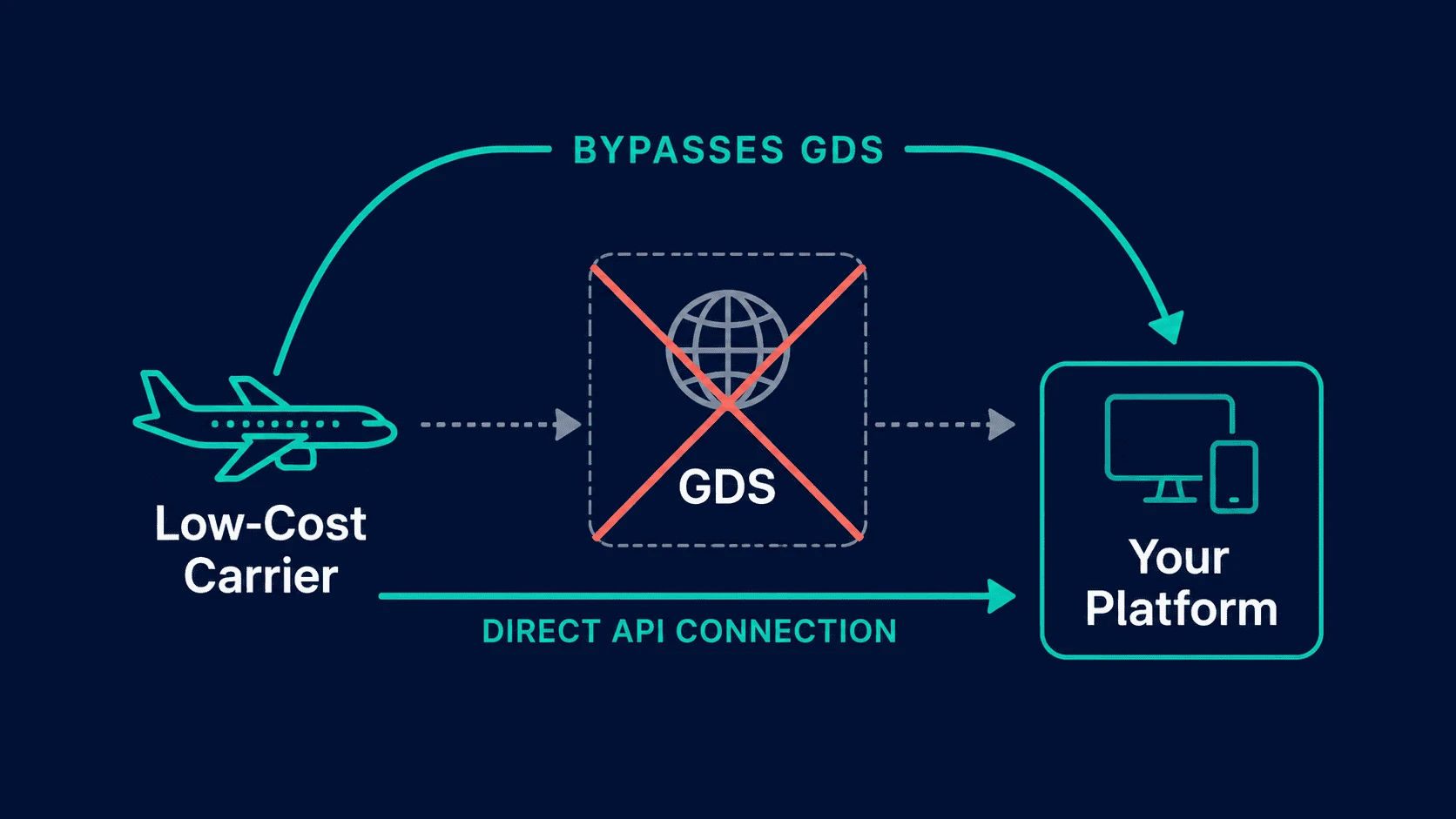
The result: a platform that connects only to a GDS sees the full-service airlines clearly and much of the low-cost market dimly or not at all. On short-haul routes in Europe, Asia and the Middle East, that is often where the cheapest fares are.
Why You Need LCC Content
- Price comparison. On many short and medium routes, the lowest fare is an LCC fare. Without it, your prices look high.
- Regional markets. In India, Southeast Asia, Europe and the Gulf, low-cost carriers carry a large share of domestic and regional travel.
- Diaspora and worker travel. Corridors such as South Asia to the Gulf are served heavily by low-cost airlines.
- Customer trust. Travellers know what budget airlines charge. A site that never shows those fares loses credibility fast.
For a platform that competes on price, LCC content is not an extra. It is what the comparison is made of. It also brings new customers: travellers who search for the cheapest way between two cities often start with a budget airline in mind, and a platform that shows those fares — honestly priced — earns their next booking too, including the hotel and the transfer that go with it.
How LCC Fares Differ From Full-Service Fares
| Full-service fare | Low-cost fare | |
|---|---|---|
| Base fare | Often includes a checked bag and a meal | Usually seat only, with a cabin bag |
| Checked bags | Often included | Usually paid, priced by weight or piece |
| Seat selection | Often free or part of the fare family | Usually paid |
| Changes and refunds | Rules vary by fare family | Usually strict; changes for a fee, refunds rare |
| Connections | Through-tickets with protection | Often point-to-point; separate bookings have no protection |
| Ticketing | Booking, then ticketing before a time limit | Usually confirmed and paid at once |
| Distribution | GDS and NDC | Often the airline’s own channel |
These differences shape your interface. A low-cost fare that looks cheaper without a bag may cost more than a full-service fare once a bag is added. Show the total for what the traveller needs, not just the headline.
How an LCC Booking Works
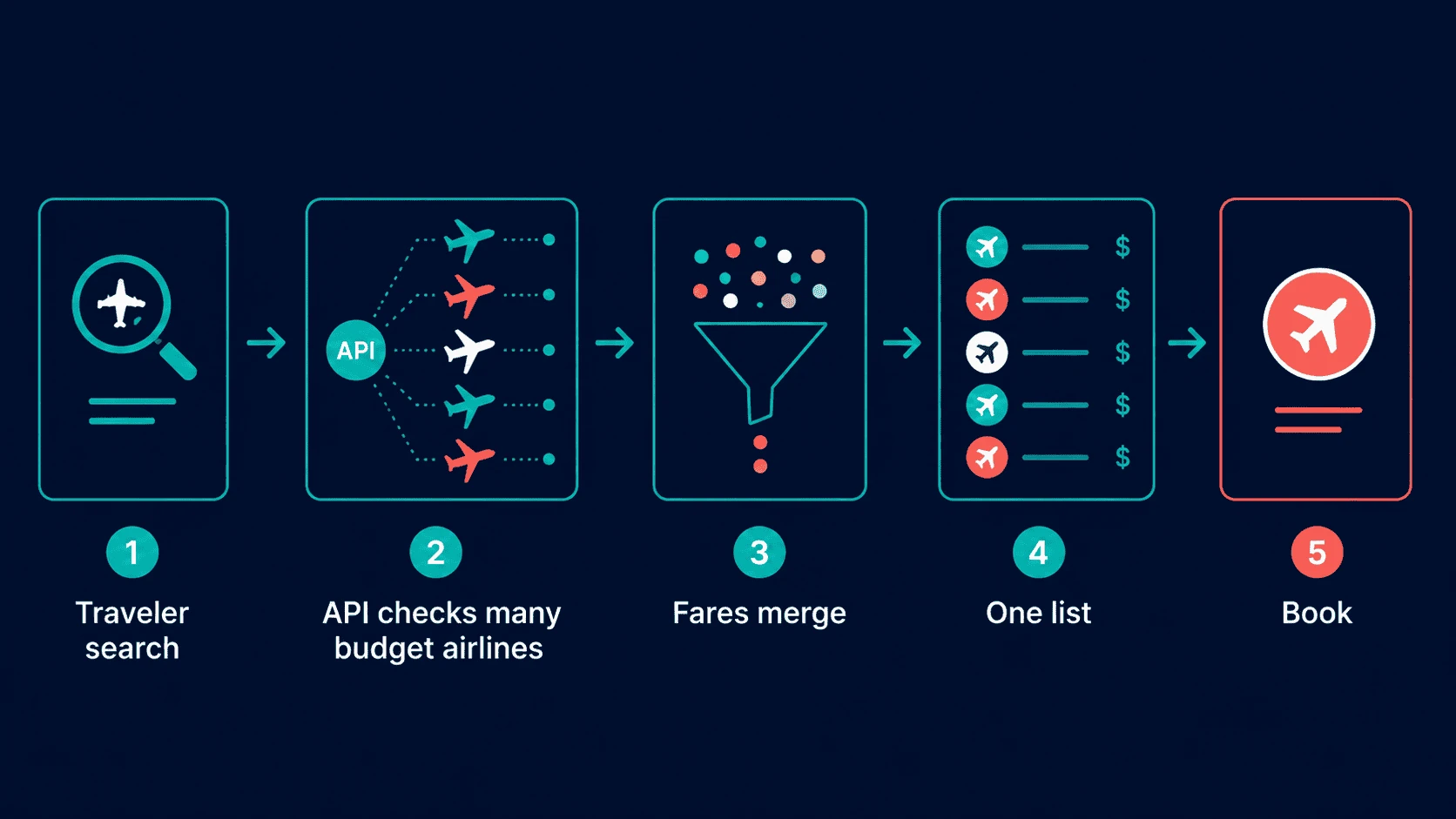
- Search. Your platform sends route, dates and passengers. Through an aggregator, many LCCs are searched at once.
- Results. Fares come back with what each includes — usually a cabin bag only.
- Extras. You request bag, seat and meal options and their prices for the chosen flight.
- Price check. The fare and extras are re-confirmed before payment, because LCC prices move fast.
- Book and pay. The booking is created and usually confirmed at once; payment is final.
- Confirmation. The traveller receives a booking reference and itinerary, often with check-in instructions.
- After the sale. Changes, if allowed, follow the airline’s paid rules; refunds are rare except when the airline cancels.
The biggest difference from a full-service booking is step 5: there is often no hold. A full-service booking can sit unpaid until its ticketing time limit; a low-cost booking usually cannot. Make sure the price and extras are final before you take the customer’s money.
A Worked Example: A Family Trip on a Short-Haul Route
A family of four — two adults and two children — searches a two-hour route within Europe for a week’s holiday. They need two checked bags and want to sit together.
- The search returns a full-service fare with one checked bag per person included, and a low-cost fare that looks much cheaper with cabin bags only.
- The extras step prices two checked bags and four seats together on the low-cost flight.
- The comparison now shows the real totals side by side: the low-cost fare plus bags and seats, against the full-service fare with its included bags. Sometimes the low-cost option is still cheaper; sometimes it is not.
- The family chooses with the full picture, books, and receives a confirmation at once.
- Two weeks later, one child is ill. The low-cost fare allows a date change for a fee but no refund; the family sees the fee before deciding.
A platform that showed only the headline fares would have sold the low-cost option every time — and taken the complaint at the airport. Showing the total for what the traveller needs is the whole difference.
LCC Coverage by Region
Low-cost carriers are regional by nature. The list on Tripgic’s LCC page shows how varied they are:
| Region | Examples from Tripgic’s LCC list |
|---|---|
| Europe | easyJet, Wizz Air, Vueling, Norwegian, Transavia, Volotea, Jet2, Eurowings, Condor, airBaltic, SunExpress, Pegasus Airlines |
| South Asia | IndiGo, Air India Express, Akasa Air, SpiceJet |
| Southeast and East Asia | AirAsia, AirAsia X, Scoot, VietJet Air, Cebu Pacific, Lion Air, Batik Air, Jeju Air, Peach Aviation, Jin Air |
| Middle East | flydubai, Air Arabia, Air Arabia Abu Dhabi, flynas, Jazeera Airways, SalamAir |
| Americas | Frontier Airlines, Spirit Airlines, Allegiant Air, Sun Country, Flair Airlines, JetSMART |
| Africa | FlySafair, Air Arabia Egypt |
Coverage matters per route, not per region. Before you choose a provider, search your own busiest routes and see which low-cost carriers actually appear. Note the ones you expected but did not find, and ask the provider about them directly.
Long-Haul and Hybrid Low-Cost Airlines
Not every low-cost airline is short-haul. Tripgic’s list includes long-haul low-cost carriers such as AirAsia X, Scoot and Norse Atlantic, and airlines such as flydubai that mix a low-cost model with fare families and a business cabin.
These sit between the two models:
- Fare families may include bags and seat selection on higher tiers, like a full-service airline.
- Long flights make extras — meals, blankets, seats with more space — a bigger part of the price.
- Connections may be offered on one booking on some routes, and as separate bookings on others.
Treat them as low-cost in your data — extras priced separately unless the fare says otherwise — and show their fare families clearly, as you would for an NDC offer. On a ten-hour flight, that clarity matters even more.
LCCs on the Corridors That Matter
Some of the busiest travel corridors in the world are dominated by low-cost airlines:
- South Asia to the Gulf. IndiGo, Air India Express and Akasa Air compete with Gulf carriers such as flydubai and Air Arabia on routes used by millions of workers and families.
- Within India and Southeast Asia. Domestic and regional flying is largely low-cost, with IndiGo, AirAsia, Cebu Pacific, VietJet Air and Lion Air among the largest operators.
- Within Europe. easyJet, Wizz Air, Vueling, Transavia and others carry much of the leisure travel between European cities.
- Within the Gulf and North Africa. flynas, Jazeera Airways, SalamAir and the Air Arabia group serve regional routes.
A platform selling on any of these corridors without low-cost content is missing the fares its customers compare first. For the Gulf in particular, see our Middle East travel API guide.
Direct Connections vs an Aggregator
| Direct to each LCC | Through an aggregator | |
|---|---|---|
| Integrations | One per airline | One |
| Formats | Different for each airline | One normalized format |
| Agreements | One per airline, where offered | One |
| Combining with GDS and NDC | Your job | Usually done for you |
| Maintenance | Each airline’s changes are yours | Mostly the aggregator’s |
| Best for | A seller focused on a few airlines | Most OTAs, agencies and B2B platforms |
A few airlines also offer NDC or agent portals — Tripgic’s flydubai NDC guide describes flydubai’s NDC channel alongside a direct-connect API and a registered travel agent portal. That variety is exactly why most platforms connect through one aggregator rather than one airline at a time. For the wider model, see what a travel API aggregator is.
Mixing LCC and Full-Service Fares in One Search
Showing budget and full-service fares side by side is where many platforms struggle:
- Normalise the baggage. Turn every fare’s bag allowance into one field so “1 checked bag included” and “bag from an extra fee” sit in the same column.
- Show the total for the traveller’s needs. If the traveller says they need a checked bag, price it into every result.
- Label self-transfer journeys. Two separate low-cost bookings on one trip have no protection if the first flight is late. Say so clearly.
- Merge duplicates. The same flight can arrive from more than one source; show it once.
- Explain the rules. LCC change and refund rules are strict. Put them next to the price, not on a later page.
Done well, a mixed search — budget and full-service fares compared on equal terms — is the strongest results page a travel platform can offer. Done badly, it is the main source of complaints.
Selling LCC Fares to Travel Agents
B2B portals and wholesalers sell low-cost fares to agents, not travellers, and that changes a few things:
- Net fares and markups. Agents add their own margin; your portal needs a clear net price for each fare and extra.
- Service fees. Many agencies charge a booking fee on low-cost fares, which carry little or no commission.
- Instant payment. Because LCC bookings are usually paid at once, agents need a deposit or credit with you to book without delay.
- Clear rules. Agents must be able to tell their customers exactly what a fare includes and what changes cost.
See our B2B travel platform guide for how portals handle pricing and agent credit.
After the Sale: Servicing LCC Bookings
Low-cost bookings generate their own kind of support work:
| Request | What usually applies |
|---|---|
| Date change | Allowed on many fares for a fee plus any fare difference |
| Name correction | Often a fee; some airlines allow small corrections only |
| Cancellation by the traveller | Usually no refund except taxes on some airlines |
| Cancellation by the airline | Refund or rebooking under the airline’s policy |
| Adding bags or seats later | Usually possible, often at a higher price than at booking |
Store the rules returned with each booking, show them in the confirmation, and give your support team one view of the booking and its rules. Most LCC complaints come from rules the traveller never saw.
Common LCC Integration Problems
| Problem | What happens | How to avoid it |
|---|---|---|
| Headline fare without bags | Traveller pays much more at the airport | Price bags into the search when needed |
| Prices move between search and payment | Booking fails or costs more | Re-check price and extras before payment |
| No hold | Payment and booking happen together | Take payment only after the final price check |
| Name errors | Name changes are expensive or impossible | Validate names against passports before booking |
| Self-transfer connections | Missed second flight, no protection | Label clearly; consider minimum connection times |
| Schedule changes | Airline moves or cancels a flight | Notify travellers and handle the airline’s options |
| Different rules per airline | Support gives wrong answers | Store the rules returned with each booking |
How to Test an LCC API
- Search your top routes and list which LCCs appear and which do not.
- Add every kind of extra — bags, seats, priority boarding — and check the totals.
- Book adults, children and infants, since LCC rules for each differ.
- Change and cancel a test booking and compare the result with the airline’s rules.
- Mix sources: search a route served by both an LCC and a full-service airline, and check the results compare fairly.
- Force a price change and confirm your flow shows the new price before payment.
Measuring Whether Your LCC Content Works
Once you are live, five numbers show whether low-cost content is doing its job:
| Measure | What it tells you |
|---|---|
| Searches with at least one LCC result | Whether your coverage matches the routes customers search |
| Share of bookings on LCCs | Whether customers are finding and choosing budget fares |
| Extras per LCC booking | Whether bags and seats are sold at booking, not at the airport |
| Price-check failures on LCC fares | How often prices move before payment |
| Support contacts per LCC booking | Whether rules and extras are clear enough |
Track them by route and airline. A low-cost carrier that disappears from results, or a jump in support contacts, usually points to a change upstream worth raising with your provider at once.
How to Choose an LCC API Provider
| Question | What a good answer looks like |
|---|---|
| Which low-cost carriers do you connect, by name? | A published list you can check against your routes |
| Are extras — bags, seats, meals — bookable through the API? | Yes, as priced options before booking |
| Are LCC fares in the same search as GDS and NDC fares? | Yes, in one normalized response |
| How are prices confirmed before payment? | A validation step that returns the final price |
| What happens on schedule changes and cancellations? | A clear process and notification |
| How do you charge per booking? | A stated model — percentage or flat fee |
For the wider flight picture, see our flight booking API guide, and for regional detail, the Middle East travel API guide.
How Tripgic Gives You Low-Cost Carriers
Tripgic is a B2B travel API aggregator. For low-cost content, here is what its own pages state:
- 100+ low-cost carriers. Its LCC page lists them by name, with regions and route counts, from easyJet, Wizz Air and Vueling to IndiGo, AirAsia, Scoot, flydubai, Air Arabia, Frontier and JetSMART.
- One search with GDS and NDC. LCC fares sit beside Amadeus, Sabre and Travelport content and airline NDC offers — 800+ airline and LCC connections in total — with duplicate flights across GDS sources returned once, per its GDS page.
- Extras through the API. Baggage, seat and meal options are their own calls among the fifteen flight endpoints in the API docs, alongside validation, booking, ticketing and cancellation.
- Final prices. Prices at validation and booking are final: the supplier net fare plus a flat Tripgic fee per passenger, never a percentage, with figures on the pricing page.
- Test first. A free sandbox after a short call; activation for live use usually takes 3–5 business days.
Final Thoughts
Low-cost carriers carry a large share of the world’s short and medium-haul travel, and many of them are invisible to a GDS-only platform. Adding them means more than another connection: their fares, extras and rules work differently, and your search, checkout and support must reflect that.
Connect through one API that already carries them beside GDS and NDC fares, show the real total for what each traveller needs, and test your own routes before you choose. The platforms that win on price are rarely the ones with the lowest headline fare; they are the ones whose totals hold true all the way to the airport.
Want low-cost and full-service fares in one search? Book a demo and get Tripgic sandbox credentials after a short call.