
 Akhirul Islam
Developers keep searching for the “Google Flights API” — a way to pull flight prices, times, and availability straight from Google. But there is a catch that most search results bury: Google shut down its public flights API back in 2018. The only public flight-related API Google offers today calculates carbon emissions, not fares.
That leaves a lot of confusion. Some pages sell you a “Google Flights API” that is really a web scraper. Others point you to Google programs that work the opposite way from what you expect. This guide clears it up: what the API was, why it ended, what still exists from Google, and — most importantly — the real options for a platform that needs to actually search and book flights.
Does Google have a Flights API in 2026?
No. There is no public Google Flights API for searching or booking flights. Google retired its developer-facing flight API (QPX Express) in 2018. The only publicly available flight API from Google now is the Travel Impact Model API, which returns carbon emission estimates — the same figures you see on Google Flights — and nothing about fares or booking.
An enterprise version of the original technology (QPX / ITA Software) still exists, but it is contract-only, aimed at large travel companies with direct commercial agreements and significant budgets. For the vast majority of developers and travel businesses, it is not an option you can simply sign up for.
So if your goal is to add flight search or booking to a website or app, the honest answer is: you will not do it with a Google API. You will use one of the alternatives further down this page.
What was the Google Flights API?
The story starts in 2010. Google acquired ITA Software, a well-known flight-information company, for roughly $700 million. ITA was famous for two products: QPX, an enterprise search-and-pricing engine, and the ITA Matrix, a public fare-search tool that is still online today.
The acquisition drew attention from the US Department of Justice over antitrust concerns — the worry was that Google could lock competitors out of flight data. As a condition of approval, Google was required to keep giving competitors and customers access to that data for at least five years.
A few years later, Google launched QPX Express — a simplified, developer-friendly version of QPX. This is the product almost everyone means when they say “the Google Flights API.” It let developers pull aggregated airline data: flight times, availability, and prices, with filters for dates, routes, airlines, and more. Pricing was accessible for smaller players: the first 50 queries per day were free, then roughly $0.035 per query (later reduced to about $0.02).
Why Google shut it down in 2018
In 2018, Google closed QPX Express and gave clients six months’ notice. Two things drove the decision.
First, the five-year antitrust obligation from the ITA acquisition had expired. Google was no longer required to keep the public API open.
Second — and this is the part Google downplayed — the company had its own consumer product to protect. Google Flights had become a major way people search for flights. An open API that fed the same data to competing travel sites worked directly against Google’s interest in keeping that traffic (and the resulting ad and referral revenue) on its own pages. Google officially cited low interest among travel partners, but the strategic logic is hard to miss.
This pattern is not unique to Google. Big flight-data providers change or close their public programs regularly, which is why so many travel businesses end up needing a migration plan. Amadeus, for example, has pushed teams through a similar shift — we cover that in our guide to Amadeus self-service API alternatives.
What Google offers now
Google still touches flights in three ways — but none of them is the “pull flights into my app” API most people are looking for.
- Google Flights (the consumer app): excellent for a human comparing fares, but it cannot be integrated into your product. Every search and click sends the traffic — and the potential sale — to Google, not to you.
- Travel Impact Model API: free and public, but it only returns carbon emission estimates. Useful if you are building eco-conscious travel features; useless as a fare or booking source.
- Google Flights Search (GFS) partner program: this one causes real confusion. Google’s Flights Search documentation looks like an API, but GFS works in the opposite direction — airlines and online travel agencies feed their fares to Google so they appear in Google Flights. It is a distribution channel into Google, not a data feed you pull from Google.
“Google Flights API” alternatives — three different things
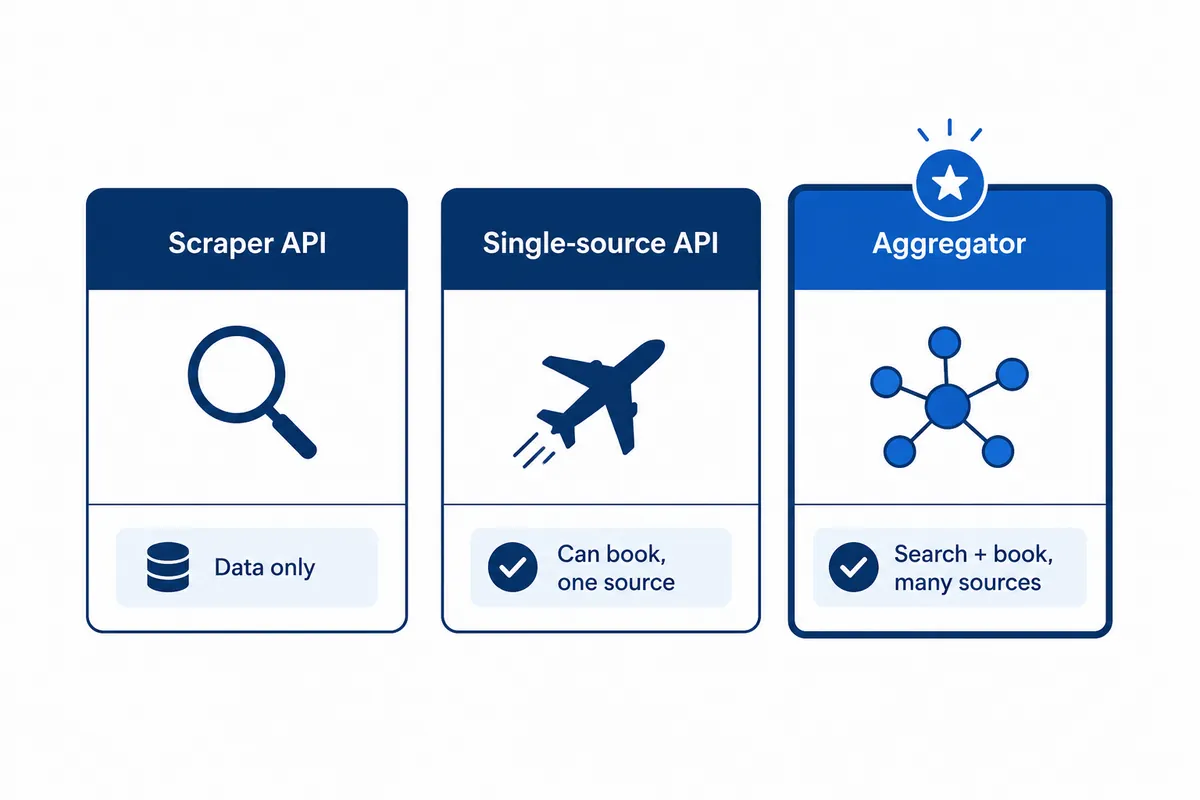
Here is where most articles go wrong. They lump every option under “alternatives” without saying that these are fundamentally different products. Before you pick one, understand which of these three you actually need.
1. Scraper APIs (data only)
Services like SerpApi, Apify, RapidAPI, and SearchApi sell what they call a “Google Flights API.” In reality, they scrape the results Google displays and return them as structured JSON. They are handy for one narrow job: monitoring prices or gathering data for research.
But they carry real limits. They cannot book anything — they only read what is on screen. They live in a terms-of-service and legal grey area, because they extract data from a page you do not own. And they break whenever Google changes its layout. For a serious booking product, a scraper is the wrong foundation.
2. Single-source booking APIs
Providers like Duffel, or a single airline’s own NDC connection, let you actually search and book real flights. This is a genuine step up from scraping. The trade-off is scope: you are connected to one pipeline. If you need broad coverage, you integrate and maintain each source yourself — one contract, one integration, one set of quirks at a time.
3. Multi-supplier aggregators
An aggregator gives you search and booking across many suppliers — GDS content, airline NDC, low-cost carriers, and consolidator fares — through one integration and one booking flow. Instead of stitching together several APIs and normalizing their data yourself, you get a single, consistent result set. This is the category Tripgic sits in.
| Option | Can book? | Sources | Legal footing | Best for |
|---|---|---|---|---|
| Scraper API | No | Google’s displayed data | Grey area (ToS) | Price monitoring, research |
| Single-source booking API | Yes | One pipeline | Solid | Narrow or single-supplier needs |
| Multi-supplier aggregator | Yes | Many (GDS + NDC + LCC + consolidator) | Solid | OTAs and platforms that book at scale |
Which one does your platform need?
Match the tool to the job:
- Just tracking prices or doing market research? A scraper API is the cheapest path — as long as you accept the terms-of-service risk and the fact that you cannot book.
- Selling from a single or narrow source? A single-source booking API is enough.
- Running an OTA, booking engine, or travel platform that must search and book at scale? A multi-supplier aggregator saves you from building and maintaining a dozen separate integrations.
If you are still deciding between building on a raw GDS connection versus a modern API, our comparison of travel API vs GDS breaks down the trade-offs, and what a GDS is covers the older distribution layer. For a broader shortlist, see our guide to the best travel API in 2026.
How a real flight booking API works
Unlike a scraper that just reads a page, a real booking API follows a clear sequence:
- Search — you send an offer request (who is travelling, where, and when).
- Select — the API returns offers; you pick one.
- Order — you create an order (a PNR) with passenger details.
- Ticket — the booking is confirmed and ticketed.
Most modern APIs use REST with JSON responses, so a few lines of code get you from search to booking. The difference an aggregator makes is what happens behind that flow: it pulls content from many suppliers, normalizes it into one search result, and handles a single booking path regardless of which supplier the fare came from. Without that, your team writes and maintains separate logic for each source — the same infrastructure problem we describe in our guide to travel booking software.
What travel businesses use flight data for
Once you have a reliable flight API, the same data feed powers several parts of a travel business:
- Flight and booking search: the core use — let customers find and book flights inside your own product instead of sending them to Google or an OTA.
- Dynamic pricing: real-time fares let you react to demand and competitor moves instead of relying on static prices.
- Packaging: combine flights with hotels, transfers, or activities to sell higher-value bundles. (An aggregator that also carries those products makes this far simpler — see our note on how consolidator fares reach a platform.)
- Revenue and demand analysis: historical and live fare data helps forecast peak periods and manage margins.
- Market research: route, price, and availability trends inform which markets to enter or expand.
Notice that all but the last one require booking, not just data — which is why a scraper falls short for most real products.
The bottom line
The public Google Flights API has been gone since 2018, and it is not coming back — an open API works against Google’s own consumer product. What remains from Google is an emissions API and a partner program that feeds data to Google, not from it. The “Google Flights APIs” you see advertised are mostly scrapers that read data but cannot book.
If all you need is flight data for research, a scraper may do. But if you are building a product that has to search and book real flights — especially from more than one supplier — you need a genuine booking API, and ideally an aggregator that gives you broad coverage through a single integration.
That is exactly what Tripgic provides: one API to search and book flights (and hotels, activities, transfers, and more) across many suppliers. Book a demo to see how it fits your platform.



 Mehedi Ahsan Ashif