 Golam Shahrier
NDC stands for New Distribution Capability. It is an XML-based data standard from IATA that lets airlines build and send their own offers — fare, seat, bags, meals, and extras — straight to booking platforms. Instead of a middleman assembling a basic fare, the airline packages the whole product itself.
IATA now runs the program under a longer name: Distribution with Offers & Orders (New Distribution Capability – NDC). Most of the industry still just says NDC.
This guide explains NDC in plain English: how it works, which airlines use it, how it differs from a GDS, the three ways to get NDC content, and what it takes to integrate. It is written for travel platforms and OTAs deciding whether NDC belongs on their roadmap.
Last reviewed August 2026 against IATA’s June 2026 Distribution with Offers and Orders fact sheet and the 2026 industry NDC airlines datasheet. Both are linked below.
What is New Distribution Capability (NDC)?
New Distribution Capability is a travel-industry data standard, created by IATA, for how airlines send flight offers to the platforms that sell them. IATA stands for the International Air Transport Association, the global airline body.
The standard is built around two ideas: Offers and Orders.
- An Offer is what the airline proposes. It can include the fare, the seat, checked bags, a meal, extra legroom, or a bundle of all of them.
- An Order is the record of what the customer actually bought, plus every change made to it afterwards.
Because the airline creates the Offer itself, it controls the whole product. It can show a photo of the seat, explain what a fare includes, and price a bundle differently for different customers. Older systems could not carry that kind of detail.
NDC is also open. IATA states that the standard is available “to any third party, intermediary, IT provider or non-IATA member” to implement and use. You do not need to be an airline or an IATA member to build with it. For the official description, see IATA’s Distribution with Offers & Orders (NDC) program page.
What NDC is not
This is where most confusion starts, so it is worth being blunt.
- NDC is not a system or a database. You cannot log in to NDC. There is no central pool of NDC fares.
- NDC is not software you buy. It is a specification. Airlines and sellers each build their own implementation of it.
- NDC is not a replacement for your booking platform. It is one more content source your platform can read.
- NDC is not a single API. Every airline exposes its own NDC endpoint. “Supporting NDC” means supporting many airline connections that all follow roughly the same format.
That last point is the one that surprises engineering teams. The standard makes the messages similar — it does not make them identical.
How NDC works, step by step
An NDC booking works by sending a live search to the airline, letting the airline build a custom offer in real time, and then creating an order the airline can service afterwards. Here is the flow.
- A traveler searches for a flight on your platform.
- Your platform sends that search to the airline’s NDC endpoint.
- The airline builds an offer in real time, based on the route, the date, and whatever it knows about the customer.
- The offer comes back with the fare plus seats, bags, meals, and any bundles.
- The traveler picks an offer and your platform creates an order.
- Later changes — a seat swap, an extra bag, a cancellation, a refund — are made against that same order.
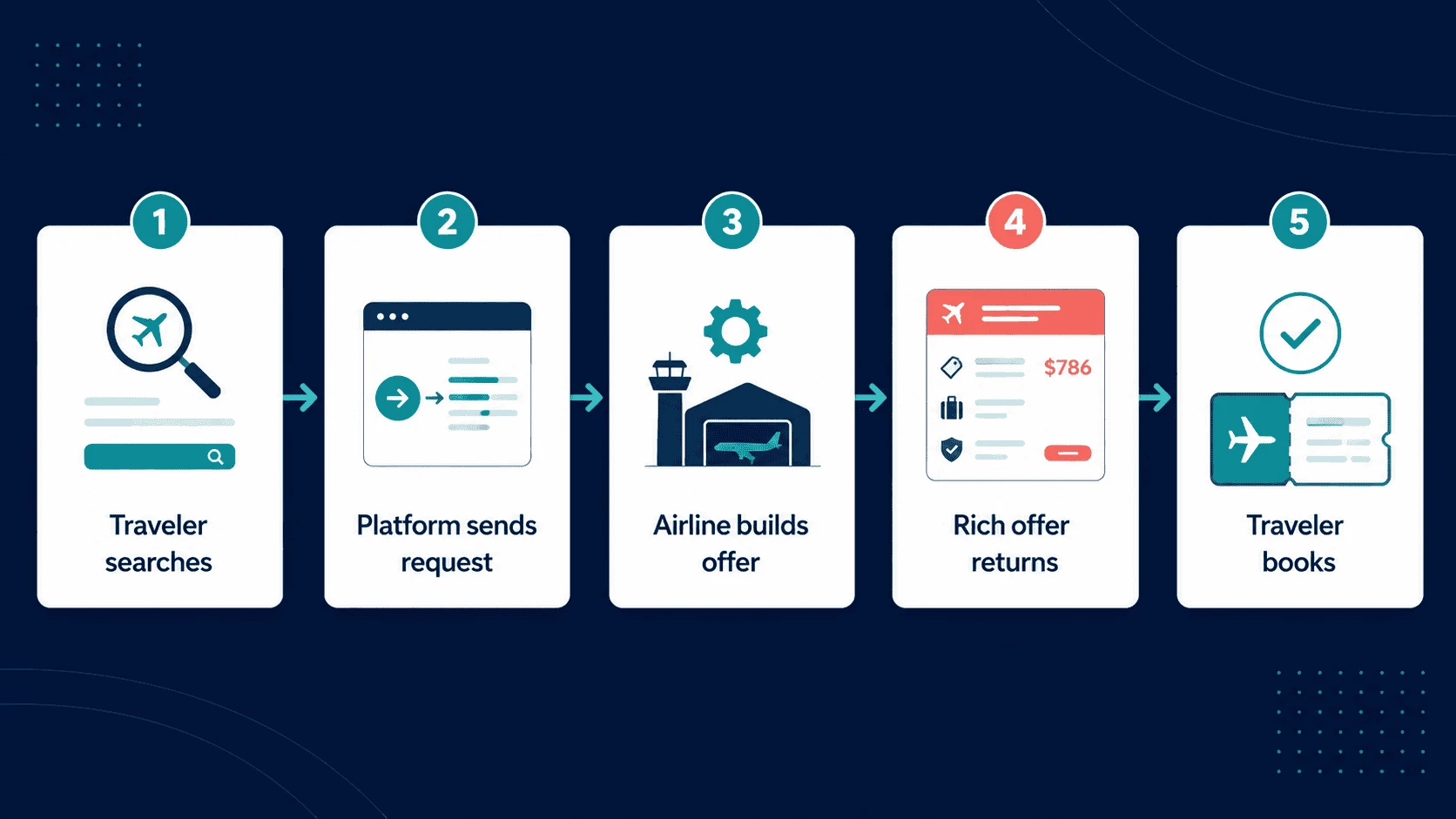
Step six matters more than people expect. Older bookings were a static record. An NDC order is meant to stay live and serviceable for the whole trip, which is why IATA groups the standard’s capabilities into four interactions between sellers and airlines: shop and offer distribution, order creation, order servicing and cancellation, and payments and refunds.
What NDC lets a travel seller actually do
Those four interactions translate into concrete things your platform can offer.
- Shop. Request live offers instead of reading a cached fare table. Prices and availability reflect the airline’s current position.
- Order. Create a booking that the airline recognizes as its own order, not just a reservation record held elsewhere.
- Service. Change, add to, or cancel that order through the same channel — no phone call to the airline, no separate tool.
- Pay. Handle payment and refunds inside the standard, including newer payment methods the old pipes never supported.
The commercial version of that list is simple: you can sell more than a seat, and you can keep serving the customer after the sale.
NDC vs GDS: what actually changed
For decades a GDS controlled flight distribution. GDS stands for Global Distribution System — Amadeus, Sabre, and Travelport are the three big ones. If you are new to that side, start with our guide to what a GDS is and how it works.
The old model worked well for schedules and basic fares. It struggled with everything else, because the GDS assembled the offer from data the airline had filed in advance. Bundles, photos, and per-customer pricing did not fit.
| Point | Traditional GDS | NDC |
|---|---|---|
| Who builds the offer | The GDS, from filed fares | The airline, in real time |
| Extras and bundles | Limited | Rich |
| Personalization | Low | High |
| Data format | EDIFACT (legacy) | XML (modern) |
| Order servicing | Often outside the channel | Inside the standard |
| Airline coverage | Near-universal | 82 airlines and growing |
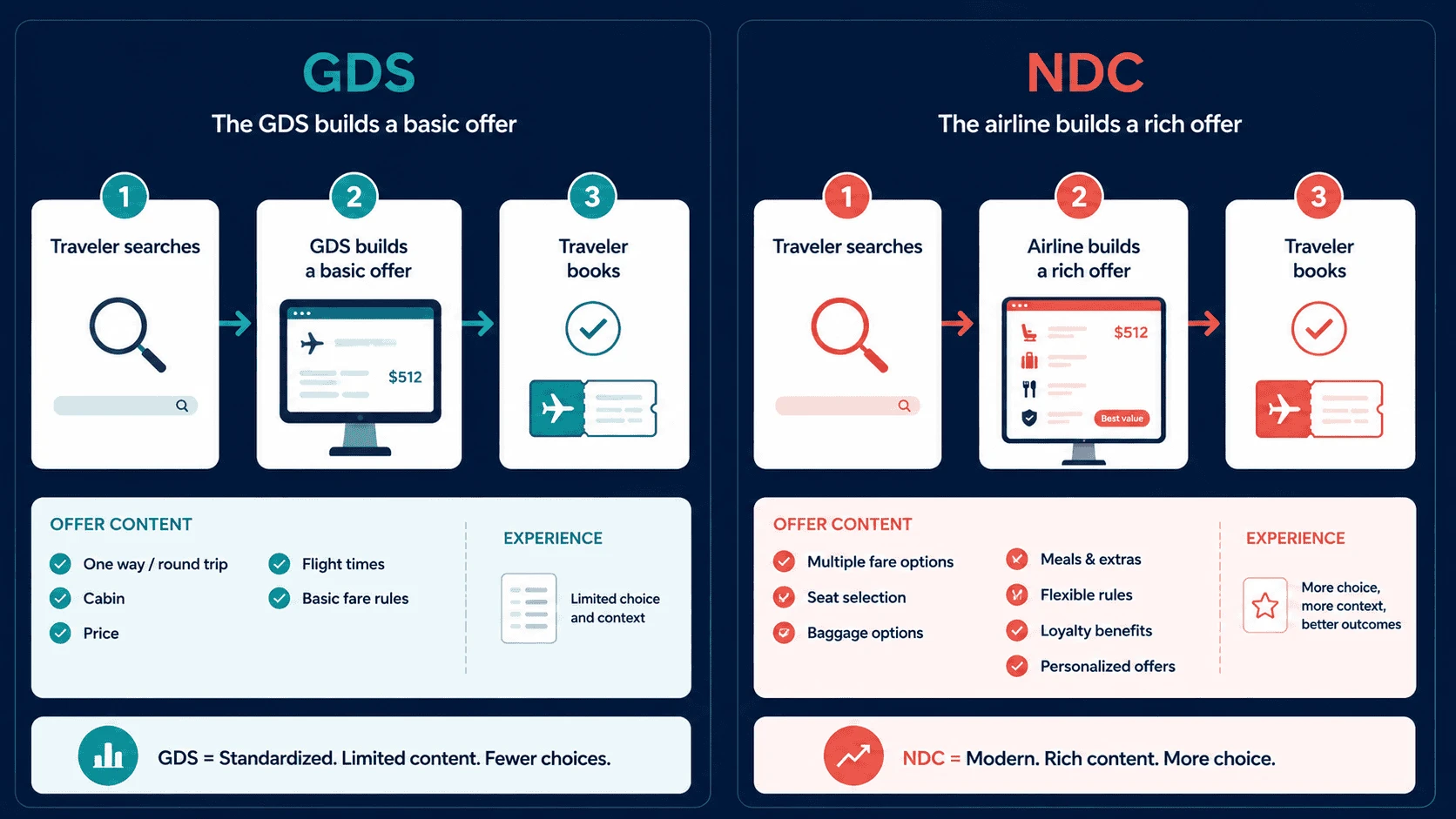
Note the last row. NDC gives you better content; the GDS still gives you broader coverage. That is why this is not an either-or decision for most platforms. We break the trade-off down properly in NDC vs GDS: how airline distribution is changing, and compare the wider options in travel API vs GDS.
Which airlines use NDC?
82 airlines currently have independently verified NDC capabilities, up from 75 a year earlier, according to the 2026 NDC airlines datasheet published by AltexSoft (last updated 30 July 2026), which cross-checks IATA’s ARM index registry against direct contact with the carriers.
Two things follow from that number.
First, the major full-service carriers are largely on board. The airlines most often named as leading NDC adopters are American Airlines, Lufthansa Group (including Swiss and Austrian), British Airways and Iberia (IAG), Emirates, United Airlines, and Air France-KLM. Several of these now actively steer sellers toward their NDC channel rather than the GDS — Lufthansa Group was the first to add a surcharge on GDS bookings, and American Airlines moved a large share of its content to NDC-only fares.
Second, 82 is not the whole market. There are hundreds of airlines selling seats worldwide. So a platform running on NDC alone would have visible gaps — especially in low-cost carriers, which mostly distribute through their own direct APIs rather than NDC. If LCC content matters to you, see our guide to the low-cost carrier API.
The practical read: treat NDC as a high-value content source to add, not as the single pipe that replaces everything else.
NDC and ancillaries: where the extra revenue comes from
Ancillaries are the paid extras around a ticket — bags, seats, meals, priority boarding, lounge access, extra legroom. They are one of the strongest reasons platforms want NDC content.
Under the old model, ancillaries were hard to show and harder to sell. The data was thin, so a platform often displayed a bare fare and left the extras to the airline’s own site. Every one of those handoffs was lost revenue.
With NDC, the ancillary is part of the offer. That means you can:
- Show a seat map and let the traveler choose an actual seat.
- Price and sell extra bags at the point of booking.
- Present fare families side by side, so the difference between “basic” and “flex” is visible.
- Upsell after the booking, against the live order, instead of losing the customer to the airline’s site.
For a platform, this is the clearest commercial case for NDC: a higher average order value on the same traffic.
How to access NDC content: three routes
There are exactly three ways to get NDC content into your platform. They differ enormously in effort.
1. Direct airline connections
You integrate with each airline’s NDC endpoint yourself. You get the richest content and the best commercial terms, and you carry all the work: separate certification per airline, separate quirks, separate maintenance. This suits large platforms with a dedicated distribution team and a small target list of carriers.
2. Through a GDS
All three major GDSs now resell NDC content alongside their traditional inventory. You keep one familiar connection and get some NDC content through it. The trade-off is that you see what the GDS chooses to pass through, and not always the full offer the airline built.
3. Through an aggregator
An aggregator has already done the airline-by-airline work and exposes it as one API. You integrate once and get NDC, non-NDC, LCC, and GDS content through the same interface, already normalized into one format.
From building this layer ourselves, the part teams underestimate is not the connection — it is the normalization behind it. Tripgic exposes flights alongside seven other product families across 73 endpoints through one API, and the majority of that engineering effort goes into reconciling formats, fare rules, and error behavior after the responses arrive, not into making the calls. That is the work you are really outsourcing when you pick an aggregator. Our NDC API page covers what we expose on the flight side.
Most platforms choose the third route, because the first is a multi-year program and the second is incomplete. Our guide to the NDC aggregator model explains how that layer works, and NDC API integration walks through the technical steps if you are building it yourself. For the broader pattern, see what a travel API aggregator is.
IATA’s role: schemas, the ARM index, and why there is no deadline
People search for “IATA NDC” expecting a rulebook with dates in it. That is not what IATA publishes.
Schemas. IATA maintains versioned message schemas that define the XML. The 21.3 schemas were enhanced in 2024 to smooth the transition, and the current generation is NDC 24.1. Version differences are a real integration concern: two airlines can both “support NDC” while running different schema generations.
The ARM index. The Airline Retailing Maturity index is IATA’s recognition program. It publishes companies with their independently validated capabilities in a public registry, which is how anyone can check what an airline actually supports rather than trusting a press release. This registry is the source most industry counts of “NDC airlines” are built on.
No mandate. IATA is explicit that adoption is “available on a voluntary and open basis,” and that it “will not prescribe a specific course of action” — each airline decides its own timeline. The longer-term direction is Modern Airline Retailing with 100% Offers and Orders, but that is a goal for standards availability, not an industry deadline. Details are in IATA’s Distribution with Offers and Orders fact sheet (June 2026).
The practical consequence for you: there will be no date on which NDC becomes the only way to sell flights. You will be running mixed content sources for years.
The challenges of NDC integration
NDC is powerful and it is genuinely hard to implement. The honest list:
- Every airline is a little different. The standard leaves room for interpretation, so each carrier has its own quirks, optional fields, and error behavior.
- Certification takes time. Each airline connection has its own onboarding and testing cycle, usually measured in weeks, sometimes longer.
- Schema versions drift. Supporting several airlines can mean supporting several schema generations at once.
- Mixing content is the real work. You must merge NDC, non-NDC, LCC, and GDS results into one ranked list with no duplicates and consistent fare rules. This is usually harder than any single connection.
- Servicing has to work end to end. A rich booking is worthless if your team cannot change or refund it cleanly afterwards.
- Ongoing maintenance never stops. Airlines update their implementations; your integration has to keep up.
For a technical view of the wider problem, this overview of airline content integration from AltexSoft is a good read. It is precisely this workload that pushes most platforms toward an aggregator.
Is NDC worth it for your platform?
Usually yes — but as one content source among several, and rarely as a direct-integration project.
NDC is worth prioritizing if:
- Ancillary revenue matters to your business model.
- Your customers compare fare families and expect to see what is included.
- You lose bookings to airline websites at the extras stage.
- Your key carriers already have verified NDC capabilities.
It matters less if your volume sits with low-cost carriers, or if you are still building basic search and booking. In that case get broad, reliable coverage working first, then add richer content on top.
The bottom line
NDC is the modern way airlines package and sell flights. The airline builds the offer, so the offer can finally contain the whole product — seats, bags, meals, bundles, and personalized pricing. For a travel platform that means richer results, better fares on some routes, and real ancillary revenue.
The catch is the work. 82 airlines, each with its own quirks and schema version, plus the job of blending NDC with non-NDC, LCC, and GDS content into one clean result set. That is a distribution program, not a sprint.
Tripgic gives you NDC and non-NDC flight content through a single travel API, already normalized, so you skip the airline-by-airline integration work. Book a demo to see how it fits your platform.