 Golam Shahrier
An NDC aggregator connects to many airlines’ NDC channels and returns their offers through one API, so a travel seller does not build and certify a separate link for each airline. Tripgic is one: its Flight API blends airline-direct NDC offers with Amadeus, Sabre, Travelport and 100+ low-cost carriers in one normalised response, with no per-airline certification on your side.
This guide explains what NDC is, how an NDC aggregator works, how it compares with direct airline links and the GDS, how airlines approve aggregators, the main types of provider and how to choose one. Facts about other companies come from their own websites, read on 26 October 2026; the IATA definition comes from IATA’s own NDC page.
What Is NDC?
NDC stands for New Distribution Capability. IATA describes it as a travel industry-supported programme launched by IATA. In practice it is a data exchange standard that lets an airline send rich, personalised offers to travel sellers, instead of the limited fare classes that traditional GDS distribution carries.
With NDC, the airline builds the offer at the moment of the request. That makes four things possible that the older model struggles with:
- Branded fares. Fare families such as Economy Light or Economy Flex, each with clear inclusions.
- Dynamic pricing. Prices computed in real time rather than filed in advance.
- Ancillaries in the offer. Seats, bags, meals and other extras sold at the point of sale.
- Rich content. Product descriptions and images that show the product the way the airline intends.
For a deeper explanation of the standard, read our guide to what NDC is, and for how it sits beside the GDS, our comparison of NDC vs GDS.
Why NDC Access Matters Now
For many years a travel seller could reach almost every airline through a GDS. That is changing. Several airlines now put their best content, branded fares and some of their lowest prices on NDC channels, and some add a surcharge to bookings made through traditional GDS channels.
The result is a content gap. A seller with only a classic GDS connection may see fewer fare options, or higher prices, than a seller with NDC access on the same route. For an OTA or a travel agency, that gap shows up directly in conversion and margin.
The details differ by airline: when it introduced NDC, whether it charges a GDS surcharge, and which fares are NDC-only. Tripgic publishes airline-by-airline NDC guides covering those points for carriers such as British Airways, Emirates, Qatar Airways, Saudia, Turkish Airlines and Lufthansa Group. Read the guides for the airlines on your routes before you decide how to connect.
What Is an NDC Aggregator?
An aggregator is a company that joins many sources behind one API. An NDC aggregator does this for airlines’ NDC channels: it connects to each airline, handles each airline’s version of the standard, and serves all of them to you in one format.
The work it removes is significant. Every airline implements NDC differently, with different message versions, authentication and offer management flows. A direct NDC connection means a separate build, a separate commercial agreement and often a certification process for each airline, and then ongoing maintenance as each airline updates its implementation.
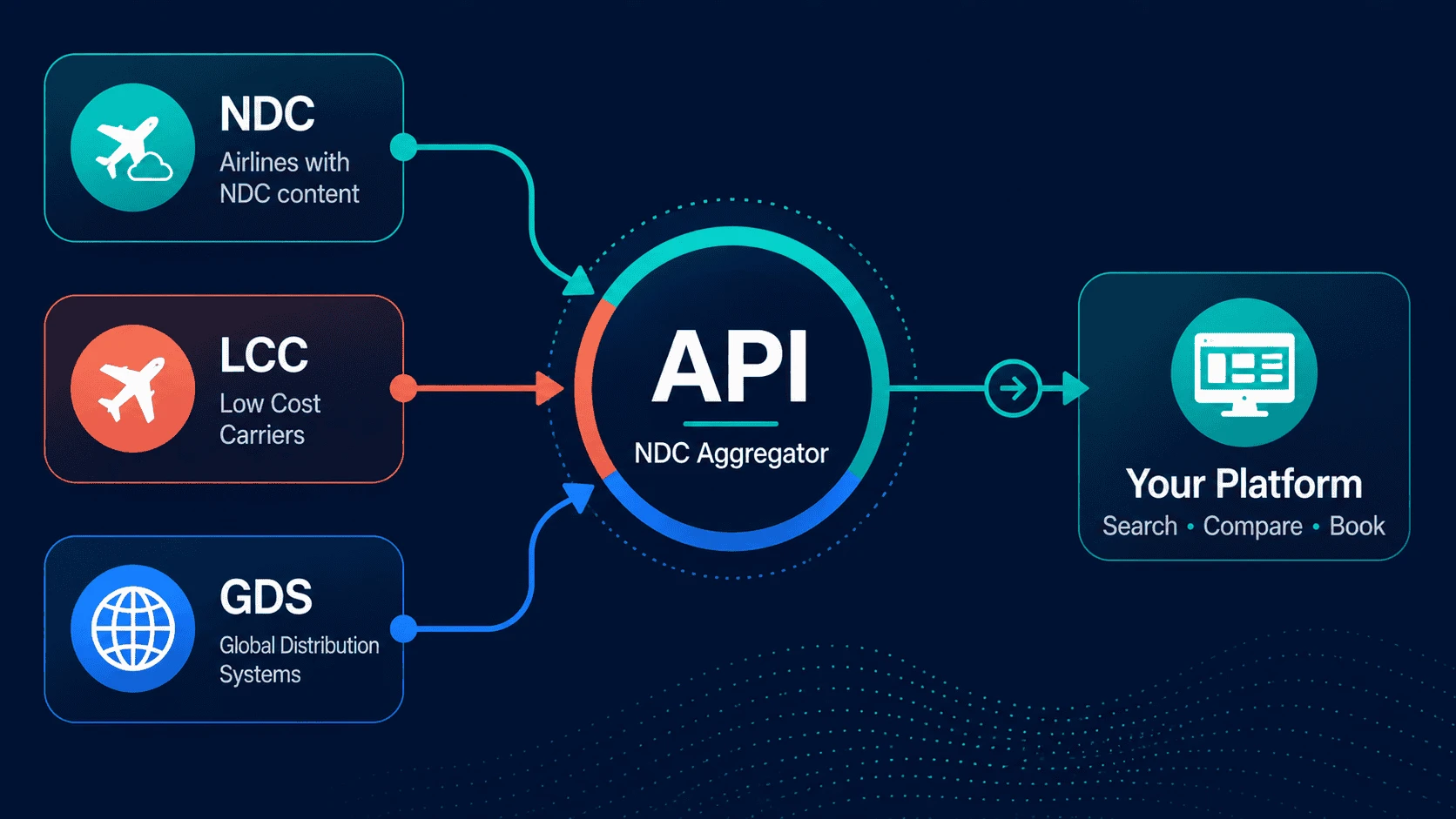
Many NDC aggregators go further and combine NDC with other sources: GDS content for the airlines and fares that are still best reached there, and low-cost carriers, many of which sell through their own direct channels. A seller then gets one search that covers all three.
How an NDC Aggregator Works
The IATA NDC standard is built around offers and orders. A booking moves through a sequence of messages, which the aggregator handles with each airline on your behalf:
- Shopping. Your platform sends one search. The aggregator asks each relevant airline for offers through its NDC channel (the AirShopping step in the standard) and, if it blends sources, queries the GDS and low-cost carriers too.
- Normalisation. Each airline answers in its own way. The aggregator maps every offer into one format, removes duplicates and returns a single list.
- Pricing. For the offer the traveller chooses, the aggregator confirms the current price and conditions with the airline (OfferPrice).
- Ordering. The aggregator creates the booking with the airline (OrderCreate). In NDC, the result is an order held by the airline.
- Servicing. Later changes, cancellations and retrievals go through the same channel (OrderRetrieve, OrderChange, OrderCancel), again normalised by the aggregator.
Your platform sees only one API throughout. It does not need to know which airline returned which offer, or which version of NDC that airline runs. Our NDC API integration guide walks through the same flow from the developer’s side.
Offers and Orders: What Changes for a Travel Seller
IATA groups NDC under its work on distribution with offers and orders, and the two words describe what is different for a seller.
An offer is what the airline sends back to a search: a price, a fare brand, the included services and any extras, built for that request at that moment. Because the airline builds it live, two searches minutes apart can return different offers, and an offer usually has a short validity. Your platform should treat an offer as something to confirm, not something to store and reuse later.
An order is what exists after booking. It is the airline’s record of what was bought and what was paid for: the flights, the passengers, the seats, the bags. Changes and cancellations act on that order, through the airline’s NDC channel. In practice this means the servicing flow matters as much as the booking flow. An aggregator that books well but cannot change or cancel orders through the API leaves your team handling every schedule change by hand.
For a seller used to the GDS, the shift is mostly invisible when an aggregator normalises it. What stays visible is the product: fare brands with clear inclusions, extras sold at the point of sale, and prices that follow the airline’s live pricing.
NDC Aggregator vs Direct Airline Links vs GDS
There are three ways to get airline content into your platform. They trade speed, coverage and control.
| NDC aggregator | Direct NDC link | GDS | |
|---|---|---|---|
| Integrations to build | One | One per airline | One per GDS |
| Airline content | Many airlines’ NDC offers | One airline’s full NDC offer | Many airlines, mainly filed fares |
| Branded fares and ancillaries | Yes, as each airline offers them | Yes, fully | Varies by airline and GDS |
| Certification | Held by the aggregator | Per airline | Per GDS |
| Time to launch | Days to weeks | Months per airline | 6–12 months per GDS |
| Best for | Most OTAs, agencies and startups | Very large sellers focused on a few airlines | Agencies already working in a GDS |
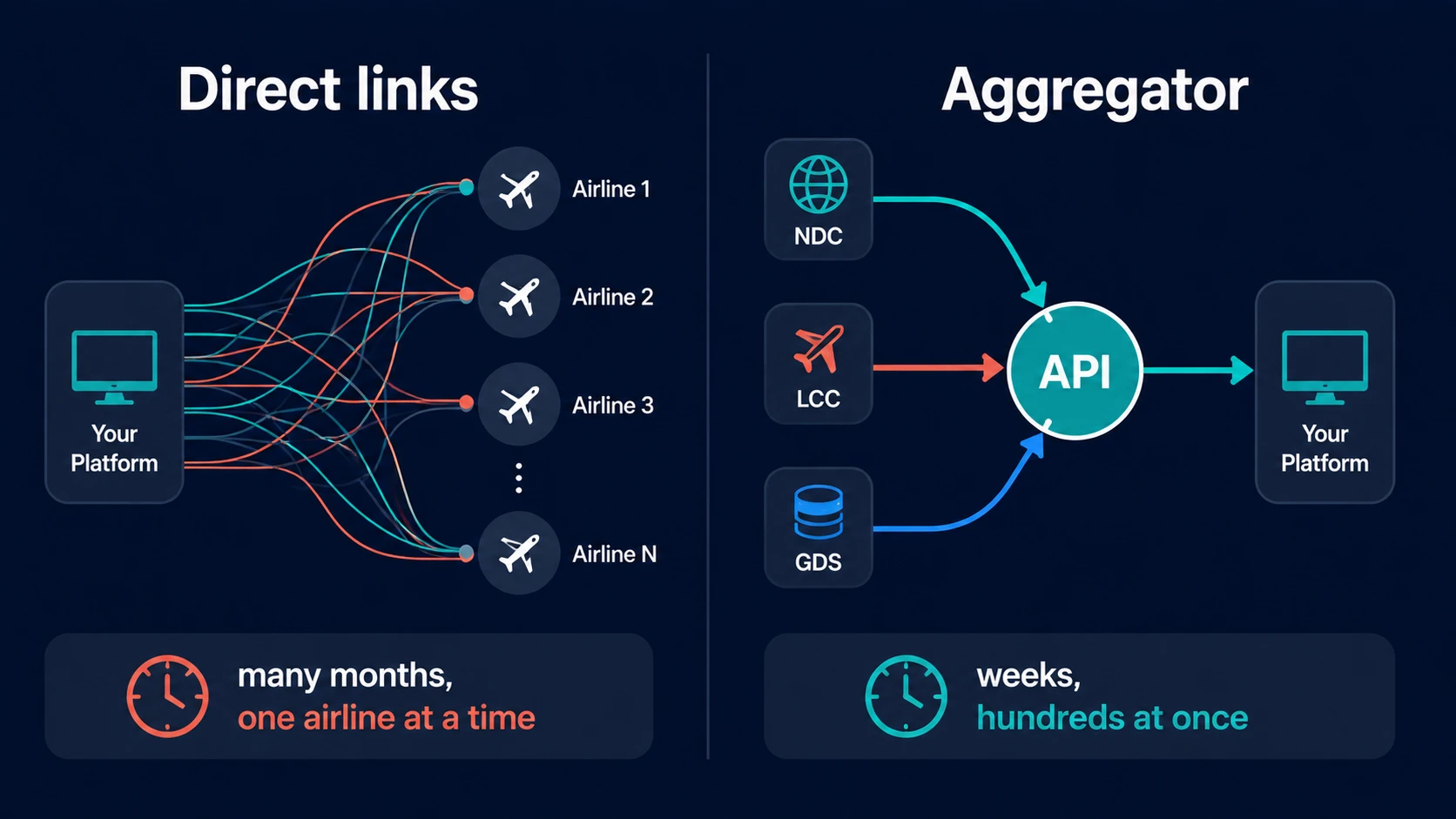
Direct links make sense for a seller whose volume is concentrated on one or two airlines and who has the engineering team to maintain them. For everyone else, an aggregator gets the content with a fraction of the work.
Airline-Approved NDC Aggregators
Airlines do not leave the choice of aggregator entirely open. Several publish their own pages on connecting to their NDC content through an aggregator. Lufthansa Group has a page to find and compare aggregators for its NDC offering, and Qatar Airways keeps a list of approved aggregators on its trade portal.
This matters for two reasons. First, an aggregator that is not on an airline’s list may not be able to sell that airline’s NDC content at all. Second, airline lists change as airlines add partners, so a list you saw a year ago may be out of date.
The practical step is simple. List the airlines that matter most on your routes, open each one’s NDC page, and ask every aggregator you are considering to confirm in writing which of those airlines it can sell through NDC today, and which it serves through the GDS instead.
Types of NDC Aggregator
Providers that sell NDC content fall into a few groups. The group decides what else comes in the same API.
| Type | What it offers | Suits |
|---|---|---|
| Multi-source travel API | NDC blended with GDS and low-cost carriers, often with hotels and other products | OTAs and platforms that want one integration for the whole trip |
| NDC specialist | NDC content, sometimes with tools for airlines and agencies | Sellers focused on airline retailing |
| Developer-first flight API | Modern REST API with NDC among its sources | Flight-focused apps and startups |
| LCC and NDC aggregator | Low-cost carriers and NDC content | Sellers strong in low-cost routes |
None of these is better in general. The right type depends on whether you want flights only or the whole trip, and on how much of your demand is on full-service, NDC-heavy airlines versus low-cost carriers.
NDC Aggregators Compared
The table describes each provider in its own words, from its own website, on 26 October 2026. It is a selection, not a census of the market, and it is not a ranking.
| Provider | How it describes itself | Also offers |
|---|---|---|
| Tripgic | Airline-direct NDC offers blended with GDS (Amadeus, Sabre, Travelport) and 100+ low-cost carriers in one normalised response | Hotels, transfers, activities, rail, eSIM, visas in the same API |
| Duffel | “One integration to access hundreds of airlines” | Stays |
| AirGateway | Helps travel players adopt airline NDC distribution channels, through its API and BookingPad | — |
| TPConnects | An IATA-certified NDC travel technology company developing offer and order management and travel aggregator solutions | Solutions for airlines |
| Travelfusion | A travel content aggregator with content from hundreds of LCC and NDC suppliers in a single API, for OTAs, TMCs and online booking tools | — |
| Verteil | An NDC distribution company, per its homepage | — |
For a wider comparison of flight API providers, see our guides to the best travel APIs and how to choose a travel API provider.
Tripgic as an NDC Aggregator
Tripgic’s NDC API is one of three sources behind its Flight API, alongside the GDS and low-cost carriers. Here is what that means for a travel seller, from Tripgic’s own pages:
- Blended results. NDC and GDS results appear in a single response with the same JSON schema, so your interface does not need to know which source provided a fare. Low-cost carriers sit in the same response.
- No NDC complexity on your side. Each airline’s NDC implementation is different; Tripgic abstracts the message versions, authentication and offer flows.
- No per-airline certification. Tripgic holds the airline NDC connections and the GDS credentials. You integrate one REST API, with no per-airline NDC certification, no separate GDS contract and no EDIFACT messaging.
- Named NDC airlines. Tripgic lists Lufthansa Group, British Airways, Air France-KLM, Singapore Airlines, American Airlines, United Airlines, Emirates, Qatar Airways, Qantas, Cathay Pacific, IAG Group, Finnair, Turkish Airlines and Etihad Airways among its NDC-enabled carriers.
- Airline guides. Twenty-two airline NDC guides cover key dates, GDS surcharges and access options, including Gulf and South Asian carriers such as Saudia, Riyadh Air, flydubai, Gulf Air, Oman Air and Biman Bangladesh Airlines.
- Rich offers. Branded fares, dynamic pricing and ancillaries such as seats, bags and meals, sold in the same flow.
- More than flights. The same API sells 2M+ hotel properties, transfers, activities, tours, rail, eSIM and visas: 73 endpoints across 8 product families.
- Plans and pricing. NDC coverage differs by plan. Flights carry the supplier’s net fare plus a flat fee per passenger, never a percentage; figures are on the pricing page.
- Test first. Sandbox credentials are issued after a short kick-off call, and a Live Rate Check Panel, after an NDA, lets you compare live fares with your current suppliers before paying.
For sellers moving off the closed Amadeus Self-Service API, our Amadeus migration guide maps the old calls to Tripgic’s endpoints.
NDC Aggregator Examples: Three Typical Setups
The same API serves very different sellers. These three setups show what each one needs from an NDC aggregator.
An OTA selling leisure flights. It wants the widest choice and the lowest prices in one search, so it needs NDC offers blended with GDS fares and low-cost carriers, with duplicates removed. Branded fares help it show clear choices, and seats and bags sold in the same checkout raise the value of each booking.
A corporate travel tool. It needs NDC content from the airlines in its clients’ corporate deals, shown next to GDS fares so the policy engine compares like with like. Servicing matters most: business travellers change plans often, so order changes and cancellations must work through the API.
A travel agency focused on ticketing. Its problem is airlines whose content is no longer complete in its GDS. It needs an aggregator that covers those specific airlines through NDC, and a clear answer on who issues the tickets. For this agency, the airline list is everything.
Common NDC Mistakes to Avoid
The same few problems appear in most first NDC launches:
- Comparing NDC and GDS fares that are not the same product. A cheaper NDC fare may be a lighter brand with fewer inclusions. Show the brand and its inclusions, not only the price.
- Storing offers and reusing them. Offers are built live and expire. Always confirm the price before taking payment.
- Launching without servicing. If changes and cancellations do not work through the API, every schedule change becomes manual work.
- Assuming one airline list fits every market. Coverage that is strong in Europe may be thin in the Gulf or South Asia. Check the airlines on your own routes.
- Forgetting low-cost carriers. An NDC-only search misses many budget airlines, which sell through their own channels.
How to Choose an NDC Aggregator
These checks separate providers that look alike in a demo.
| Check | What to ask |
|---|---|
| Airline coverage | Which of my top airlines can you sell through NDC today, and which through the GDS? |
| Airline approval | Are you on the approved-aggregator list for those airlines, where they publish one? |
| Other sources | Do GDS and low-cost carrier fares come in the same response? |
| Normalisation | Are branded fares and ancillaries mapped into one structure across airlines? |
| Servicing | Can I change, cancel and retrieve orders over the API, for every airline? |
| Ticketing | Who issues tickets, and do I need my own IATA accreditation? |
| Certification | Is any certification required on my side before going live? |
| Pricing model | Percentage, per-segment fee or flat fee per passenger? |
Servicing is the check most often skipped. A booking that cannot be changed through the API turns every schedule change into a manual task for your team.
Questions to Ask Before You Sign
A demo shows search results. These questions show what happens after the booking, which is where most NDC problems start:
- Schedule changes: when an airline changes a flight, how does the change reach my platform, and can the traveller accept or rebook through the API?
- Refunds: are voluntary and involuntary refunds handled through the API, and how long do they take to settle?
- Extras after booking: can a traveller add a bag or choose a seat after the booking, or only at the time of booking?
- Fare brands: are brand names and inclusions returned in a structured form I can display consistently across airlines?
- Airline changes: if an airline changes its NDC version or its terms, who updates the connection, and how much notice do I get?
Write the answers into the agreement. A promise on a sales call does not help when a traveller is waiting at the airport.
What an NDC Aggregator Costs
Providers charge in several ways, and many combine them: a setup or activation charge, a fee per booking, passenger or segment, a share of the fare, or a monthly subscription. Some also pass on airline-specific charges.
Compare the model before the numbers. A percentage of the fare grows with every price increase, while a flat fee per passenger stays the same on a short economy trip and a long business-class one. Ask each provider for a quote on your expected monthly bookings and average fare, and include post-booking servicing in the comparison. Our guide to travel API pricing models explains how each model scales.
NDC for Sellers in the Middle East and South Asia
For sellers in the Gulf and South Asia, the airlines that matter most are often regional carriers. Their NDC programmes, GDS surcharges and approved-aggregator lists differ from those of European and American airlines, so check them one by one.
Start with the carriers your customers fly most. For many Gulf sellers that means Emirates, Qatar Airways, Etihad, Saudia, flydubai, Gulf Air and Oman Air, all of which have Tripgic NDC guides. Then add the low-cost carriers on the same routes, which an NDC-only provider may not cover. Our guides to the UAE, Saudi Arabia and the wider Middle East go deeper on each market.
Final Thoughts
An NDC aggregator turns many airline-specific NDC connections into one API. It gives a seller branded fares, ancillaries and NDC-only prices without building and certifying a link for each airline.
Choose on coverage of the airlines on your routes, approval by those airlines, whether GDS and low-cost content come in the same response, and how servicing works after the booking. Then test in a sandbox with your own routes before you sign.
Tripgic blends NDC, GDS and low-cost carrier fares in one response, with no per-airline certification on your side. Book a kick-off call to get free sandbox access and check coverage on your routes.