
 Mehedi Ahsan Ashif
A UAE travel API connects your booking platform to the flights, hotels, transfers, and packages available across Dubai, Abu Dhabi, Sharjah, and the wider UAE. The UAE is one of the world’s most important aviation hubs. Specifically, Dubai International Airport handled over 86 million passengers in 2023, making it the busiest international airport on earth. For travel platforms, that volume represents a major commercial opportunity — but accessing UAE content reliably requires understanding the local airline landscape and market-specific nuances.
This guide covers what a UAE travel API provides, the airline options, hotel market, key challenges, and how to connect.
Why the UAE Is a Global Travel Hub
The UAE sits at the crossroads of Europe, Asia, and Africa. Consequently, that geography and heavy aviation investment have made it one of the world’s most important transit and destination markets.
- Emirates airline: Dubai-based, flies to over 150 destinations across 80+ countries — one of the world’s largest airlines by international passengers.
- Etihad Airways: Abu Dhabi-based, serves 70+ destinations with a focus on premium travel and strategic codeshares.
- Hub strategy: both carriers built their models around maximising connections. As a result, many travelers book through Dubai or Abu Dhabi as a stopover destination in its own right.
- Dubai Tourism: the emirate targets 25 million annual visitors. In 2023, it received over 17 million international overnight visitors.
- MICE market: Dubai and Abu Dhabi are major conference and exhibition destinations. Consequently, MICE travelers generate strong hotel and activity booking volumes throughout the year.
For a broader regional overview, see Middle East travel API: connect regional and global supply. Additionally, for background on UAE tourism, tourism in the UAE covers the market’s growth and visitor trends.
What a UAE Travel API Covers
A UAE travel API through an aggregator gives access to multiple product types in one integration:
- Flights: Emirates (GDS + NDC), Etihad (GDS + NDC), flydubai (LCC, limited GDS), Air Arabia (LCC, hub Sharjah), and international carriers serving DXB, AUH, and SHJ airports.
- Hotels: luxury and business properties across Dubai (Downtown, JBR, DIFC, Marina), Abu Dhabi (Corniche, Saadiyat Island), and other emirates.
- Airport transfers: private and shared options from Dubai International (DXB), Abu Dhabi International (AUH), and Al Maktoum International (DWC).
- Tours and activities: desert safaris, city tours, Burj Khalifa access, Dubai Frame, Abu Dhabi cultural experiences, and major theme parks.
- Stopover packages: bundled short-stay products combining a connecting flight with 1-3 nights hotel — popular with Emirates and Etihad passengers transiting through the UAE.
Moreover, if you already serve the broader Middle East region, UAE content typically integrates as a natural extension of your existing regional API setup.
UAE Airlines: Emirates, Etihad, and LCC Options
UAE aviation has four main carriers. In particular, understanding how each is distributed matters for your API setup.
| Airline | Type | Hub | GDS | How to access |
|---|---|---|---|---|
| Emirates | Full-service | Dubai (DXB) | All major GDS | GDS or NDC aggregator |
| Etihad | Full-service | Abu Dhabi (AUH) | All major GDS | GDS or NDC aggregator |
| flydubai | LCC (Emirates subsidiary) | Dubai (DXB) | Partial | Direct or aggregator feed |
| Air Arabia | LCC | Sharjah (SHJ) | Partial | Direct or aggregator feed |
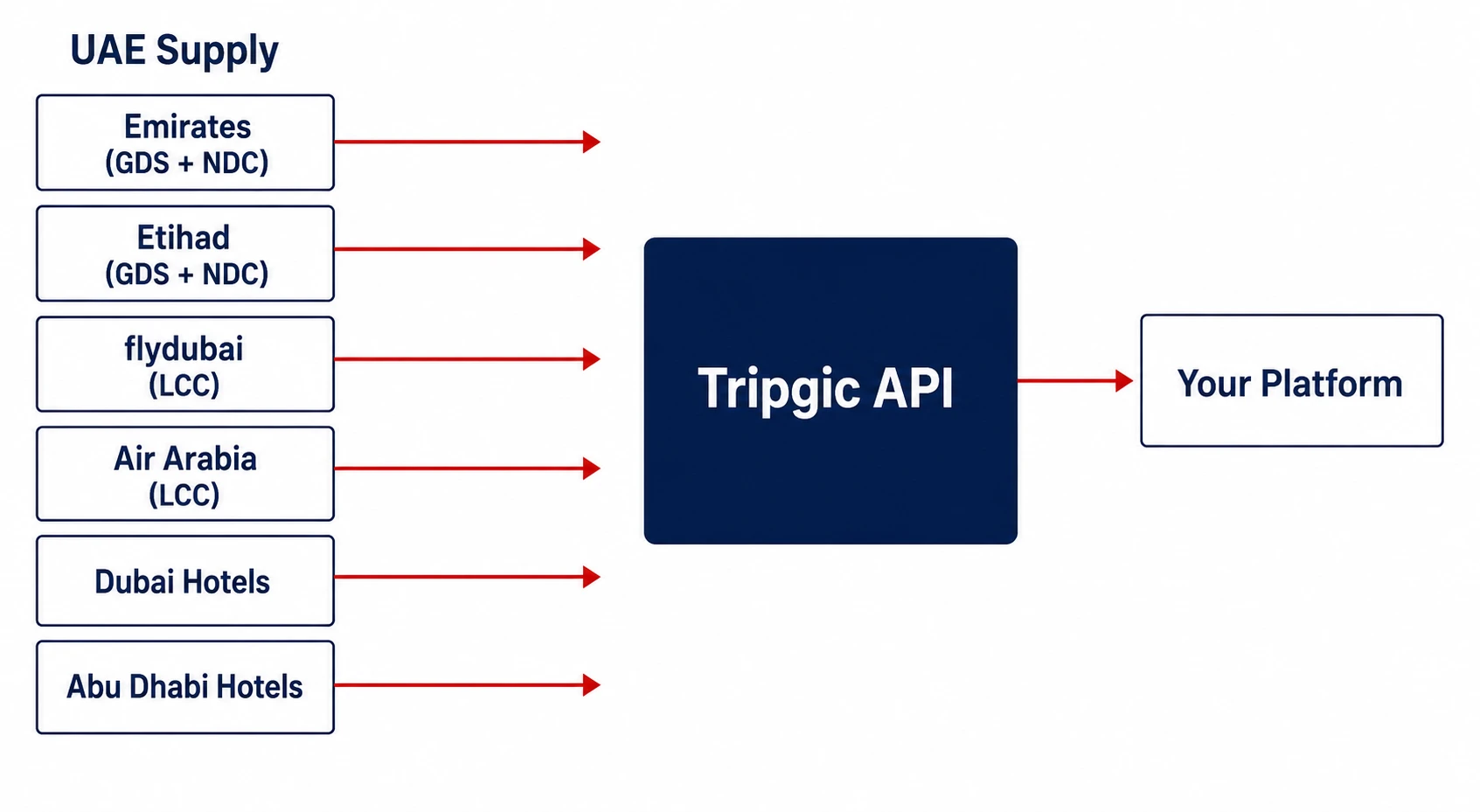
Emirates and Etihad are fully represented on all major GDS systems and have active NDC programs. However, flydubai and Air Arabia have more limited GDS distribution. Therefore, an aggregator API with direct LCC feeds covers significantly more inventory than a pure GDS connection for UAE routes.
For more on LCC content access, see low-cost carrier API: how to access LCC content. To understand flight API specifics, see flight booking API: how it works and how to connect.
Hotels and the UAE Accommodation Market
Dubai and Abu Dhabi have two of the highest concentrations of 5-star hotels in the world. Additionally, the UAE hotel market has several characteristics that directly affect your API setup.
- Luxury density: Downtown Dubai, Palm Jumeirah, and DIFC have some of the highest average daily rates globally. Inventory is tight during peak season (October to April) and major events like the Formula 1 Abu Dhabi Grand Prix and Dubai Shopping Festival.
- Business travel: DIFC in Dubai and Abu Dhabi’s financial district generate strong corporate booking volumes throughout the year.
- Serviced apartments: a significant share of Dubai accommodation is serviced apartments rather than standard hotel rooms. Your API should return this inventory type alongside traditional hotels.
- Ramadan impact: hotel offerings change during Ramadan — restaurants, bars, and entertainment adjust operating hours. Some platforms flag this for travelers to manage expectations at the point of booking.
For hotel API details, see hotel API integration: a complete guide for 2026.
Key Challenges for UAE Travel Platforms
Before connecting a UAE travel API, prepare for these market-specific challenges:
- LCC distribution gaps: flydubai and Air Arabia have limited standard GDS presence. You need an aggregator with direct connections, or you will miss a significant share of short-haul UAE fares.
- Content normalization: Arabic and English property names coexist across the market. A good aggregator normalizes and returns both versions for accurate search and display.
- VAT at 5%: the UAE charges 5% VAT on most services including travel. Lower than most regional markets, but it still needs to appear correctly in pricing and invoicing.
- Stopover package content: Emirates and Etihad both offer official stopover programs — these are specific bundled products, not simply a flight plus a hotel. Confirm your aggregator has this inventory if you plan to sell stopovers.
- Dubai vs the full UAE: many platforms focus on Dubai only and miss Abu Dhabi, Sharjah, Ras Al Khaimah, and other growing tourism markets. Confirm your aggregator covers all seven emirates.
For context on related challenges in the region, see Saudi Arabia travel API. Additionally, the Visit Dubai website publishes annual visitor statistics and market reports.
How to Connect a UAE Travel API
In practice, connecting a UAE travel API through an aggregator follows a standard path with a few UAE-specific additions:
- Choose an aggregator with UAE coverage. Confirm Emirates, Etihad, flydubai, and Air Arabia are all in the feed. Specifically, ask what LCC short-haul and domestic coverage looks like.
- Check hotel inventory depth. Dubai alone has hundreds of properties. Confirm the aggregator covers luxury, mid-market, and serviced apartments — not just international chain hotels.
- Integrate in sandbox. Build your search, pricing, and booking flows against test data. UAE content behaves like any regional content at the API layer.
- Test stopover products if relevant. If you plan to sell Emirates or Etihad stopover packages, run end-to-end tests on those products before going live.
- Go live in phases. Start with Dubai flights and hotels. Then add Abu Dhabi and other emirates. Finally, layer in activities and stopover packages.
For a general guide to evaluating travel API providers, see best travel API in 2026: how to pick the right one.
Final Thoughts
The UAE is one of the world’s most visited and best-connected travel markets. Emirates and Etihad drive global demand, while flydubai and Air Arabia cover regional routes that a GDS-only connection misses.
Tripgic gives you a single API for UAE flights, hotels, transfers, and packages — including LCC content that standard GDS connections miss.
Talk to the Tripgic team to see how to connect UAE travel content to your platform.


 Akhirul Islam
 Mohammad Fahim
 Md Sozibul Islam