
 Mehedi Ahsan Ashif
A Saudi Arabia travel API connects your booking platform to the flights, hotels, transfers, and packages available in the Kingdom. Saudi Arabia is one of the fastest-growing travel markets in the world. Vision 2030, the government’s economic reform program, targets 150 million tourist arrivals per year by 2030. For travel platforms, that is a major opportunity — but accessing Saudi content through a single, reliable API requires understanding both the technical setup and the market-specific challenges unique to this region.
This guide covers what a Saudi Arabia travel API provides, the local airline landscape, hotel and religious tourism content, key challenges, and how to connect.
Why Saudi Arabia Travel Is Growing Fast
Saudi Arabia opened its doors to international leisure tourism in 2019. Before that, visitor visas were limited to business, religious, and family travel. Since then, growth has accelerated rapidly.
Key drivers include:
- Vision 2030: tourism is targeted to reach 10% of GDP. Billions are being invested in new hotels, airports, and destinations like NEOM, AlUla, and Diriyah.
- Religious tourism: Saudi Arabia hosts the two holiest sites in Islam. Hajj draws around 2 million pilgrims per year. Umrah attracts 25 million or more annually and runs year-round.
- Leisure tourism: e-visa programs now cover over 50 nationalities, opening the market to travelers from Asia, Europe, and the Americas.
- Mega-events: Formula 1, LIV Golf, and the 2034 FIFA World Cup are each generating new international traveler demand.
For travel platforms already serving the region, Saudi Arabia is often the next logical market to add. For a broader regional overview, see Middle East travel API: connect regional and global supply.
What a Saudi Arabia Travel API Covers
A Saudi Arabia travel API through an aggregator gives access to multiple product types in one integration:
- Flights: Saudia, flynas, flyadeal, Air Arabia, and international carriers. An aggregator combines GDS content with NDC and direct LCC feeds into one response.
- Hotels: properties near the Haramain (Grand Mosques in Makkah and Madinah), plus international chains at business and leisure destinations including Riyadh, Jeddah, and AlUla.
- Airport transfers: private and shared options at major airports — King Abdulaziz International (Jeddah), King Khalid International (Riyadh), and Prince Mohammad Bin Abdulaziz (Madinah).
- Tours and activities: heritage sites (AlUla, Hegra), desert experiences, city tours, and cultural activities at emerging tourism zones.
Additionally, if you already serve Middle East markets, a Saudi-specific integration usually extends naturally from your existing regional API setup.
Saudi Airlines: Carriers, LCCs, and NDC Content
Saudi aviation includes both full-service and low-cost carriers. Understanding how each is distributed matters for your API setup.
| Airline | Type | GDS distribution | How to access |
|---|---|---|---|
| Saudia | Full-service (national carrier) | Yes — Amadeus, Sabre, Travelport | GDS or NDC aggregator |
| flynas | Low-cost carrier | Limited / not standard GDS | Direct or aggregator NDC feed |
| flyadeal | Low-cost carrier (Saudia subsidiary) | Limited | Direct or aggregator NDC feed |
| Air Arabia | UAE-based LCC, many Saudi routes | Limited | Direct or aggregator NDC feed |
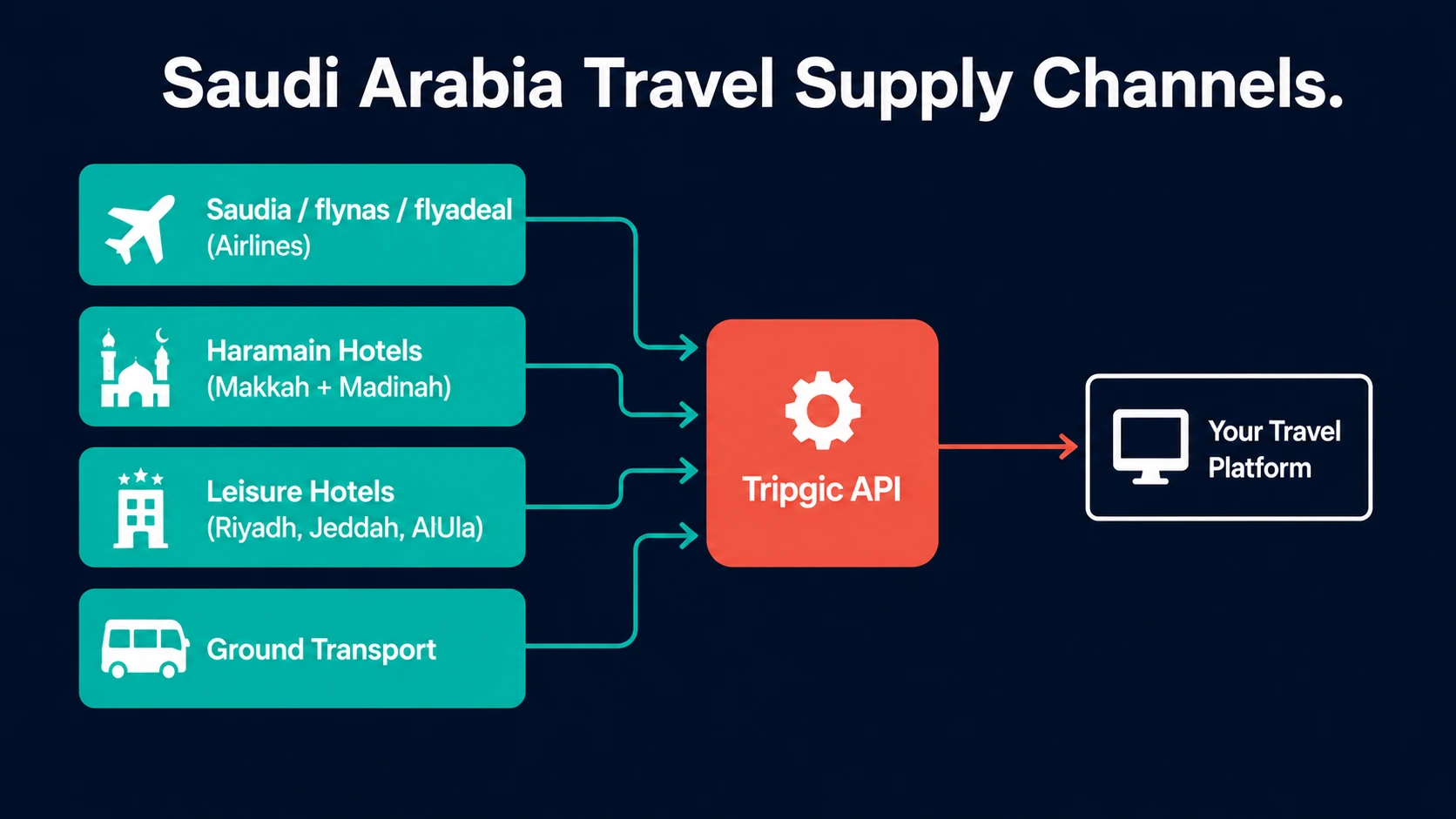
flynas and flyadeal carry a significant share of domestic Saudi traffic. However, they are not available on standard GDS systems. Therefore, accessing their fares requires either direct API connections or an aggregator with those feeds already in place. This is one of the main reasons tour operators and OTAs choose an aggregator over a pure GDS connection for the Saudi market.
For more on LCC content access, see low-cost carrier API: how to access LCC content. For flight API fundamentals, see flight booking API: how it works and how to connect.
Hotel Demand Near the Holy Sites
Saudi Arabia has two distinct hotel markets: the leisure and business market (Riyadh, Jeddah, Red Sea, AlUla) and the market around the holy sites (Makkah, Madinah).
Hotel demand near the Grand Mosque in Makkah and the Prophet’s Mosque in Madinah is among the highest-density in the world. Major international chains — Marriott, Hilton, Fairmont, Raffles — operate large properties within walking distance of both mosques. Availability is extremely tight during peak Umrah seasons (Ramadan and the months before Hajj).
A few things to know about this market:
- Non-Muslim access restrictions: non-Muslims cannot enter Makkah. This limits the traveler base for Haramain hotels but also means demand from eligible travelers is concentrated and predictable.
- Hajj is tightly regulated: Hajj is a one-time annual event with government-controlled access, separate from standard travel APIs — it requires a Ministry of Hajj quota and operator license. Umrah does not require a special quota and is open year-round to licensed operators.
For hotel API specifics, see hotel API integration: a complete guide for 2026.
Key Market Challenges to Know First
Before connecting a Saudi Arabia travel API, prepare for these market-specific challenges:
- LCC content gaps: flynas and flyadeal are not on standard GDS. You need an aggregator that covers them through direct or NDC connections, or you will miss a large share of domestic and regional fares.
- Arabic localization: many Saudi travelers book in Arabic. Property names and destination labels often exist in both Arabic and English. A good aggregator normalizes and returns both versions.
- VAT at 15%: Saudi Arabia charges 15% VAT on most goods and services, including domestically sold travel products. Your pricing, invoicing, and payment flows must reflect this correctly.
- MADA payments: MADA is the local card network used by most Saudi bank cards. International payment gateways do not always support it. If you sell direct to Saudi consumers, MADA acceptance improves conversion significantly.
For context on regional content normalization across the wider Middle East, see Middle East travel API. For Saudi market statistics, the Saudi Tourism Authority publishes annual reports and visitor data. Background on the broader market is also available in the Wikipedia overview of tourism in Saudi Arabia.
How to Connect a Saudi Arabia Travel API
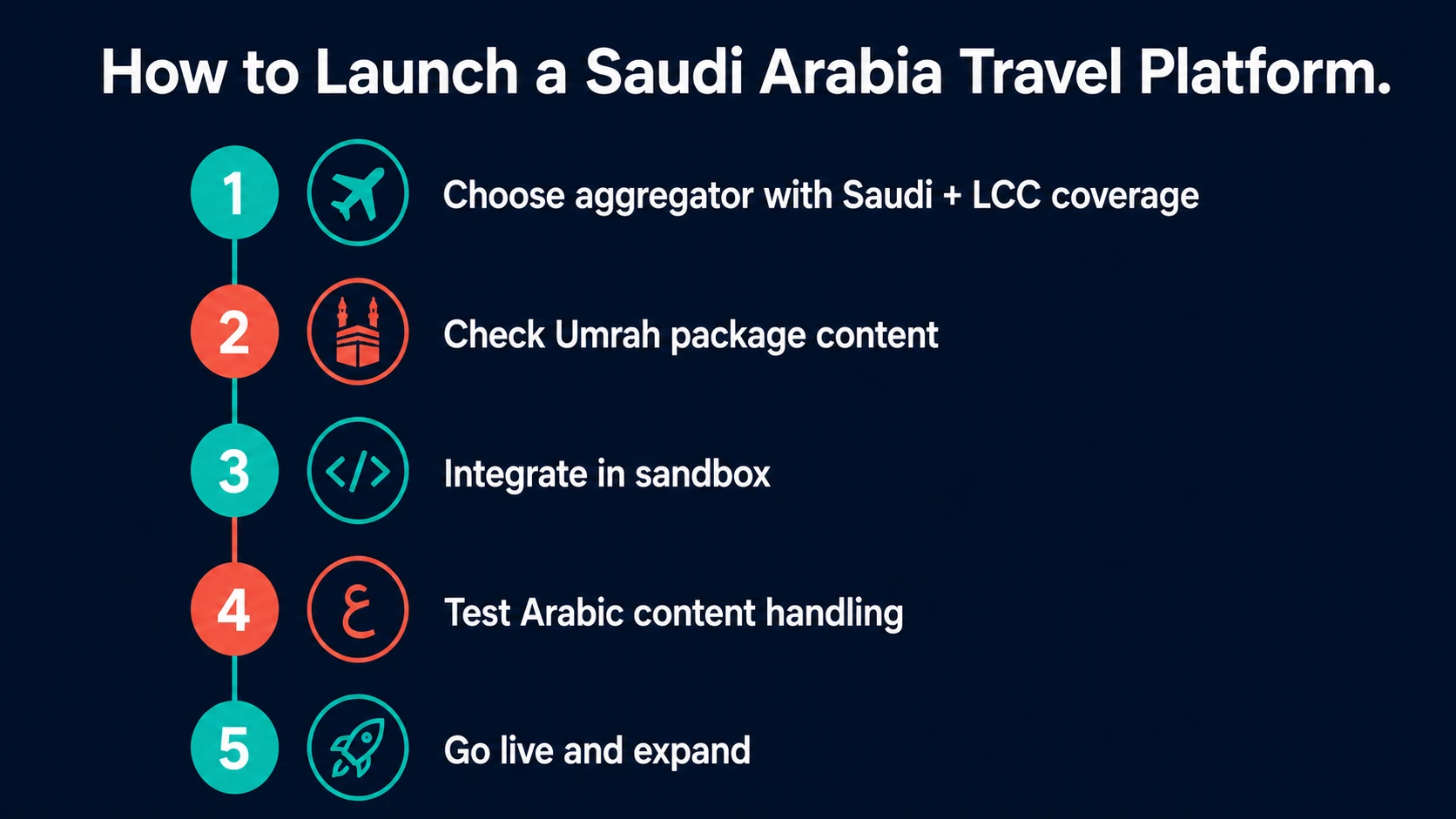
Connecting a Saudi Arabia travel API through an aggregator follows the same steps as any regional integration, with a few Saudi-specific additions:
- Choose an aggregator with Saudi coverage. Confirm it includes Saudia, flynas, flyadeal, and key Saudi hotel suppliers — not just global GDS content. Ask specifically what LCC and domestic fare coverage looks like.
- Confirm VAT and MADA payment handling. Make sure your checkout and invoicing flow account for Saudi Arabia’s 15% VAT and the local MADA card network before going live.
- Integrate in sandbox. Build your search, pricing, and booking flows against test data. Saudi content behaves the same as any regional content at the API layer — the complexity is in the supplier network, not the endpoint.
- Test Arabic content handling. Confirm your platform displays Arabic property names and destination labels correctly if you serve Arabic-speaking customers.
- Go live in phases. Start with leisure content (Riyadh, Jeddah, AlUla) before expanding to other cities and product types. Validate inventory quality at each stage.
For a general guide to choosing a travel API provider, see best travel API in 2026: how to pick the right one.
Final Thoughts
Saudi Arabia is one of the most significant travel market opportunities of the next decade. Vision 2030, the growth of religious tourism, and new leisure destinations make it a high-priority market for OTAs, tour operators, and travel platforms globally.
Tripgic gives you a single API for Saudi flights, hotels, transfers, and packages — including LCC content that standard GDS connections miss.
Talk to the Tripgic team to see how to connect Saudi Arabia travel content to your platform.



 Akhirul Islam
 Mohammad Fahim
 Md Sozibul Islam