
 Mehedi Ahsan Ashif
A travel API for startups is the fastest way to turn a travel idea into a live product. Instead of spending a year on supplier contracts and integrations, you connect to one API and get flights, hotels, cars, and activities from day one. As a result, your small team can launch in weeks and spend its time on the product, not on plumbing. This guide shows how it works, what it costs, and how to choose well.
What Is a Travel API for Startups?
A travel API for startups is a single connection between your app and the travel supply chain. It handles four jobs: search, live pricing, booking, and cancellation. Your app sends a request, and the API returns real inventory from many suppliers.
The key benefit is access. Airlines, hotel chains, and bed banks rarely sign direct deals with a new company. They want volume history and financial guarantees. However, an aggregator already holds those contracts. If this model is new to you, start with our guide on what a travel API aggregator is and how it works.
In short, the API lets you borrow years of supplier relationships through one integration. Therefore, your launch no longer depends on your negotiating power.
Why Travel Startups Should Buy, Not Build, API Integrations
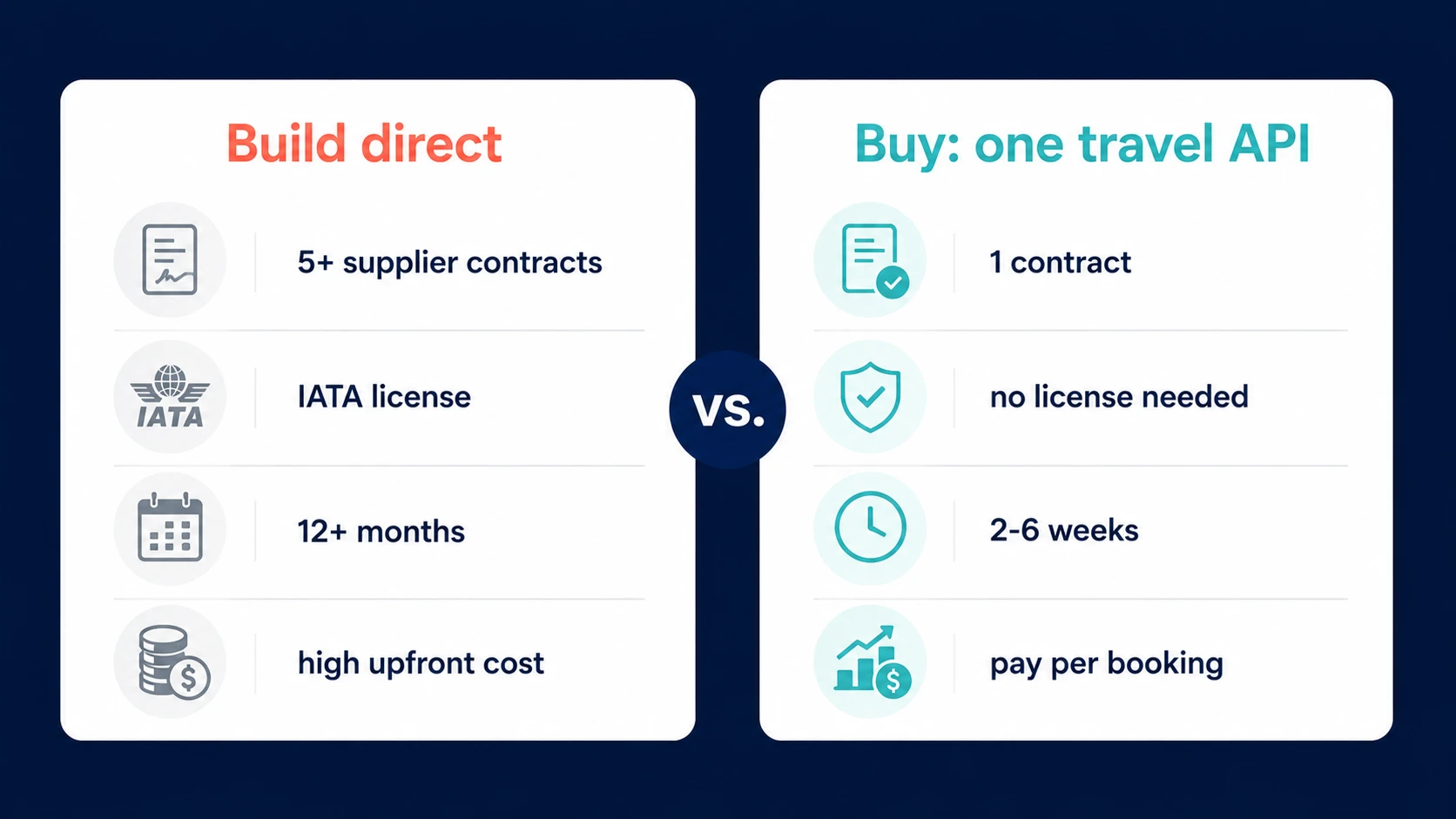
Founders with strong tech teams often want to build direct integrations. It feels cheaper and more flexible. In practice, it burns the two things a startup has least: time and cash.
- Time. Each direct supplier integration takes 4-12 weeks. Five suppliers can cost a year. Your competitors launch while you integrate.
- Cash. Suppliers ask for deposits, minimum volumes, and certification fees. According to CB Insights, 38% of failed startups simply ran out of cash.
- Licenses. Selling flights directly often needs an IATA license or an airline consolidator deal. Both take months and money.
- Maintenance. Every direct API needs monitoring, version updates, and outage handling. That is a permanent tax on a small team.
We compared the two paths in detail in our build vs buy travel API guide. For almost every early-stage startup, buy wins. You can still build direct connections later, once volume justifies them.
What a Travel API for Startups Must Offer
Not every travel API fits a startup. You have no spare engineers and no spare budget. So judge providers on these five points.
- Low or zero upfront cost. Look for revenue share or pay-as-you-go. Avoid big setup fees before your first booking.
- Clear documentation and sandbox. Your developers should make their first test call on day one, without sales calls.
- Multi-product coverage. Flights, hotels, cars, and activities behind one contract. You may start with one, but growth needs more.
- Booking management included. Cancellations, refunds, and schedule changes must work through the API. Manual workarounds do not scale.
- Real support. A named contact and fast response times. When a booking fails at midnight, a ticket queue is not enough.
Additionally, check the contract for exit terms. A good travel API for startups grows with you and lets you leave without penalty if it does not.
MVP First: Launch in Weeks, Not Months
A minimum viable product (MVP) is the smallest version of your product that real users can buy. For travel startups, the API decides how fast that MVP ships.
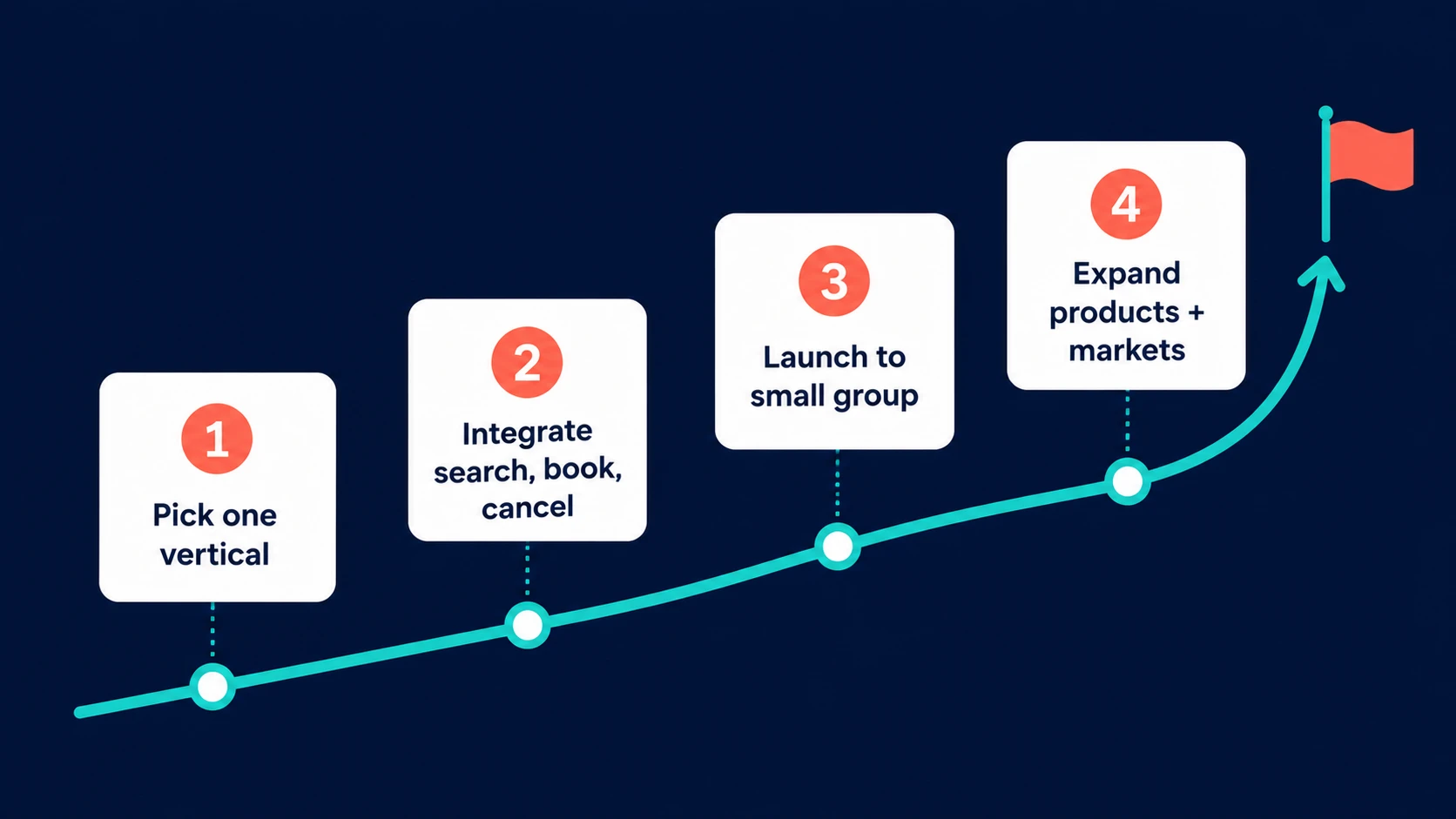
The pattern that works looks like this. First, pick one product vertical, for example hotels in one region. Second, integrate only three flows: search, book, and cancel. Third, launch to a small user group and watch real bookings. Finally, expand products and markets through the same API.
With a documented aggregator API, this first cycle takes 2-6 weeks. Our travel API integration timeline post breaks down each phase, from signing to first booking.
How to Choose a Travel API for Startups
Choosing a travel API for startups is a different exercise than choosing one for a large OTA. Your weights change. Speed and cost matter more; deep customization matters less. Use this comparison when you shortlist providers.
| Factor | Weight for a startup | What to check |
|---|---|---|
| Upfront cost | Very high | Setup fee, deposits, minimum volume |
| Time to first booking | Very high | Sandbox today, live in weeks |
| Documentation quality | High | Public docs, code samples, clear errors |
| Product coverage | High | Can you add hotels, cars, activities later? |
| Support | High | Named contact, response time promise |
| Custom features | Low at MVP stage | Nice to have, not a blocker |
If your product is an online travel agency, also read our companion guide on the travel API for OTAs. It covers OTA-specific needs like look-to-book ratios and content quality.
Costs: Models That Fit a Startup Budget
Travel APIs use four common pricing models. For a startup, the best model is the one that moves cost after revenue, not before it.
- Revenue share. The provider earns a share of each booking. No bookings, no cost. This is the most startup-friendly model.
- Markup on net rates. You get a net price and set your own margin. Good for hotels and packages.
- Per-request. You pay per API call. Risky early on, because test traffic and browsing create cost without revenue.
- Subscription. A fixed monthly fee. Predictable, but it burns cash in the months before launch.
Therefore, ask every provider for a revenue-share or hybrid option first. Run your numbers against realistic booking volumes, not hopeful ones.
From MVP to Scale: Growing with the Same API
The right API is not only a launch tool. It is a growth path. After your MVP proves demand, you scale along three lines without changing your integration.
- More products. Add cars, activities, transfers, or insurance to raise revenue per customer.
- More markets. Switch on new regions and currencies that the suppliers already cover.
- Better terms. As your volume grows, renegotiate your share or move key routes to direct deals while the API covers the rest.
This staged path keeps your early risk low. Moreover, it avoids the painful replatforming that hits startups who built a quick hack first.
Common Mistakes Travel Startups Make
We see the same traps across early-stage travel companies. Check your plan against this list before you sign anything.
- Building direct integrations too early. Volume first, direct deals later. The reverse order burns your runway.
- Launching every product at once. One vertical, one market, then expand. Wide launches hide what is actually working.
- Ignoring cancellation flows. Real customers cancel and change plans. If the API cannot handle it, your support inbox will.
- Choosing on demo quality. A polished demo says little about uptime, support, and reconciliation. Ask for references.
- No data ownership clause. Make sure booking and customer data stay yours if you switch providers later.
Final Thoughts
For a travel startup, speed is survival. Every month spent on supplier plumbing is a month of runway gone. The right travel API for startups gives you supply on day one, costs that follow revenue, and a clear path from MVP to scale.
If your startup is building an AI assistant, the same rules apply with a few more: see our guide to building an AI travel agent that can book, not just plan.
Tripgic gives travel startups one API for flights, hotels, cars, and activities, with startup-friendly terms. Talk to our team and see how fast your idea can go live.

 Akhirul Islam