
 Mehedi Ahsan Ashif
A corporate travel API powers the booking tools that companies use to manage business trips. It connects a travel tool to flights, hotels, and cars, with the controls that businesses need. As a result, employees book within policy, and managers keep full visibility. Moreover, it adds approval flows, reporting, and cost control that leisure tools lack. In this guide, you will learn what a corporate travel API does and how to connect one.
Business travel is a huge market. Global business travel spend is well over $1 trillion a year. Therefore, tools that manage it well are in high demand.
What Is a Corporate Travel API?
A corporate travel API connects a business travel tool to travel content and controls. It serves flights, hotels, and cars, plus the rules companies need. An application programming interface (API) simply lets two systems talk to each other.
It supports business travel, where the company, not the traveler, sets the rules. So the API must handle who can book what, and at what price. Therefore, it is more than a search-and-book tool.
The audience is different from leisure. The buyer is a company. The traveler is an employee. The manager approves and tracks spend. Specifically, the tool must serve all three at once.
How Corporate Travel Differs from Leisure
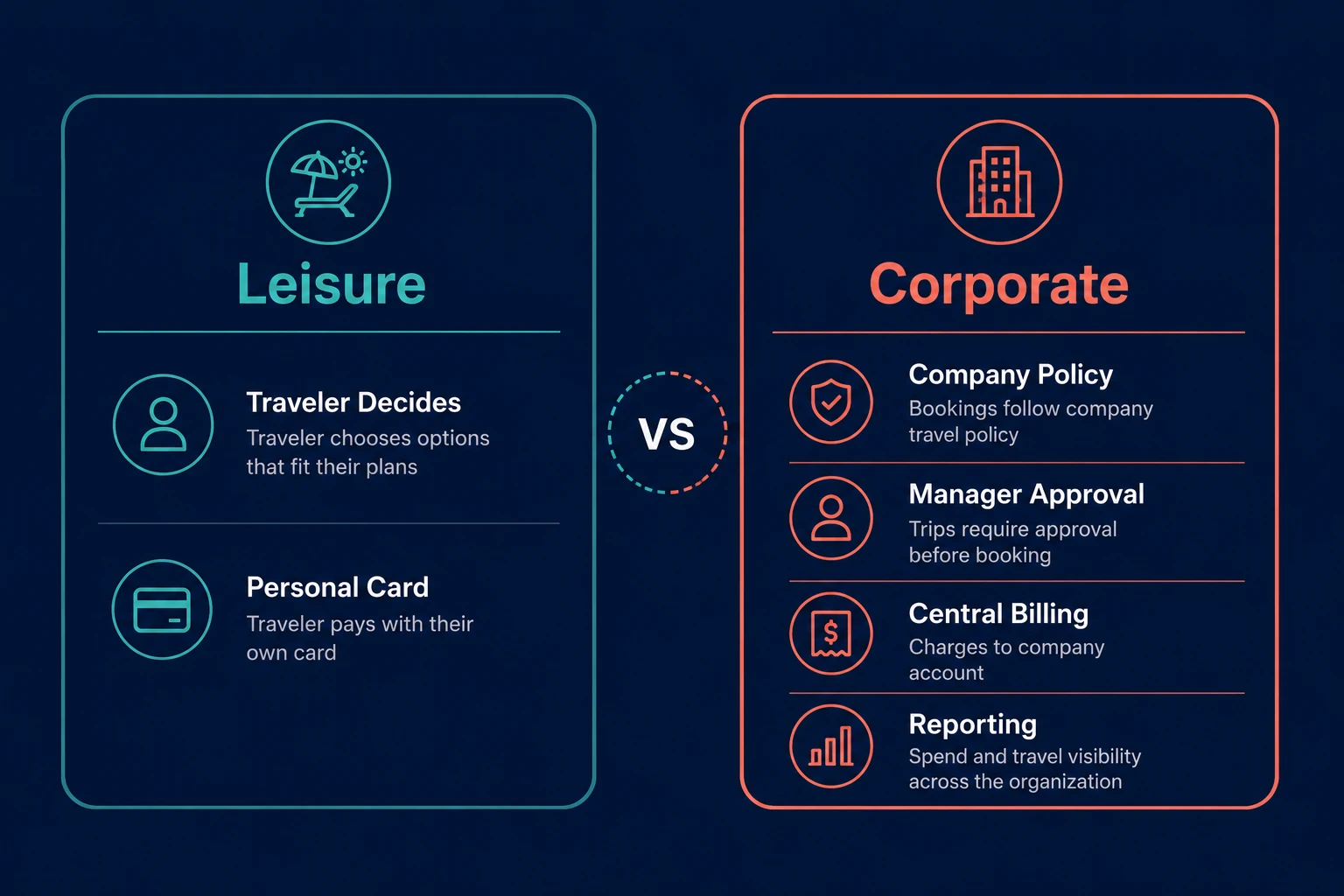
Leisure travel is simple: one person books their own trip. Corporate travel adds layers of control. Here are the main differences.
| Point | Leisure | Corporate |
|---|---|---|
| Who decides | The traveler | The company policy |
| Approval | None | Manager sign-off |
| Payment | Personal card | Central company account |
| Reporting | Not needed | Detailed spend reports |
So a corporate travel API must enforce rules, not just sell trips. As a result, the control layer is the real value. The travel content alone is not enough.
What a Corporate Travel API Does
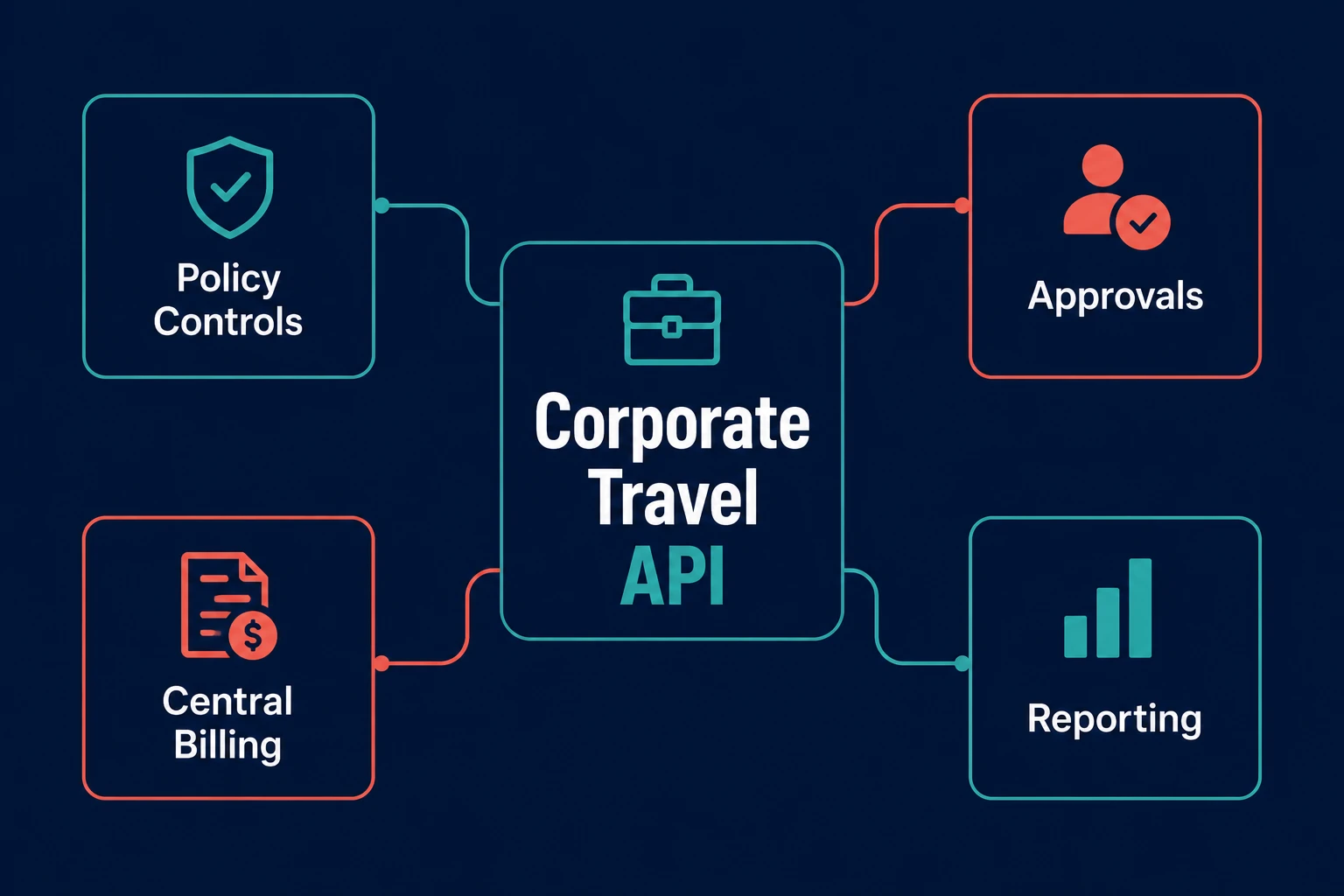
Beyond search and booking, a corporate travel API adds business controls. Here are the core features.
- Policy controls: limit fares, cabins, and hotel star ratings by rule.
- Approval flows: route trips to a manager for sign-off.
- Central billing: charge to a company account, not the traveler.
- Reporting: export spend by team, trip, and traveler.
- Traveler profiles: store IDs, loyalty numbers, and preferences.
- Duty of care: track where employees are when traveling.
These features turn raw travel content into a managed tool. Therefore, the content from a flight booking API and hotel API is just the base. The corporate layer sits on top.
Why Use a Corporate Travel API
For travel management companies and corporate tools, the right API is the foundation. Here is what you gain.
- Fast launch: get travel content without building supplier links.
- Policy by design: enforce rules at the search and book step.
- One source of truth: all bookings and spend in one place.
- Scale: serve many client companies from one platform.
- Stickiness: controls and reporting make clients stay.
A corporate travel API also widens content. You reach flights, hotels, and cars through one connection. To understand that base, read our guide on what a travel API aggregator is.
Common Challenges to Watch
Corporate travel is detailed. Know these pitfalls before you build.
- Complex policies: each client company wants different rules.
- Approval logic: multi-step sign-off can get complicated.
- Reporting needs: finance teams want detailed, clean data.
- Many suppliers: corporate buyers expect wide content and negotiated fares.
- Duty of care: you must track traveler location safely and privately.
The biggest challenge is flexible policy. Every client sets its own rules. Therefore, your tool needs a configurable policy engine, not fixed settings.
How to Connect a Corporate Travel API
You have two main paths. The right one depends on your team and goals.
Option 1: Build on direct supplier links
You can connect each supplier directly, then build the corporate layer. This gives full control. However, you first integrate flights, hotels, and cars separately. Then you build policy, approval, and reporting on top. This path is slow and needs a large team.
Option 2: Use an aggregator for content
An aggregator gives you all travel content through one API. So you skip the supplier work and focus on the corporate features. As a result, you launch your business travel tool far faster. This is the same model behind a unified travel API.
The basic steps to connect are simple:
- Sign with a provider and get sandbox keys.
- Connect flight, hotel, and car search.
- Build the policy and approval layer.
- Add central billing and reporting.
- Go live and onboard your first client company.
Final Thoughts
A corporate travel API is the engine behind every business travel tool. It pairs wide travel content with the policy, approval, and reporting that companies demand. However, the control layer is complex and client-specific. Therefore, most teams use an aggregator for content, then build the corporate features on top.
Tripgic connects flights, hotels, cars, activities, and more through one unified API, ready for corporate tools. Want to launch a business travel platform faster?




 Akhirul Islam