 Md Sozibul Islam
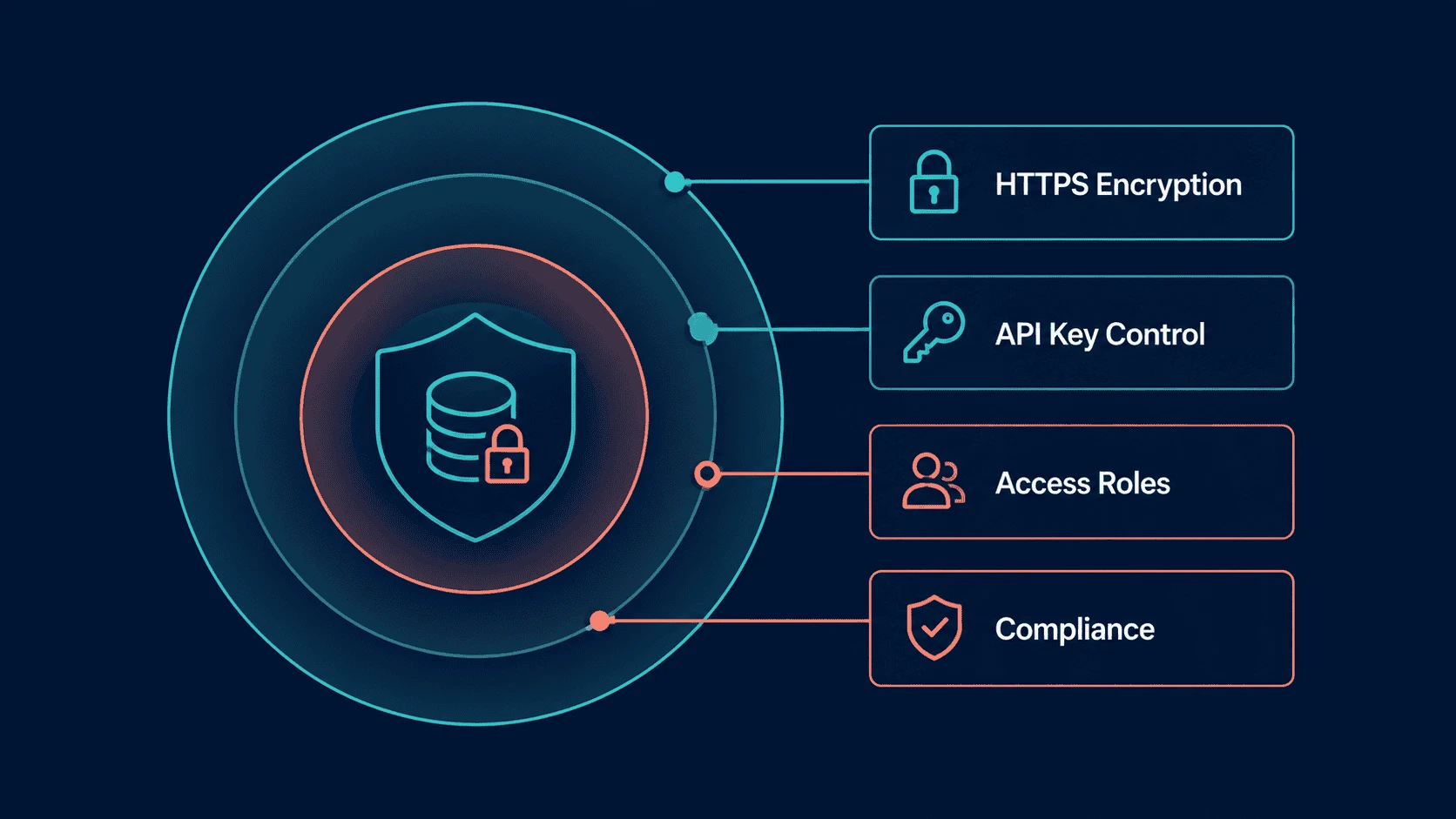
Travel API security is the set of controls that protect the traveller data and bookings moving through a travel API: encryption, key handling, access control, monitoring, compliance with PCI DSS and the GDPR, and defence against travel-specific abuse such as bots and fraud. Tripgic, for example, encrypts every API call with TLS 1.2 or higher, issues time-bound keys you can rotate or revoke, and requires IP whitelisting for production traffic.
This guide explains why travel APIs are a target, the risks that cause most incidents, what PCI DSS and the GDPR require, the threats specific to travel, and a checklist for securing your own integration and choosing a provider.
Why Travel APIs Are a Target
A travel booking holds more personal data than most online purchases:
| Data | Why it is valuable to an attacker |
|---|---|
| Full name and date of birth | Identity fraud |
| Passport or ID number | Identity fraud, forged documents |
| Email and phone | Phishing that looks like a real booking message |
| Card details | Direct financial fraud |
| Itinerary | Knowing when someone is away from home; targeted scams |
| Loyalty account | Points can be spent or sold |
One stolen booking record can be enough to impersonate a traveller. Large breaches in travel have led to heavy penalties: in the UK, the Information Commissioner’s Office fined British Airways £20 million and Marriott £18.4 million over data breaches. Beyond fines, travellers who receive fake “booking problem” messages blame the brand they booked with.
The Risks Behind Most Incidents
Leaked or long-lived keys
API keys end up in code repositories, mobile apps, shared documents and logs. A key that never expires stays useful to whoever finds it.
Weak checks on who can read what
The most common API flaw in the OWASP API Security Top 10 is broken object-level authorisation: an API that returns booking 1234 to anyone who asks for it, without checking that the caller owns it. In travel, that is a list of passports one number away.
Unencrypted data
Data sent without TLS can be read in transit. Data stored without encryption is exposed by any server or backup breach.
Too much access
Staff, contractors and partners with access to every booking, when they need only some. Every extra account is an extra way in.
Insecure partners
Your platform is only as safe as the suppliers, payment providers and tools that receive its data. OWASP lists “unsafe consumption of APIs” — trusting partner data without checks — as its own risk.
Too much data in logs
Debug logs that capture full requests often capture passport numbers and card data too, then keep them for months in a system nobody thinks of as sensitive.
PCI DSS: Protecting Card Data
PCI DSS is the security standard of the payment card industry. It applies to every business that stores, processes or transmits card data. The current version is 4.0.1; the requirements that were future-dated in version 4.0 became mandatory on 31 March 2025.
What it asks, in short
- Protect stored card data, or better, do not store it.
- Encrypt card data in transit over open networks.
- Restrict access to card data to those who need it.
- Identify and authenticate every user, with multi-factor authentication for access to card data environments.
- Log and monitor access.
- Test security regularly, including scans and penetration tests.
- Maintain a security policy.
How travel platforms reduce their PCI scope
The single most effective step is to keep card data off your own systems:
| Approach | Card data on your servers? | PCI effort |
|---|---|---|
| Payment page hosted by a certified provider | No | Lowest |
| Provider’s embedded fields (iframes) | No | Low |
| Tokenisation — card replaced by a token | Token only | Lower |
| Collecting cards in your own forms | Yes | Highest |
When choosing a payment provider, ask for its PCI DSS attestation, whether it supports strong customer authentication such as 3-D Secure for European cards, and how it screens for fraud. These three answers decide most of your card risk.
Even with a hosted page, some duties remain — such as securing the page that redirects to it — so confirm your level with your payment provider.
Cards and suppliers
Travel adds a twist: some suppliers need card details to guarantee a booking, and virtual cards are often used to pay hotels. Agree with your providers how card data moves, so it never passes through systems that are not built for it.
The GDPR: Protecting Traveller Data
The General Data Protection Regulation governs personal data of people in the European Union. It applies to companies outside the EU that offer goods or services to people there. Serious breaches can lead to fines of up to €20 million or 4% of worldwide annual turnover, whichever is higher.
What it means for a travel platform
- A lawful reason for each use of data — booking a trip is usually performance of a contract.
- Data minimisation — collect only what the booking needs. Passport data only when the trip requires it.
- Retention limits — delete or anonymise data once it is no longer needed.
- Transparency — a clear privacy notice naming who receives the data, including suppliers.
- Security — appropriate technical and organisational measures.
- Processor agreements — a data processing agreement (DPA) with every provider that processes data for you.
- Breach notification — to the authority within 72 hours where required, and to travellers when the risk is high.
- Rights — access, correction and deletion requests answered on time.
International transfers
Travel data crosses borders by nature: a booking for an EU traveller may pass to a supplier in Asia and an airline in the Middle East. Check that each transfer has a lawful basis and that contracts cover it.
Other privacy laws
The GDPR is the best known, but not the only one. California’s CCPA, the UK GDPR and many national laws set similar duties. A programme built around the GDPR covers much of what the others require.
Threats Specific to Travel
Scraping bots
Bots search fares and rates thousands of times to copy prices. They raise your supplier search costs, can breach look-to-book limits and slow the site for real travellers.
Inventory holding
Bots or bad actors create bookings and hold seats or rooms without paying, so real travellers see them as sold out. This is sometimes called denial of inventory.
Card testing
Fraudsters use the payment step to test stolen card numbers with small bookings. A spike in failed payments is the usual sign.
Account takeover
Stolen passwords are used to log into traveller or agent accounts, spend loyalty points, or change bookings and refunds.
Fake booking messages
Attackers who obtain booking details send convincing messages asking travellers to “re-confirm” payment. Hotels and booking platforms have been targeted this way.
| Threat | Signals | Defences |
|---|---|---|
| Scraping | High search volume, no bookings | Rate limits, bot detection, caching |
| Inventory holding | Many unpaid holds | Short hold times, payment before hold, limits per user |
| Card testing | Many small failed payments | Fraud screening, CAPTCHA at payment, velocity limits |
| Account takeover | Logins from new places, quick changes | Multi-factor login, alerts on changes |
| Fake messages | Traveller reports | Data protection, clear guidance to travellers |
Securing Your Own Integration
The provider secures its side. These are yours:
Keys and credentials
- Keep keys on the server, never in a mobile app or browser code.
- Use a secrets manager, not code or configuration files in a repository.
- Separate sandbox and production keys.
- Rotate keys on a schedule and immediately when someone with access leaves.
- Have a plan for replacing a leaked key without downtime.
Access control
- Check ownership on every booking request: the user asking for booking 1234 must own it.
- Roles for staff: an agent may view and book; only finance may refund.
- Remove access the day it is no longer needed.
Data handling
- Encrypt sensitive data at rest, especially passport numbers.
- Mask data in logs — no full card or passport numbers.
- Delete what you no longer need, on a schedule.
Monitoring
- Log access and changes to bookings.
- Alert on unusual patterns: search spikes, failed payments, mass booking views.
- Practise your incident plan before you need it.
Security Along the Booking Flow
Each step of a booking carries its own risks:
| Step | Main risk | Control |
|---|---|---|
| Search | Scraping, search-cost abuse | Rate limits, bot detection, caching |
| Price check | Manipulated prices sent from the browser | Always take the price from the API on the server, never from the client |
| Traveller details | Exposure of names, birth dates, passports | Encryption, masking in logs, minimal collection |
| Payment | Card theft, card testing | Hosted payment page, fraud screening |
| Booking and ticketing | Unpaid holds, duplicate bookings | Hold limits, idempotent booking calls |
| After sale | Account takeover, refund fraud | Multi-factor login, checks before refunds go to new accounts |
The price check deserves a special note. A common mistake is to let the browser send the price back to the server at checkout. An attacker can change it. The server must always use the price it received from the travel API at validation.
Passport and Advance Passenger Data
Many international flights require advance passenger information — passport number, nationality, date of birth, document expiry — before departure. This is some of the most sensitive data a travel platform holds.
- Collect it only when the trip requires it, close to when it is needed.
- Encrypt it at rest and restrict who can view it.
- Do not show full numbers in staff screens unless needed; mask them.
- Delete it when the trip and its legal retention period are over.
Security for B2B and Agent Platforms
Platforms that let travel agents and sub-agents book face extra risks:
- Compromised agent accounts can book on credit and disappear before payment. Use multi-factor login, credit limits and alerts on unusual booking patterns.
- Shared logins in agency offices hide who did what. Require one login per person.
- Sub-agent hierarchies need clear permissions: a sub-agent should see its own bookings, not its parent’s whole book.
- Refunds to new bank details are a classic fraud path. Confirm changes through a second channel.
Mobile Apps
Mobile apps add their own traps:
- Never put supplier or provider API keys in the app. Apps can be unpacked; keys inside them are public. The app should call your own server, which calls the travel API.
- Use secure storage on the device for tokens.
- Pin to HTTPS and reject insecure connections.
- Expire sessions sensibly, especially where payment cards are saved.
When Something Goes Wrong: An Incident Plan
Have a written plan before you need it:
- Detect — alerts on unusual access, payment failures or traffic.
- Contain — revoke exposed keys, block abusive traffic, lock affected accounts.
- Assess — what data, how many travellers, which systems.
- Notify — authorities where the law requires (within 72 hours under the GDPR when it applies), partners and providers, and affected travellers when the risk is high.
- Fix — close the cause, not only the symptom.
- Review — what would have caught it earlier.
Agree with your travel API provider how each side tells the other about incidents. Its notification process is part of your plan.
A Go-Live Security Checklist
- Production keys stored in a secrets manager, not in code
- Sandbox and production keys separate
- Server IPs registered where the provider requires IP whitelisting
- Every booking request checks that the caller owns the booking
- Prices at checkout taken from the API, never from the browser
- Card data handled by a certified payment provider
- Passport and card numbers masked in logs
- Rate limits and bot protection on search and payment
- Staff roles set, and multi-factor login for admin access
- DPA signed with the provider
- Incident plan written and contacts known
What to Ask a Travel API Provider
| Question | Good answer |
|---|---|
| Is every call encrypted in transit? | Yes, TLS 1.2 or higher |
| Is sensitive data encrypted at rest? | Yes |
| How are keys issued, rotated and revoked? | Time-bound keys, rotation without downtime, revocation on demand |
| Can production access be restricted by IP? | Yes |
| Are access and transactions logged? | Yes, with audit logs |
| Is the sandbox separate from production? | Fully isolated |
| How are incidents handled and communicated? | A defined process with customer notification |
| Will you sign a DPA? | Yes |
| Which frameworks does your programme follow? | Named frameworks, with documents on request |
| How do I report a vulnerability? | A published contact and process |
Ask for documents, not adjectives. A security page is a starting point; a DPA, security overview and procurement questionnaire answers are evidence.
Aggregator or Direct Connections: The Security View
| Many direct connections | One aggregator | |
|---|---|---|
| Credentials to protect | One set per supplier | One set |
| Data paths to secure | Many | One |
| Parties holding traveller data | Many | Fewer, through one contract |
| Security reviews | One per supplier | One main review |
| Risk concentration | Spread out | Concentrated — the review matters more |
An aggregator does not remove risk, but it turns many small, hard-to-check relationships into one you can examine properly. See what a travel API aggregator is for the wider picture.
Common Mistakes
- Keys in code repositories. The most common leak, and the easiest to prevent.
- One key for everything. Sandbox, production and every developer sharing the same credential.
- Trusting the browser. Prices, booking IDs or user IDs taken from the client without checks.
- Logging everything. Full requests with passports and cards kept in log tools for months.
- No rotation plan. A leaked key that cannot be replaced without downtime stays in use.
- Ignoring partners. Sending traveller data to tools and suppliers without agreements or checks.
- Treating compliance as a badge. PCI DSS and the GDPR are ongoing duties, not one-time certificates.
Key Terms
| Term | Meaning |
|---|---|
| TLS | Transport Layer Security — encryption for data in transit; version 1.2 or higher is the current baseline |
| Encryption at rest | Data encrypted where it is stored |
| Tokenisation | Replacing a card number with a token that is useless if stolen |
| IP whitelisting | Accepting traffic only from approved server addresses |
| DPA | Data processing agreement between a business and a provider that processes data for it |
| Object-level authorisation | Checking that the caller may access the specific record requested |
| Look-to-book ratio | Searches per booking; abuse raises it |
| Card testing | Using a payment form to check whether stolen cards work |
How Tripgic Secures Its API
According to Tripgic’s Security & Compliance page:
- Encryption everywhere — TLS 1.2 or higher on every API call, and sensitive data encrypted at rest.
- Rotatable credentials — time-bound API keys, scoped per environment, that you can rotate or revoke on demand from your dashboard.
- IP whitelisting — production endpoints accept traffic only from your approved application servers.
- Audit logging across access and transactions.
- Environment isolation — the sandbox is completely separate from production data and systems.
- Incident response — a defined process for detection, escalation and customer notification.
- Compliance — the security programme is built around GDPR and CCPA obligations, SOC 2 practices and TLS 1.2+ standards, with a DPA and security documentation available on request for procurement review.
- Data minimisation — only the data needed for search, booking and post-ticketing operations is processed.
- Responsible disclosure — vulnerabilities can be reported to support@tripgic.com.
Base URLs and credentials are issued during onboarding rather than published, as the API documentation explains. The same integration covers flights from 800+ airline and LCC connections, 2M+ hotel properties and more, so one security review covers every product. Testing starts in a free sandbox.
Final Thoughts
Travel APIs carry some of the most sensitive data people share online, which is why they attract attackers. Most incidents come from a short list of causes — leaked keys, weak access checks, unencrypted data, too much access and insecure partners — plus travel’s own threats of bots and fraud. PCI DSS and the GDPR set the baseline; your own key handling, access checks and monitoring decide whether it holds.
Security is also a sales argument in B2B travel. Corporate buyers and larger agencies now send security questionnaires before they sign, and a platform that can show encryption, key rotation, access control, a DPA and an incident plan wins those reviews faster. Building these controls early costs less than adding them under a buyer’s deadline, and it protects the travellers whose data makes every booking possible.
When you choose a provider, ask for evidence and read it. If you want to see Tripgic’s security documentation as part of your review, book a kick-off call and ask for the DPA and security overview.