 Mehedi Ahsan Ashif

A travel API for tour operators gives an operator live, bookable travel content — flights, hotels, transfers, activities and ready-made tours — so it can sell packages online without calling each supplier or relying only on rooms and seats bought in advance. Tripgic’s Tour Package API, for example, sells pre-packaged tours from city search to issued order in nine calls, and the same API carries the flights, hotels, transfers and activities an operator needs to build its own packages.
This guide covers both ways tour operators use APIs: reselling ready-made tours and building packages from live components. It explains allotments versus live inventory, how a package booking flows, pricing, group bookings, regulation, operations when something changes, and how to choose a provider.
Two Ways Tour Operators Use a Travel API
| Sell ready-made tours | Build your own packages | |
|---|---|---|
| What you sell | Tours designed by other suppliers | Your own itineraries: flight + hotel + transfer + activities |
| What the API provides | Tour search, details, validation, order and issue | Each component, searched and booked separately |
| Your value | Choice and distribution | Design, local knowledge and the package price |
| Effort | Lower | Higher: you combine and service several bookings |
Many operators do both: they sell their own signature packages and fill gaps with ready-made tours from other suppliers. A city-break specialist, for example, might design its own three-night packages and add other suppliers’ day tours and multi-day excursions to give travellers more choice without designing every product itself.
What Tour Operators Need From a Travel API
| Need | Why it matters to a tour operator |
|---|---|
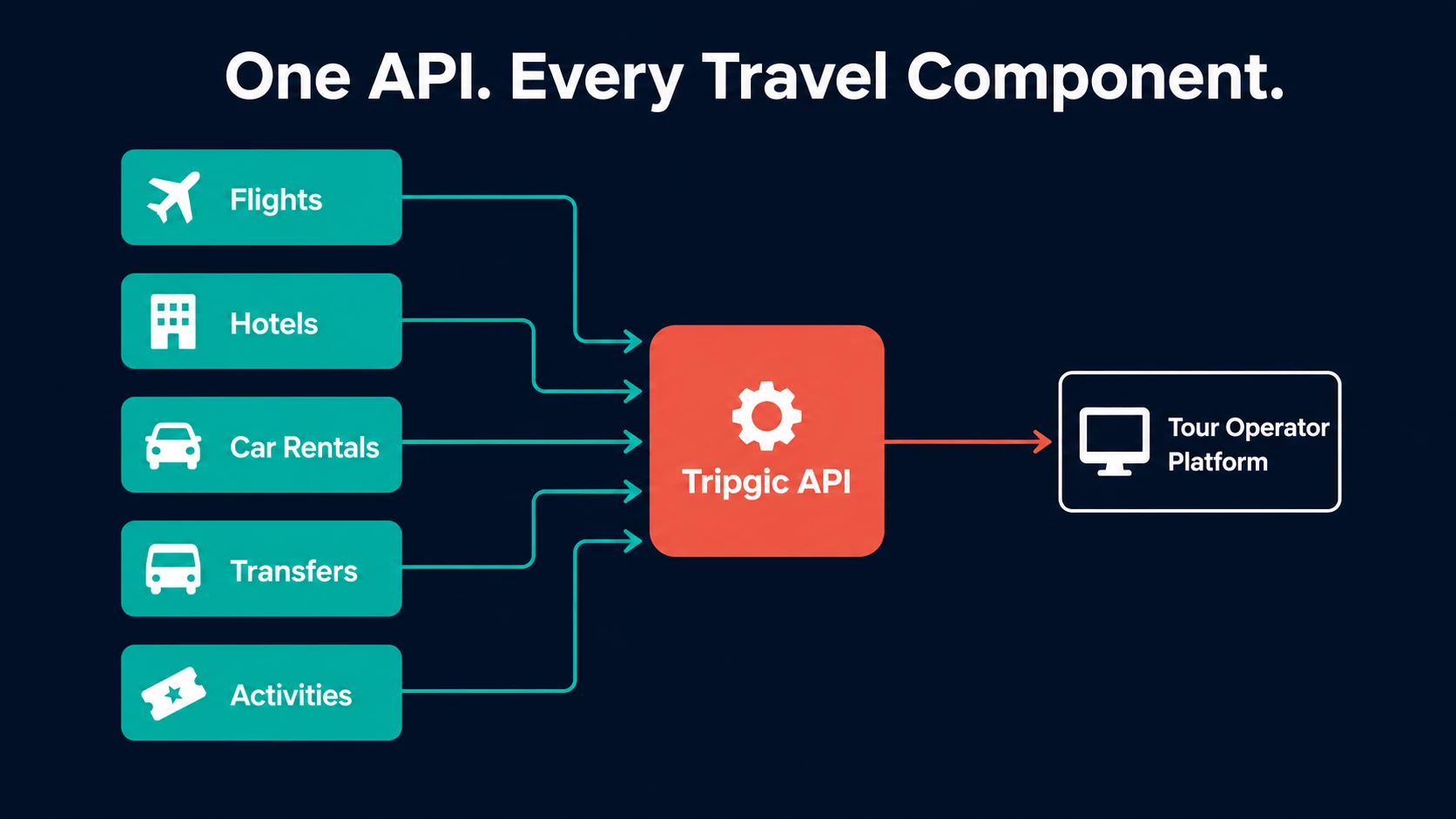
| Every component through one integration | A package needs flights, hotels, transfers and activities together |
| Final prices at validation | The package price is only as reliable as each component’s |
| Clear cancellation rules per component | Package terms must respect every supplier’s rules |
| Group handling | Many tours are sold to groups and families |
| Ready-made tours | To fill gaps in your own range |
| Net rates | So you control the package margin |
| One data format | So your package builder handles one pattern, not five |
The last row is easy to undervalue. A package builder that combines five products in five formats spends most of its code on translation; one format leaves that code for the packages themselves.
Selling Ready-Made Tour Packages
A tour package API lets you sell pre-packaged tours from tour suppliers as one product. Tripgic’s Tour Package API page describes the flow in nine documented endpoints:
| Step | What it does |
|---|---|
| City suggestion | Suggests destination cities as travellers type |
| Tour search | Searches available tours for a destination and dates |
| Tour details | Returns the itinerary, inclusions and options |
| Validate | Confirms the selected tour and options, so the price is final before payment |
| Validation details | Reads back the validated tour |
| Update traveller | Adds traveller information |
| Order | Confirms the tour and places the order |
| Order details | Retrieves the order at any time |
| Issue order | Issues the confirmed order |
Every call is a POST to the base URL issued with your credentials and returns a tracking ID you carry into the next step — the same envelope as Tripgic’s flights and hotels. For an operator, this means ready-made tours can sit beside its own products on one website, in one booking pattern.
Building Your Own Packages From Live Components
Most tour operators’ real value is their own itineraries. With an API, each component is searched and booked live:
- Flights to and from the destination, with fare families and baggage.
- Hotels for each night, with rate plans and cancellation terms.
- Transfers between the airport and the hotel, and between stops.
- Activities — tours, attractions, experiences — on the right days.
- Extras such as eSIM data plans for international travellers.
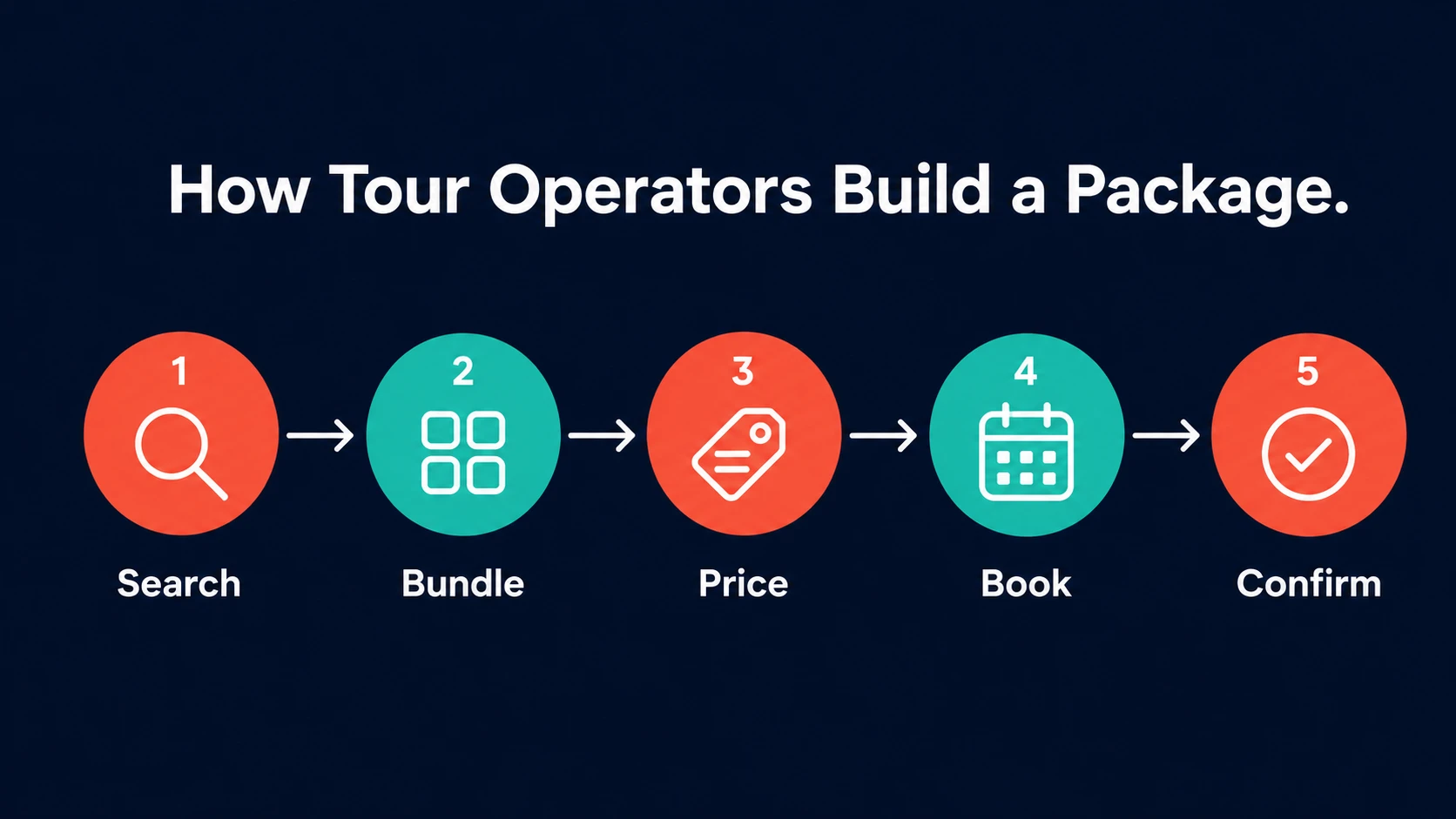
Your platform searches each component, validates each price, presents the combination at one package price, then books each component separately. The traveller sees one trip; behind it are several bookings, each with its own supplier rules. For components, see our guides to the hotel API, airport transfer API and tours and activities API.
Allotments vs Live Inventory
Traditionally, tour operators bought allotments: blocks of hotel rooms and airline seats held at agreed rates for a season. Unsold inventory went back to the supplier after a release period — a set number of days before arrival. If the operator committed to a guaranteed block, unsold rooms could cost money.
| Allotments | Live inventory through an API | |
|---|---|---|
| Availability | Guaranteed within the block | Whatever is available at booking |
| Rates | Negotiated in advance | Live rates, sometimes net rates you mark up |
| Risk | Unsold inventory, release deadlines | Price and availability can change |
| Flexibility | Fixed to the contracted hotels and dates | Any hotel, any date the API carries |
| Best for | Peak dates and core hotels | Long tail, new destinations, off-peak |
Most operators now combine both: allotments for their busiest hotels and dates, live inventory for everything else. An API removes the need to commit in advance for the long tail — which is where much of the risk sat.
Moving From Allotments to Live Inventory, Step by Step
- List your allotments by hotel, date range and release period, with how much of each you sold last season.
- Find the weak blocks — hotels and dates where you regularly returned rooms or paid for unsold ones.
- Price the same hotels and dates live through the API and compare with your allotment rates.
- Move the weak blocks first to live inventory; keep the strong ones where availability matters most.
- Run both for a season, tracking margin and availability on each.
- Renegotiate your remaining allotments with real data on what you actually sell.
The aim is not to abandon allotments but to hold only the ones that earn their risk.
Pricing a Package
Packages are usually sold at one price, not as a list of component prices. Building that price well matters:
- Start from final component prices. Validate each component and use the confirmed price, not a search estimate.
- Add your margin per package, per component or both.
- Decide what to show. Many operators show only the package price; others show inclusions without breaking down costs.
- Handle currency when components are priced in different currencies.
- Re-price before payment if the traveller takes time to decide; components can change independently.
A flat per-transaction API fee makes this simpler: each component’s cost is known in advance, and high-value components do not carry a growing fee. See travel API pricing.
Group Bookings
Groups are common for tour operators, and they stretch APIs:
- Flights: many APIs limit passengers per booking; larger groups may need group fares negotiated separately.
- Hotels: multi-room searches must return enough rooms of the right types at one hotel.
- Transfers: vehicle size must match the group.
- Activities: time slots must have space for the whole group.
Test the largest group you plan to sell in the sandbox before you advertise it, and keep a manual route for groups beyond the API’s limits. School trips, weddings and corporate incentives often exceed standard limits, so agree in advance how your team will handle them.
Seasonality and Peak Dates
Tour operators live by the calendar more than most travel businesses:
- Peak dates sell out early. Allotments still make sense for the busiest hotels and weeks, where live availability can disappear.
- Shoulder and off-peak dates are where live inventory shines: wider choice, flexible dates, no unsold blocks.
- Prices move with demand. Re-price packages close to sale rather than fixing them months ahead.
- Activities have seasons too. Some tours run only in certain months; check availability per date.
- Peak traffic tests your platform. Load-test searches before the season, when many customers price packages at once.
A good mix — allotments for peak core products, live inventory for the rest — protects both availability and margin.
Package Travel Rules
Combining travel services can bring legal obligations. In the EU, the Package Travel Directive (2015/2302) gives travellers specific protections when services such as flights and accommodation are sold together, including information requirements and responsibility for the package as a whole. Other countries have their own rules.
Before you sell combined packages, check:
- whether your packages count as package travel where you sell,
- what information you must give before booking,
- what protection for customer money is required, and
- who is responsible when a component fails.
The API supplies the components; the obligations of selling them as a package sit with you.
Selling Your Packages Through Agents and Partners
Many tour operators sell through travel agents and partner websites as well as directly:
- Net rates for agents. Agents need a net package price and their own margin; your platform must calculate both.
- A B2B portal or API. Partners either log in to book or connect to your own API. See our B2B travel platform guide.
- Consistent availability. Packages built on live components stay accurate across every channel, because each sale re-checks the components.
- Clear documents. Agents need vouchers and itineraries they can pass to their customers without editing.
Live components make multi-channel selling safer: an allotment shared across channels can oversell; a live booking cannot.
Operations: When One Component Changes
A package is only as strong as its weakest component. Plan for:
| Event | What to do |
|---|---|
| Flight schedule change | Check whether transfers and the first hotel night still fit; adjust them |
| Hotel cancellation by supplier | Find a similar hotel and inform the traveller |
| Traveller changes dates | Apply each component’s change rules; re-price the package |
| Traveller cancels | Cancel each component under its rules; refund under your package terms |
| Activity cancelled for weather | Offer an alternative or a refund |
Store each component’s booking reference, supplier rules and status under one package record. Your support team needs one view of the whole trip, not five separate bookings. When a traveller calls from an airport, the agent should see every part of the trip — and every rule that applies to it — on one screen.
The Documents Travellers Expect
A package traveller expects one clear set of documents, even though the trip is several bookings:
- One itinerary listing every flight, hotel night, transfer and activity in order, with times in local time.
- Every reference they may need: ticket numbers, hotel and activity voucher numbers, transfer pickup details.
- What is included, from meals to luggage, and what is not.
- Cancellation and change terms for the package, consistent with each supplier’s rules.
- Emergency contacts for your team during the trip.
Generate these from the booking record automatically. Hand-edited documents are where errors creep in — usually on the day of travel.
Why Manual Processes Struggle
Many operators still price packages by checking suppliers one by one, then confirm by email. That works for a handful of bookings a week and breaks as volume grows:
- Slow quotes lose customers who compare online.
- Prices change between quote and confirmation.
- Errors multiply with every manual step.
- Staff time grows with every booking.
An API lets the website quote and confirm in seconds, and lets staff focus on design and service. It also gives every quote the same accuracy, whoever prepares it and whatever the time of day, which matters when customers compare several operators in one evening.
The Technology Behind a Modern Tour Operator
| System | What it does | Where the travel API fits |
|---|---|---|
| Website and booking engine | Shows packages, takes bookings | Searches and books components and tours |
| Package builder | Combines components into packages and prices them | Supplies live prices and availability |
| Reservation system | Holds every booking and its status | Receives references, rules and documents |
| Agent portal | Lets partners book at net rates | Uses the same API behind the scenes |
| Payments and finance | Takes money, refunds, reconciles | Uses component costs returned by the API |
| CRM and marketing | Manages customers and campaigns | Uses booking data from the reservation system |
The API is the supply layer under several of these systems. Choosing one that covers every component in one format keeps the rest of the stack simpler.
Measuring Package Performance
| Measure | What it tells you |
|---|---|
| Quote-to-booking conversion | Whether package prices and presentation work |
| Margin per package, after component costs | Whether pricing is right |
| Components re-priced before payment | How volatile your components are |
| Changes and cancellations per package | Hidden servicing cost |
| Allotment usage on peak dates | Whether your blocks are the right size |
| Share of packages using live components | How far you have moved beyond allotments |
Review them by destination and season. Patterns there tell you where to hold allotments and where live inventory is enough.
A Worked Example: A Seven-Night Package
A tour operator sells a seven-night city-and-beach package.
- The traveller chooses dates and the number of adults and children.
- The platform searches flights, two hotels (three nights in the city, four at the beach), three transfers and two activities.
- It validates each component and shows one package price, with inclusions listed.
- The traveller pays, and the platform books each component, receiving a ticket, two hotel vouchers, three transfer confirmations and two activity vouchers.
- A week before travel, the airline moves the return flight by three hours. The platform checks the final transfer still works, adjusts its pickup time and tells the traveller.
- After the trip, finance sees the package revenue, each component’s cost and the margin.
Twelve bookings, one trip, one record — that is what the API and a good package model make possible. Done by hand, the same trip would take hours of supplier calls and emails.
How to Choose a Travel API for Tour Operators
| Question | What a good answer looks like |
|---|---|
| Which components can I book through one integration? | Flights, hotels, transfers, activities and ready-made tours |
| Are prices final at validation for every component? | Yes |
| What are the group limits? | Stated per product |
| How are changes and cancellations handled per component? | Documented calls with rules returned |
| Do I get net rates I can mark up? | Yes, with a clear fee model |
| Is the same format used for every product? | One schema, one booking pattern |
| How do you notify schedule changes? | A stated method |
Common Mistakes Tour Operators Make
- Showing search prices as package prices. Validate every component first.
- Treating the package as one booking. It is several; store and service each.
- Ignoring regulation. Check package-travel rules before combining services.
- Over-relying on allotments. Use live inventory for the long tail and off-peak.
- No plan for schedule changes. One flight change can break transfers and hotel nights.
- Testing only small groups. Test the largest group you sell.
How Tripgic Supports Tour Operators
Tripgic is a B2B travel API aggregator. For tour operators, its own pages state:
- Ready-made tours. The Tour Package API sells pre-packaged tours through nine documented endpoints, with the price validated before you order.
- Components for your own packages. Flights from Amadeus, Sabre, Travelport, NDC and 100+ low-cost carriers; 2M+ hotel properties from 50+ suppliers; transfers; activities; eSIM in 175+ countries — 8 product families over 73 endpoints.
- One envelope. Every product returns the same JSON envelope with a tracking ID, so your package logic handles one pattern.
- Final prices and a flat fee. Prices at validation and booking are final; the fee is a flat amount per transaction — per passenger for flights, per night for hotels, per booking for everything else — never a percentage. Which plans include tour packages is on the pricing page.
- Test first. Sandbox credentials at no charge after a short call; activation for live use usually takes 3–5 business days.
Final Thoughts
A travel API lets a tour operator do two things it could not do well by hand: sell other suppliers’ ready-made tours alongside its own, and build packages from live components priced at the moment the customer buys. The work that remains is the operator’s own — designing trips, pricing them, meeting package rules and looking after travellers when something changes.
Start with your best-selling package, rebuild it on live components, test it end to end, and grow from there. Compare its margin and conversion with the allotment version for a season. Most operators find that live components win on the long tail and allotments still win on a few peak hotels — and that the right answer is a mix decided by data, not habit. Once the first package works, the same pattern carries every other one.
Want to build packages on live inventory? Book a demo and get Tripgic sandbox credentials after a short call.