
 Mehedi Ahsan Ashif
A travel API for DMCs gives destination management companies direct access to hotels, transfers, tours, and activities through a single integration. Instead of managing dozens of supplier contacts manually, a DMC connects once and accesses real-time inventory across all its services.
What Is a Destination Management Company?
A destination management company (DMC) is a local ground specialist. It handles the on-the-ground services that travelers need at a destination. These include hotel bookings, airport transfers, guided tours, activities, and event logistics.
DMCs work with tour operators, travel management companies, and corporate clients. They act as the local expert layer of the travel supply chain. Specifically, they know their destination deeply — local suppliers, seasonal availability, regulations, and logistics.
DMCs differ from tour operators. A tour operator builds and sells packages to end travelers. A DMC provides the local components that go inside those packages. The tour operator is the seller. The DMC is the local supplier. Professional DMCs often align with the Association of Destination Management Executives (ADME) to set service standards in their destinations.
Examples of DMC services include pre-built ground packages, tailor-made itineraries, team-building programs, airport meet-and-greet, VIP transportation, and multi-day touring. The range depends on the destination and the buyer’s requirements.
Why DMCs Are Moving to API-First Operations
Most DMCs still run on manual processes. They receive requests by email, check availability by phone, and confirm bookings in spreadsheets. This approach worked when volumes were low. However, it does not scale.
Tour operators and OTAs now expect instant pricing and real-time availability. If a DMC cannot respond fast, the buyer moves on. Additionally, managing many supplier contacts manually creates errors, delays, and missed bookings.
Most B2B travel buyers now expect instant pricing. Waiting 24 to 48 hours for a manual quote is no longer acceptable. Therefore, DMCs that automate their booking flow win more business — and service it faster too.
An API-first approach solves this. Instead of manual back-and-forth, the DMC connects its platform to suppliers via API. As a result, availability checks happen in milliseconds, not hours. Bookings confirm automatically. The team spends less time on admin and more time on destination expertise.
What a Travel API for DMCs Connects You To
A travel API for DMCs should cover all the ground services a destination specialist provides. Specifically, it should connect to four core service types.
Hotels
Hotel inventory is the biggest volume item for most DMCs. A hotel API integration gives access to live rates, room types, availability calendars, and booking confirmations. The best APIs include both global chains and local boutique properties — not just big brands.
Transfers
Airport and point-to-point transfers are a core DMC service. An airport transfer API connects you to private cars, shared shuttles, and luxury vehicles with real-time pricing and availability by route, date, and vehicle type.
Tours and Activities
Tours, guided experiences, and activities are the most destination-specific content. A tours and activities API gives time-slot availability, voucher delivery, and booking confirmations for thousands of local experiences across your destinations.
Flights (Optional)
Some DMCs also handle inbound flights for their clients. Adding flight content through the same API lets you offer a complete arrival package — flight, transfer, hotel, and activities — through one booking flow.
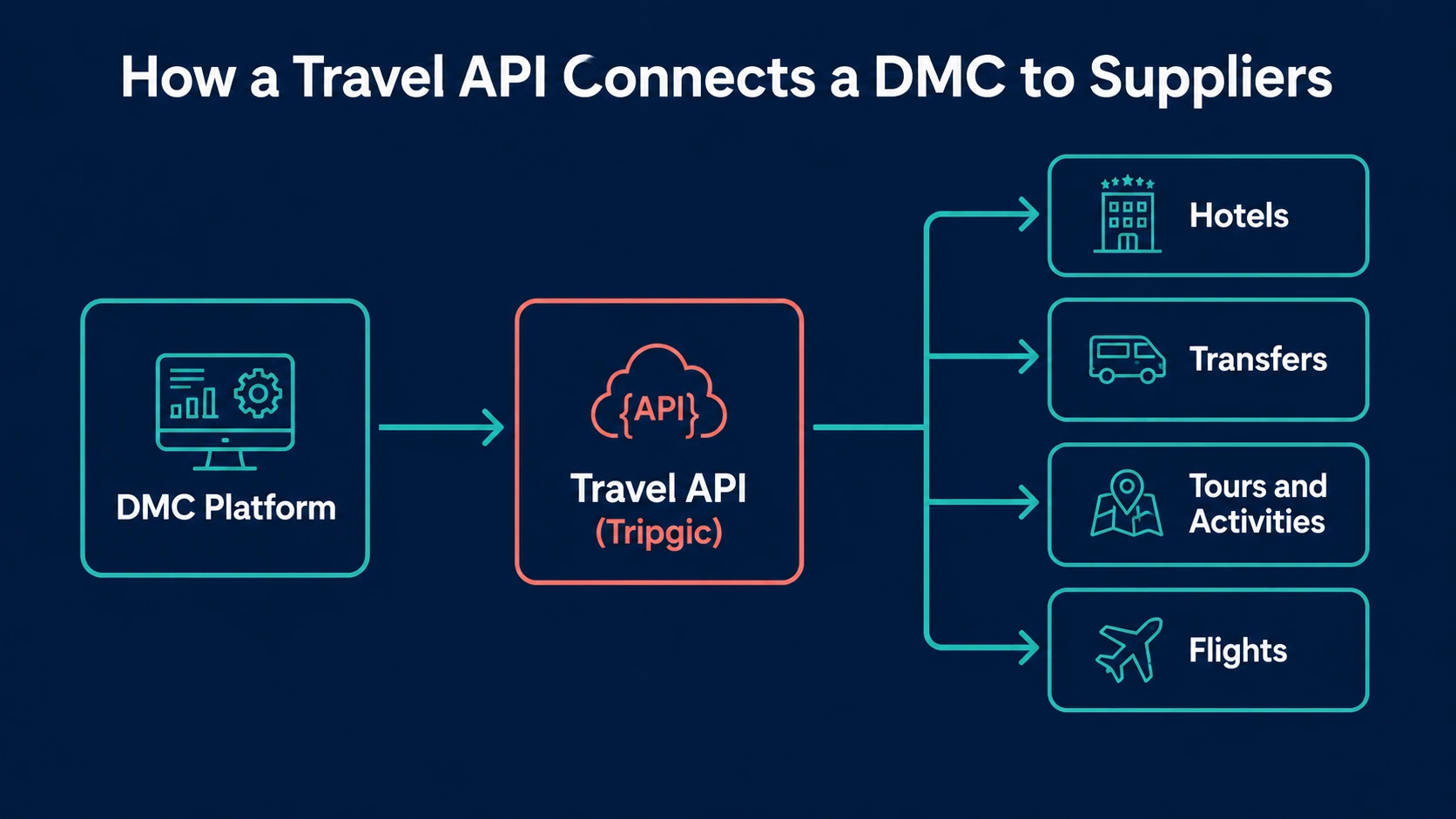
How a Travel API for DMCs Works
A travel API for DMCs follows a simple request-response flow. First, the DMC platform sends a search request — for example, available hotel rooms in Dubai for June 20 to 25. The API queries all connected suppliers at the same time and returns a combined list with live pricing.
The DMC selects an option and sends a booking request. The API forwards it to the supplier, receives a confirmation number, and returns it to the DMC platform in seconds. No emails, no phone calls, no manual follow-up needed.
Behind the scenes, the aggregator maintains live connections to dozens of suppliers. It handles authentication, request formatting, error handling, and content normalization. Consequently, your DMC platform only needs to learn one interface. The same flow works for transfers, tours, and activities too.
| Manual Process | API-First Process |
|---|---|
| Email supplier for availability | API query returns results instantly |
| Wait 24-48 hours for a response | Real-time confirmation in seconds |
| Manual data entry into spreadsheets | Booking stored automatically |
| Risk of double-bookings | Live inventory prevents duplicates |
| Scales with headcount | Scales with booking volume |
Key Features Every DMC Needs in an API
Not all travel APIs are built for ground operations. When evaluating options, look for these features specifically.
- Multi-content support: Hotels, transfers, tours, and activities in one API — not just flights.
- Local supplier depth: Does it include boutique hotels and local activity operators in your key destinations?
- Real-time availability: Cached data causes overbooking. Insist on live inventory for all content types.
- Booking management: Cancellations, amendments, and rebooking should all be API-supported, not just search and book.
- Sandbox environment: You need a test environment to validate your integration before going live.
- Reporting and reconciliation: Booking reports, commission tracking, and reconciliation exports help operations teams manage multiple suppliers.
Common Challenges for DMCs Using APIs
DMCs face specific challenges when moving to API-based operations. Understanding them in advance saves time and budget.
Supplier Fragmentation
Ground services are highly fragmented. Hotels, transfer operators, and activity providers each have their own APIs, formats, and credentials. For example, a DMC covering three destinations may need to connect separately to 10 or more hotel suppliers, five transfer operators, and eight activity providers. That is 23 or more individual integrations. An aggregator API reduces this to one connection.
Data Inconsistency
The same hotel room may appear under different names across suppliers. A transfer route may use different vehicle codes in different systems. Furthermore, activity content varies in structure by provider. A good aggregator handles normalization — it gives you clean, consistent data regardless of the source. This is especially important for DMCs managing many properties across a destination.
Technical Complexity
Building direct API connections requires developer resources and ongoing maintenance. Supplier APIs change, credentials expire, and new content types need new integrations. An aggregator takes on this technical layer. As a result, your team focuses on destination expertise, not infrastructure.
Choosing a Travel API for DMCs
Choosing a travel API for DMCs is different from choosing a flight API. Ground services require different coverage, supplier depth, and support. Use these criteria to evaluate your options.
| Criteria | What to Check |
|---|---|
| Content coverage | Hotels, transfers, tours, and activities — not just flights |
| Supplier depth | Number of local suppliers in your key destinations |
| Integration speed | Days to go live, not months |
| Sandbox availability | Free test environment included |
| Support model | Dedicated onboarding, not just documentation |
| Pricing model | Per booking, subscription, or revenue share |
For a broader look at API types and how to pick the right one, see our guide to the best travel API in 2026.
Get Started with Tripgic
Tripgic gives DMCs one API for hotels, transfers, tours, activities, and flights. You integrate once and access real-time inventory from multiple suppliers. Our team handles all supplier connections, data normalization, and ongoing maintenance.
Ready to automate your ground operations? Talk to our team and we will show you exactly what your destinations can access through the Tripgic API.





 Akhirul Islam