
 Akhirul Islam
A flight API is a web service that lets your platform work with flight data. Some flight APIs book and ticket real seats, some return fares and send the traveller to a partner, and some only report prices, schedules or live status. Which one you need depends on whether you want to sell tickets, compare fares or show information.
This guide is for OTAs, travel agencies, booking engines and developers choosing a flight API. It explains the four types, compares twelve providers side by side, then walks through how a booking works from search to ticket. Every fact about another company is that company’s own public claim, read on its own website on 1 October 2026 and linked in the sources at the end. The grouping into types is ours, and no provider is ranked above another. The Tripgic details come from our API documentation and pricing page.
The Four Types of Flight API
Search for a flight API and Google mixes four very different products on one page. A ticketing API and a plane tracker are both called “flight APIs”, and choosing the wrong kind costs weeks.
| Type | What it does | Can you sell a ticket under your brand? | Typical use |
|---|---|---|---|
| Booking API | Searches live fares, confirms the price, books and issues the ticket | Yes | OTAs, agencies, booking engines, corporate travel tools |
| Search / affiliate API | Returns fares and sends the traveller to a partner to book | No — you earn from the referral | Content sites, apps with traffic, comparison tools |
| Data API | Returns prices, schedules, routes or live status | No | Price trackers, status pages, analytics, airport screens |
| Scraper of public results | Collects results from a public site and returns them as data | No | Research, monitoring, prototypes |
If your goal is to take payment and issue a ticket, only the first row applies. Everything else is about showing information or sending traffic elsewhere.
Flight APIs Compared
Twelve providers, grouped by type. Tripgic is listed first because this is our blog; the order says nothing about which suits you.
| Provider | Type | What it gives you | How you get in |
|---|---|---|---|
| Tripgic | Booking API (multi-source) | 700+ airline and LCC connections; GDS, NDC and 67 LCCs; search to ticketing in 15 flight endpoints | Free sandbox after a short call; activation when you go live |
| Duffel | Booking API | Shop, book and manage flights, stays and extras | Test mode with a test airline; per-order fees live |
| Amadeus, Sabre, Travelport | Booking API (GDS) | Each network’s own airline content | A commercial agreement with each GDS — see our Amadeus, Sabre and Travelport guides |
| Skyscanner | Search / affiliate | Flights Live Prices: bookable itineraries with a deep link to the booking page | Partner application for established businesses with a large audience |
| KAYAK | Search / affiliate | Flights Search API to power comparison and monetise traffic with tracked outbound clicks | Contact form; free sandbox access offered |
| SerpApi | Scraper | Google Flights results as JSON, with price insights and booking tokens | API key; terms on its pricing page |
| FlightAPI | Data | Prices from 700+ airlines and vendors, flight status and airport schedules | 20 free calls at sign-up; no booking |
| Aviationstack | Data | Real-time flight status and aviation data | Free plan of 100 requests a month, non-commercial |
| Flightradar24 | Data | Live aircraft positions, airline and airport data, history since May 2016 | Pay-as-you-go |
| OAG | Data | Global schedules, flight status, seats, master data and connections | Through OAG; terms not stated on the page |
For a deeper look at the free options in this list, see our guide to free travel APIs.
Booking APIs: The Only Kind That Sells a Ticket
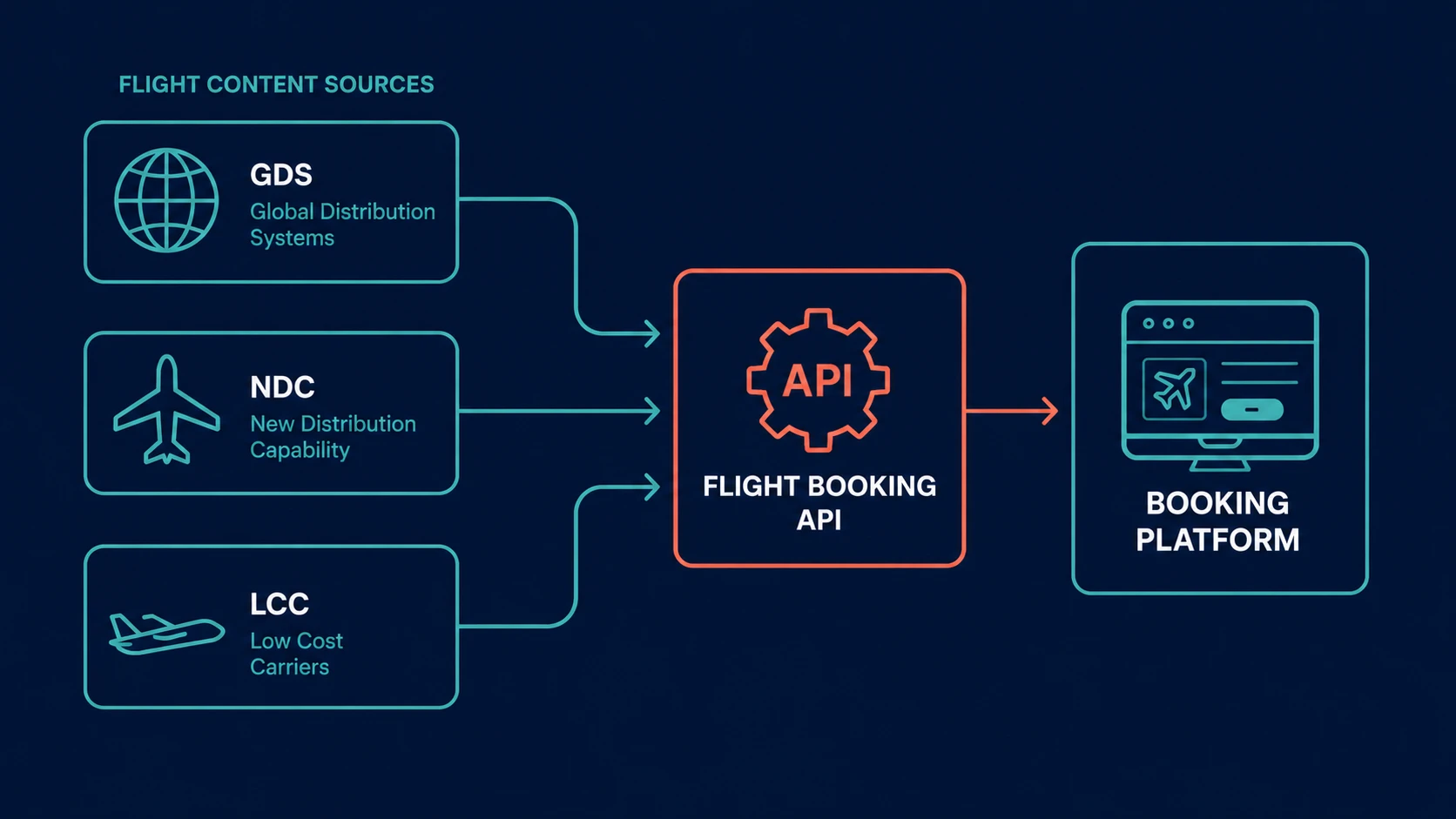
A booking API connects your platform to the airlines’ inventory and does the whole job: search, price, book, ticket and, later, cancel. Behind it sit three content sources — GDS, NDC and low-cost carriers — which the next sections cover.
You can reach that content two ways. Directly, you sign an agreement with each GDS and build to each one; a direct GDS integration takes 6–12 months, and NDC and low-cost carriers are separate work again. Through a multi-source API, you build once and reach all three. Tripgic is the second kind; Duffel is a developer-first booking API focused on flights and stays.
Developer experience differs too. Duffel’s test mode returns Duffel Airways, a test airline with the IATA code ZZ, and its pricing page lists $3.00 per flight order plus fees for managed content, paid ancillaries and excess searches. Tripgic’s sandbox runs against https://sandbox.api.tripgic.com/v1/, every call is a POST with apikey and secretecode headers, and the prices returned at validation and booking are final, so they can be shown to your customers as-is.
Search and Affiliate APIs: Show Fares, Send the Traveller On
A search or affiliate API is built for traffic, not for ticketing. You show fares inside your product, and the traveller completes the booking with a partner.
Skyscanner’s Flights Live Prices API takes an origin, a destination and a date and returns flights that will be bookable by travellers. It works in two steps: a /create call returns a quick, cached subset of results, and /poll returns the complete list once Skyscanner has called its supply partners. Each itinerary carries a deepLink field that takes the traveller to the booking page. Access is for established businesses with a large audience, by application.
KAYAK’s Flights Search API is offered through the KAYAK Affiliate Network to power flight comparison and monetise traffic with tracked outbound clicks. Partners get in touch through a contact form, and free access to sandbox APIs is offered.
This model suits a site with an audience. It does not suit a business that wants to set its own prices, bundle flights with hotels, or keep the customer after the sale.
Data APIs and Scrapers: Prices, Schedules and Live Status
Data APIs answer questions such as “what does this route usually cost?” or “is this flight on time?”. They do not create bookings, and the honest ones say so.
| Provider | What it covers | Free option |
|---|---|---|
| FlightAPI | Prices from 700+ airlines and vendors, flight status, airport schedules. Its FAQ: “You cannot book flights using our API. This API only tracks prices.” | 20 calls at sign-up |
| Aviationstack | Real-time flight status and aviation data | 100 requests a month, non-commercial use |
| Flightradar24 | Live aircraft positions from its ADS-B network, airline, airport and aircraft data, history since 11 May 2016 | Pay-as-you-go |
| OAG | Global schedules, flight status, seats, master data and connections, in RESTful JSON | Not stated on its page |
SerpApi’s Google Flights API sits in a category of its own. It scrapes Google Flights and returns the results as structured data — flight options, prices, price insights and booking_token values that lead to booking options on partner platforms. It does not book anything itself. For the background on why Google has no public booking API, see our Google Flights API guide.
How a Flight Booking API Works
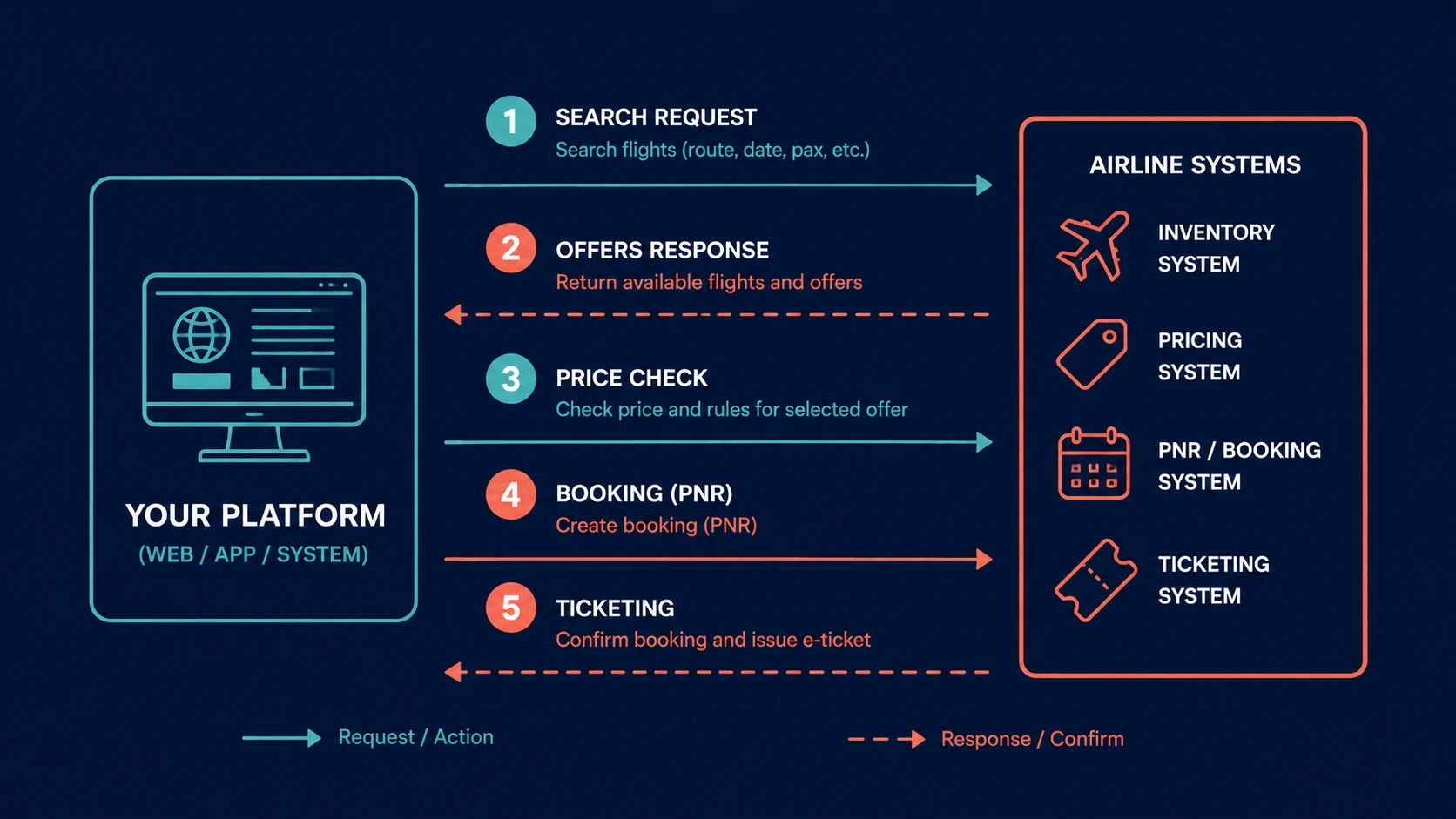
A booking follows the same cycle at every provider, though the call names differ. Here it is with Tripgic’s endpoint for each step, from our API documentation:
| Step | What happens | Tripgic endpoint |
|---|---|---|
| 1. Search | The traveller enters cities, dates and passengers; the API returns offers with times, stops, fares and baggage | /flight/search |
| 2. Fare options | Branded fares for the chosen flight — the same seat sold with different bags, changes and refunds | /flight/branded-fare |
| 3. Validate | Re-checks the itinerary and the price, because fares move between search and payment | /flight/validate |
| 4. Book (PNR) | Creates the booking record that holds the flight and the passengers | /flight/create-booking |
| 5. Extras | Baggage, seats and meals | /flight/update-baggage · /flight/update-seat · /flight/update-meals |
| 6. Ticket | Issues the ticket for the validated booking — only now is the seat real | /flight/issue-ticket |
| 7. Cancel | Cancels the booking when the traveller asks | /flight/cancel-booking |
The ticket is the step that has no hotel equivalent. A hotel booking ends at confirmation; a flight is valid only once a ticket is issued. Each booking also carries a ticketing time limit, and missing it cancels the booking, so your system has to track that deadline itself rather than trust that someone will remember.
Where Flight Content Comes From
No single source carries every airline. A booking API is only as good as the mix of sources behind it.
- GDS. The global distribution systems — Amadeus, Sabre and Travelport — carry most full-service airlines and are the classic source for agencies. Our guide to travel API vs GDS explains the trade-offs.
- NDC. New Distribution Capability is the airline industry’s modern standard, with richer offers such as seat bundles and branded fares. See how an NDC aggregator brings it together.
- Low-cost carriers. Many LCCs sit outside the GDS and are reached directly or through an aggregator. Our low-cost carrier API guide covers how.
Tripgic combines all three: Amadeus, Sabre and Travelport, NDC on selected airlines, and 67 low-cost carriers, for 700+ airline and LCC connections in total. Its route catalogue lists 51,519 commercial air routes, and 137 active carriers across 152 countries and 1,619 airports.
What Data a Flight Booking API Returns
A good booking API returns everything a traveller needs to decide, not only a price. The richer the data, the better your filters and the fewer the complaints after the sale.
| Data | Examples |
|---|---|
| Flight details | Route, times, stops, aircraft, airline |
| Fare details | Price, currency, fare class, branded fare, change and refund rules |
| Baggage | Carry-on and checked allowance, paid bag options |
| Extras | Seat maps, meals |
An offer from any provider looks broadly like this. The example is illustrative and is not any provider’s exact format:
{
  "offer_id": "example-123",
  "origin": "LHR",
  "destination": "JFK",
  "departure": "2026-11-12T09:30",
  "stops": 0,
  "fare": { "amount": 412.00, "currency": "USD" },
  "baggage": "1 checked bag",
  "refundable": false
}
Fare rules deserve the most care. They decide refunds, changes and baggage, and showing them badly is how a sale turns into a dispute.
One-Way, Round-Trip and Multi-City Searches
Travellers search in three shapes, and each one changes how the price is built.
- One-way: a single journey from A to B. The simplest search.
- Round-trip: out and back. Airlines often price both legs together as one fare.
- Multi-city: several legs in one trip, such as A to B to C. The most complex search to price.
A round-trip fare is often not the sum of two one-way fares, because the airline prices the trip as a bundle. Skyscanner’s documentation shows the same idea from the data side: a return trip comes back as one itinerary with two legs. Before you build, check which shapes your provider supports and how it returns them, so the total a traveller sees is the total they pay.
Common Flight API Challenges
Flights are harder than most travel products, and teams tend to hit the same problems in the same order.
- Ticketing time limits. A booking expires if the ticket is not issued in time.
- Moving fares. Prices change between search and payment, which is why every booking flow re-validates the fare.
- Fare rules. Refunds and changes differ by fare and must be shown correctly.
- Mixed formats. GDS, NDC and LCC content arrive in different shapes; someone has to normalise them into one.
- Schedule changes. Airlines move flights after booking, and the traveller has to be told.
- Search volume. Booking APIs set a look-to-book ratio — how many searches you may make per booking — and a product that searches a lot and books little gets expensive.
Most of these share one cause: flight data is deep and changes fast. Budget time for validation, ticketing and errors, not only for the first search.
How to Choose a Flight API
Choose the type first, then the provider. If you need to sell tickets, only booking APIs are candidates; if you need status or prices, a data API is cheaper and simpler.
Then compare booking APIs on six points:
- Content mix. GDS, NDC and low-cost carriers, in the markets you sell.
- The full flow. Search, validation, booking, ancillaries, ticketing and cancellation — not only search.
- Final prices. Whether the price at validation is the price you can charge.
- A real sandbox. Free, and close enough to production to test your own routes.
- Live terms. Fees per booking, search limits and how long activation takes, in writing.
- Support. Who answers when a ticket fails at the airport.
For the wider checklist, see our guide on how to choose a travel API provider.
Where Tripgic Fits
Tripgic is a multi-source travel API. For flights, it combines Amadeus, Sabre and Travelport, NDC and 67 low-cost carriers into 700+ airline and LCC connections, and the same API sells hotels, cars, activities, packages, eSIM and more.
The flight flow runs from search to ticket in fifteen endpoints, including branded fares, baggage, seats and meals. Prices returned at validation and booking are final and can be shown to your customers as-is. Sandbox credentials are issued after a short kick-off call at no charge, with no commitment to start; you pay the one-time activation only when you are ready to go live, and activation usually takes 3–5 business days. The fee model is on our pricing page.
The API is one layer of a bigger system. For ticketing deadlines, IATA accreditation, after-sale servicing and build vs buy, see our guide to the flight booking system.
Final Thoughts
“Flight API” covers four different products. Decide first whether you need to sell tickets, send traffic, or show data — that one choice removes most of the list.
If you sell tickets, test two or three booking APIs in their sandboxes with your own routes, and compare what each one returns at validation, not only at search.
 Mehedi Ahsan Ashif