 Akhirul Islam
A flight consolidator buys airline seats in bulk — often long-haul and business class — at negotiated net rates. It then resells those seats to travel agencies, OTAs (Online Travel Agencies), and tour operators, below the published fare. An unusually low business-class price from an agency usually traces back to a consolidator. Platforms that also need GDS, NDC and low-cost fares in one pipeline often add a travel API such as Tripgic, which returns supplier net fares plus a flat fee.
Consolidators are a normal, licensed part of airline distribution — not a workaround or a loophole. This guide covers what a flight consolidator is, how the model works, and whether they are legitimate. It also covers the part most guides skip: how consolidator fares reach a booking platform through technology, not a phone call.
What Is a Flight Consolidator?
A flight consolidator is a business-to-business wholesaler. It buys airline inventory in bulk at a discounted, negotiated rate called a net fare. It then distributes that net fare to travel agencies, OTAs, and tour operators. Those businesses add their own markup and sell the ticket on to the traveler.
A few things separate a consolidator from other parts of the travel distribution chain:
- Net fares, not published fares. A published fare is the price anyone can find through a GDS or the airline’s own website. A net fare is a private, negotiated rate available only through the consolidator’s agency network.
- Business-to-business by default. Most consolidators sell through agencies rather than directly to consumers, often through a B2B travel platform where agents log in and book. Some newer players do sell discounted fares direct-to-consumer.
- Concentrated in specific routes and cabins. Consolidator inventory is strongest on long-haul international routes and business class. These are the markets where airlines have the most unsold capacity to move, and the widest margin to discount.
Net fares typically come in one of two forms. Bulk fares are pre-purchased blocks of seats at a fixed net rate, regardless of how demand shifts. IT (inclusive tour) fares tie a net rate to a packaged product, like a hotel-plus-flight bundle. These fares carry rules that limit them to package sales, not standalone ticket resale. Which form a consolidator offers affects how flexibly an agency or platform can resell the fare.
The model traces back to airline deregulation in the late 1970s. Airlines suddenly had to compete on price for the first time, and started releasing surplus international seats to third-party wholesalers. Some markets called these wholesalers “bucket shops,” a name that has mostly faded. The function is the same one consolidators perform today: buy inventory in bulk, resell it through the travel trade.
How the Consolidator Model Works
The consolidator model exists because airlines would rather sell a seat at a discount than fly it empty. But they don’t want to publicly lower the fare everyone else sees. Discounting a published fare affects every future sale on that route. Selling a private net-fare block to a consolidator does not.
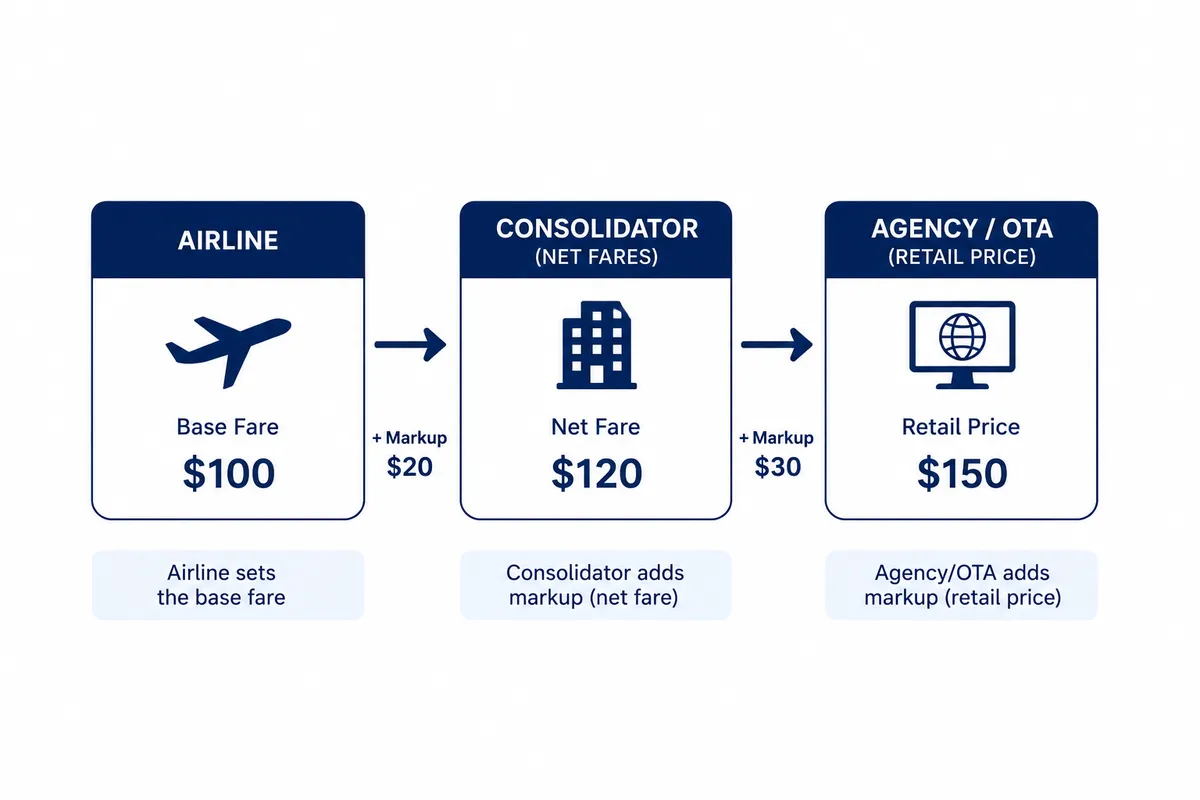
The flow typically looks like this:
- Airline to consolidator — the airline sells a block of seats, or agrees to a standing net-fare rate, on routes and cabins with excess capacity. Long-haul business class is the classic example: expensive to fill, and the discount still leaves healthy margin.
- Consolidator to agency — the consolidator distributes the net fare to its network of travel agencies and OTAs. It usually sets a minimum markup requirement to protect the fare structure.
- Agency to traveler — the agency adds its own margin and sells the ticket, still below the published fare. The agency keeps a larger margin than a standard published-fare sale would allow.
This is also the answer to “how do consolidators get cheaper tickets.” It isn’t a trick or a different type of ticket. It’s a private wholesale rate, available only through a consolidator relationship. The same wholesale pricing logic works in any other B2B distribution chain.
Consolidators often specialize. Some focus on specific regions, like South Asia, Africa, or Latin America. Others focus on premium cabins. Still others focus on ethnic or diaspora travel markets, where demand for specific long-haul routes stays consistently high.
Why Long-Haul and Business Class Fares Dominate Consolidator Inventory
Airlines manage revenue through yield management: pricing seats dynamically based on demand, the booking curve, and how much capacity remains unsold as departure approaches. Business class and long-haul routes are where this calculation is hardest to get right. A wide-body business-class cabin might have only 20 to 40 seats. Each empty seat represents thousands of dollars in lost revenue. And business travelers rarely book far enough in advance to fill a cabin through normal fare tiers alone.
Consolidators give airlines a release valve. Dropping the published business-class fare would mean every customer sees and expects that same low price going forward. So instead, the airline moves a block of unsold capacity to a consolidator at a private rate. The airline protects its public pricing and fills seats it would otherwise fly empty. The consolidator’s agency network then reaches price-sensitive premium travelers that the airline’s own retail channel does not typically capture.
This is also why consolidator inventory skews toward specific corridors. Long-haul routes with high leisure and diaspora travel demand produce the largest gap. That gap sits between the published fare a route can support, and what an airline will accept just to fill the seat.
Consolidator vs GDS vs OTA — What’s the Difference?
People often use these three terms loosely, but each describes a different layer of the same distribution chain:
- GDS (Global Distribution System) — the pipe that carries fare content between airlines and travel agencies. A GDS like Amadeus, Sabre, or Travelport carries both published fares and some negotiated net fares. Some consolidator fares load into a GDS as special fare types.
- Consolidator — a wholesaler with its own private net-fare inventory. Some GDS platforms carry consolidator fares directly. Others distribute them outside the GDS, through a private file feed or API.
- OTA — the retail storefront that sells to the end traveler. An OTA might source its flight inventory from a GDS, direct airline NDC connections, or consolidators — often blending all three into one search result.
Airlines are also increasingly distributing content directly through NDC (New Distribution Capability) APIs, bypassing the GDS layer for certain fare types and ancillaries. A modern OTA or agency platform typically needs to combine all of these sources — GDS, NDC, and consolidator — rather than relying on just one.
Are Flight Consolidators Legitimate?
Yes — when the consolidator is properly accredited. Licensed consolidators in the US hold ARC (Airlines Reporting Corporation) accreditation. Many international consolidators hold IATA accreditation instead. This accreditation authorizes the consolidator to issue tickets and requires it to be bonded, protecting agencies and travelers downstream.
The risk comes from unlicensed operators, not from the consolidator model itself. Before booking through or partnering with a consolidator, check:
- Accreditation — ask for the ARC or IATA number and verify it independently, rather than taking it at face value.
- Ticket delivery method — a legitimate consolidator issues a real e-ticket promptly. Long delays or “we’ll confirm closer to departure” are red flags.
- Payment protection — understand how the consolidator handles refunds and chargebacks if something goes wrong before ticketing.
- Track record — check reviews and complaint history through agency associations or trade forums, not just the consolidator’s own marketing.
Forums like Reddit and TripAdvisor host plenty of consolidator complaints. Most trace back to a narrow set of issues. An unaccredited reseller never actually held the inventory it sold. A block got oversold, causing a last-minute cancellation. Or a ticket arrived so close to departure that verifying it became difficult. None of these problems are inherent to the consolidator model. They signal an unaccredited or poorly managed operator — exactly why accreditation and ticket-delivery checks matter more than price alone.
Consolidators are not a relic of the pre-internet travel industry. They remain an active, significant part of airline distribution today — especially for long-haul and premium-cabin content that airlines want to move without discounting published fares.
Benefits and Drawbacks
For travel agencies and OTAs, consolidator fares are a trade-off worth understanding on both sides.
Benefits:
- Access to net fares meaningfully below published prices, especially for business class and long-haul international routes
- Inventory that isn’t visible on public fare shelves, which can be a genuine differentiator against competitors
- Wider margins for the agency or OTA reselling the fare, compared to a standard published-fare sale
- Access during high-demand periods — during peak travel dates or short-notice bookings, airlines sometimes release consolidator allocations that don’t appear in standard published availability. This lets agencies secure seats that show as sold out elsewhere.
Drawbacks:
- Stricter fare rules — net fares often carry tighter change and refund restrictions than published fares
- Ticketing risk with unlicensed operators, including delayed or failed ticket issuance
- Access isn’t automatic. Using consolidator fares at scale requires either a direct relationship with a consolidator, or a technical integration that brings their fares into your platform.
- Limited transparency into fare sourcing. Net fares are private, so a platform aggregating multiple sources needs its own labeling and rules engine. Otherwise, consolidator content gets confused with standard published fares in reporting.
- Volume commitments. Many consolidator relationships include minimum sales targets or exclusivity terms. These can limit flexibility for smaller agencies just starting with net fares.
How Consolidator Fares Reach a Booking Platform
This is the part most guides to flight consolidators skip. Most guides target individual travelers or independent agents, not the OTAs and travel platforms actually building booking technology.
The Manual Process Doesn’t Scale
The manual way still exists: an agent calls or emails a consolidator’s desk, gets a quote, and manually issues the ticket. That works for a single booking. It does not work for a platform showing live, bookable fares to hundreds or thousands of users. The process isn’t real-time, doesn’t scale, and introduces manual error at volume.
The Modern, API-Based Process
The modern way brings consolidator fares into the same technical pipeline as GDS and NDC content. A platform can then search, price, and book them automatically, alongside everything else:
- Multi-source aggregation — a booking platform queries GDS fares, NDC fares, and consolidator net fares at the same time. It then merges and de-duplicates the results into a single, ranked search response.
- Normalized pricing and rules — each source returns data differently. The platform must normalize fare rules, cancellation terms, and ticketing timelines to display them consistently, regardless of source.
- One booking flow, not three — the traveler shouldn’t see a different checkout process depending on where their fare came from. A single PNR and booking flow must cover all three sources.
- Automated ticketing — the system issues the ticket, sends confirmation, and queues any manual exceptions, like fares needing offline verification, without a human in the loop for most bookings.
Booking extranets and travel API aggregators solve the same infrastructure challenge more broadly. A normalization layer sits between a platform and every one of its supply sources, so the platform only integrates once. This is the same layer covered in how booking extranets work. Consolidator fares are simply one more supply source to aggregate alongside GDS and NDC content — not a separate system bolted on afterward.
A Practical Example
Consider an OTA that wants to display a business-class consolidator fare alongside a published GDS fare for the same route. Without aggregation, the team manually checks the consolidator’s rate sheet, confirms availability by phone or email, and hand-keys the booking into a separate ticketing queue. Meanwhile, the GDS fares update in real time on the website.
With an aggregation layer, the platform queries the consolidator’s rate feed the same way it queries GDS and NDC content. Search results show both fares side by side, and the existing checkout and ticketing flow handles whichever one the traveler picks.
Consolidator vs Travel API Aggregator
Platforms often ask whether they need a consolidator, an aggregator or both. They solve different problems:
| Flight consolidator | Travel API aggregator | |
|---|---|---|
| What it holds | Private net fares negotiated with airlines | Technology connections to many fare sources |
| Main value | Price: fares below the published level | Reach and speed: many sources in one format |
| Ticketing | Usually issues tickets under its own accreditation | Varies — ask who issues and settles |
| Routes | Strongest on specific long-haul corridors and premium cabins | Broad, depending on the sources behind it |
| Technology | Ranges from phone desks to full APIs | API-first by definition |
| Best for | Agencies selling premium and long-haul trips | Platforms that need GDS, NDC and low-cost content together |
The two can work together: an aggregator can carry consolidator fares as one more source, and a consolidator can offer an API. What a platform should avoid is a separate, one-off integration for each — which is the problem both of them exist to remove. For more on the aggregator model, see what a travel API aggregator is.
Questions to Ask a Consolidator Before You Sign
If you are an agency or platform choosing a consolidator partner, these questions separate a good one from a risky one:
| Question | What a good answer looks like |
|---|---|
| What is your ARC or IATA number? | A number you can verify independently today |
| Which airlines, routes and cabins are your strongest? | Specific corridors that match where your clients fly |
| How and when are tickets issued? | Promptly, as e-tickets, with a clear time limit before departure |
| What are the change and refund rules on your net fares? | Written rules per fare, returned with the fare, not discovered later |
| Is there a minimum markup or a sales target? | Stated plainly in the agreement |
| How do I pay — deposit, credit line or card? | Terms that fit your cash flow, with clear settlement dates |
| Can I search and book through an API? | Live search, validation, booking and ticketing — not a rate sheet |
| Who handles schedule changes and disruptions? | A named desk or an API notification, with stated hours |
The last two matter most for a platform. A consolidator that can only quote by email will cap how far you can grow with it.
The Future of Flight Consolidators
The consolidator model is not disappearing, but how its fares reach the market is changing. As airlines push more distribution through NDC APIs, they gain more direct control over which content goes where. That includes the ability to offer negotiated rates programmatically, instead of through a separate wholesale relationship. Some airlines are already experimenting with dynamic, API-driven offers that blur the line between a standard NDC fare and a traditional consolidator net fare.
For agencies and platforms, the practical effect is the same either way: fare sources are multiplying. The winners will be the ones that can plug in a new source without a multi-month integration each time. Whether a discounted fare comes from a legacy consolidator relationship or a next-generation NDC offer, the technical requirement stays the same. Normalize it, price it consistently, and book it through the same flow as everything else. Consolidators that adapt to API-based distribution will remain relevant. Those relying solely on manual, phone-based booking will become a shrinking part of how travel businesses source fares.
Choosing a Consolidator — or the API Behind One
The right approach depends on whether you’re an agency buying fares directly, or a platform building the technology to distribute them.
If you’re an agency buying consolidator fares directly: check accreditation first. Then compare route and cabin coverage against where your clients travel. Review payment terms, and test how responsive support is before committing real volume.
If you’re building a platform that needs to distribute consolidator fares at scale, the question shifts. It’s no longer “which consolidator” — it’s “does this fare source integrate via API.” Ask three things: how quickly a fare source connects, whether ticketing automates end-to-end, and whether the integration sits inside a broader aggregation layer that also covers your GDS and NDC content. Otherwise, it becomes yet another one-off connection your engineering team has to maintain separately.
Either way, the relationship is not “set and forget.” Route networks change. Airlines adjust which cabins they release to consolidators each season. Re-verify accreditation status periodically — don’t just check it once at onboarding. A light review cadence helps: quarterly checks for agencies, ongoing monitoring for platforms with automated feeds. This catches a lapsed accreditation or a dropped route before it turns into a failed booking for a traveler.
Common Questions About Flight Consolidators
Do flight consolidators still exist in 2026? Yes. They remain an active part of airline distribution, particularly for long-haul and business-class inventory. That’s where airlines have the most incentive to move unsold capacity through a private channel, rather than a public fare cut.
Which flight consolidator is best for a travel agency? There isn’t a single best answer — it depends on the routes and cabins your clients book most. The right evaluation criteria: accreditation, route depth on your specific markets, fare rule flexibility, and how reliably the consolidator issues tickets — not brand recognition alone.
Are consolidator fares available through a normal travel API? Not by default. Most travel APIs center on GDS and NDC content. Accessing consolidator net fares programmatically requires a source that specifically aggregates consolidator inventory alongside standard airline distribution channels.
Where Tripgic Fits
Tripgic is a travel API aggregator, not a consolidator. Here is what it provides for a platform that needs several flight sources in one pipeline, from its own pages:
- Several fare sources in one API. Amadeus, Sabre and Travelport, NDC and 100+ low-cost carriers — 800+ airline and LCC connections — through one integration.
- Net fares plus a flat fee. Its pricing page says Tripgic returns supplier net fares and adds one fixed amount per transaction — per passenger for flights — never a percentage. Your platform adds its own margin on top, the same way an agency marks up a consolidator net fare.
- Final prices at validation. Prices returned on the validation and booking endpoints are final, so your markup is added to a number that will not move.
- Merged results. When the same flight appears in more than one GDS, its GDS page says it is returned once, at the best available price.
- One booking flow, through to the ticket. Fifteen flight endpoints in the API docs cover search, branded fares, validation, booking, baggage, seats, meals, ticketing and cancellation.
- Prepaid settlement. Costs are deducted from a prepaid wallet as each ticket is processed.
Next Step
Building or scaling a platform that needs GDS, NDC and low-cost flight content in one searchable, bookable API? Book a demo with Tripgic and get sandbox credentials after a short call.