
 Mehadi Hassan
Travel booking software is not one thing. A small travel agency and a large OTA (Online Travel Agency) may both call their system “booking software” — but what runs underneath them is completely different.
If you are building or scaling a travel platform, this guide covers what booking software actually needs, the types available, the core features that separate a good system from a broken one, and why the API layer is the part that determines whether you can grow.
What Is Travel Booking Software?
Travel booking software is any system that lets users search, compare, and book travel products — flights, hotels, packages, trains, car rentals, transfers, or activities. It sits between the traveler (or travel buyer) and the suppliers: airlines, hotel chains, rail operators, and other inventory sources.
It is used across different types of travel businesses:
- Online travel agencies (OTAs) — platforms like Booking.com or regional equivalents that sell travel inventory directly to end users
- Travel agencies and advisors — teams that search and book travel on behalf of their clients
- Corporate travel platforms — tools that manage business travel for companies, including approval workflows and expense tracking
- Tour operators and DMCs (Destination Management Companies) — businesses that package and sell tours, transfers, and group travel products
- Travel-tech startups — companies building new products on top of travel inventory, from AI travel agents to loyalty platforms
The key split in the market is buy vs build. Small agencies usually buy off-the-shelf SaaS tools. OTAs and growing travel platforms usually build their own — on top of travel APIs. Understanding which track you are on shapes every decision about software architecture, supplier strategy, and cost.
Types of Travel Booking Software
Not all booking software is the same. The type you need depends on what products you sell and who your customers are.
Flight Booking Systems
Flight booking software connects to airline inventory — either through a GDS (Global Distribution System) like Amadeus, Sabre, or Travelport, or directly via NDC (New Distribution Capability) APIs offered by airlines. It handles search, real-time pricing, seat selection, ancillary upsells (bags, meals, upgrades), and ticketing — the creation of a PNR (Passenger Name Record) that confirms the booking.
Flight systems are among the most technically complex to build. Fare rules, pricing logic, and ticketing workflows differ across carriers and GDS systems. Most OTAs rely on an aggregator or GDS middleware rather than building direct airline connections.
Hotel Booking Engines
Hotel booking software connects to property management systems (PMS) and hotel inventory APIs. It handles real-time availability, room types, rate plans, cancellation policies, and booking confirmation. A common challenge is room-type mapping — the same physical room may be described differently across suppliers, requiring normalization before it can be shown cleanly in search results.
Hotel inventory comes from multiple sources: global chains with direct APIs, regional inventory aggregators, GDS hotel content, and bed banks. A mature hotel booking engine connects to multiple sources and deduplicates and merges the results.
Package and Tour Booking Platforms
Package booking systems combine multiple products — typically flight plus hotel, often with transfers — into a single bookable item with one price. Dynamic packaging is the more advanced version: the package is assembled in real time from live inventory rather than pre-built itineraries. Dynamic packaging requires an API layer that can query flight and hotel inventory simultaneously, normalize rates across suppliers, and present a combined price reliably.
Tour booking platforms handle structured tours and group travel: fixed itineraries, group sizes, departure dates, activity schedules. These are often used by tour operators and DMCs who manage their own product catalog rather than pulling live supplier inventory.
Corporate Travel Management Software
Corporate travel platforms add a layer of business logic on top of standard booking capabilities: travel policy enforcement, approval workflows, duty of care tracking, and expense integration. They need to show travelers only options that comply with company policy — specific fare classes, preferred hotel chains, budget caps — while also capturing data for reporting and reconciliation.
Full-Stack OTA Platforms
A full-stack OTA platform covers all of the above in one system. Users can book flights, hotels, packages, trains, transfers, and activities in a single flow, often with a loyalty or rewards layer on top. These platforms are the most complex to build and operate — and the most dependent on reliable, multi-product API infrastructure behind the scenes. They typically require connections to dozens or hundreds of suppliers simultaneously.
Core Features Every Booking Platform Needs
Whether you are building a simple booking engine or a full OTA, these features are non-negotiable for a production-grade system:
Real-Time Availability and Pricing
Booking software must show live inventory — not cached data that was accurate three hours ago. Prices and availability change constantly, especially for flights and last-minute hotel rooms. Stale data leads to booking failures, which erode user trust and increase support costs. Your system needs a real-time connection to supplier inventory, with fallback logic for when suppliers are slow or unavailable.
Multi-Supplier Connectivity
A booking platform that connects to only one or two suppliers will always have gaps in its inventory. Users compare prices across platforms — if your inventory is thin, they will book elsewhere. Multi-supplier connectivity means connecting to GDS systems, direct airline and hotel APIs, bed banks, and aggregators simultaneously, then merging and deduplicating the results before presenting them to users.
Booking Management
After a booking is confirmed, the work continues. Users need to modify bookings (change dates, add passengers, upgrade seats), cancel bookings (with correct fee calculations), and receive refunds within supplier policy windows. All of this must work across all the suppliers in your network, not just some of them. Inconsistent post-booking support is one of the most common complaints on OTA platforms.
Payment Processing
Travel bookings involve high transaction values and international payments. Your payment infrastructure needs to handle multiple currencies, multiple payment methods (card, digital wallet, BNPL), fraud checks, and charge-back management. For corporate platforms, virtual card issuance and centralized billing are also common requirements.
Reporting and Reconciliation
Every booking generates a financial record that needs to reconcile against supplier invoices, refunds, and commissions. For OTAs processing thousands of bookings per day, automated reconciliation is not optional — manual reconciliation at volume is impractical. The reporting layer should also provide analytics on booking patterns, revenue by product type, and supplier performance.
Search and Merchandising
The front end of a booking platform is where conversion happens. Search must be fast — users expect flight results in under two seconds. Sorting and filtering must work correctly across merged supplier results. Upsell and cross-sell logic (suggest a hotel when a flight is booked, offer travel insurance at checkout) directly affects average order value. These front-end capabilities are often underestimated during platform builds.
Build vs Buy — Which Is Right for You?
For small travel agencies, buying off-the-shelf SaaS tools is the right call. Tools like WeTravel, TravelJoy, or Expedia TAAP give agents the core features they need without requiring any technical setup or API integration. They are fast to deploy, have predictable pricing, and work well at low volumes.
For OTAs and growing travel platforms, buying an off-the-shelf tool usually creates problems as you scale:
- Limited customization — you cannot control the user experience, pricing logic, or feature roadmap; you wait for the vendor to build what you need
- Supplier lock-in — you depend entirely on the tool’s supplier network and cannot add your own preferred suppliers or negotiate direct contracts
- Scaling limits — SaaS booking tools are not built for high transaction volumes, custom integrations, or the multi-market complexity that growing OTAs face
- Data ownership — your booking data, customer data, and supplier performance data sits on the vendor’s platform, limiting what you can do with it
Building your own platform on a travel API gives you full control — over the product, the pricing, the suppliers, the data, and the roadmap. The trade-off is integration complexity and upfront engineering investment. That is where the API aggregator model becomes critical.
How an API Powers Your Booking Platform
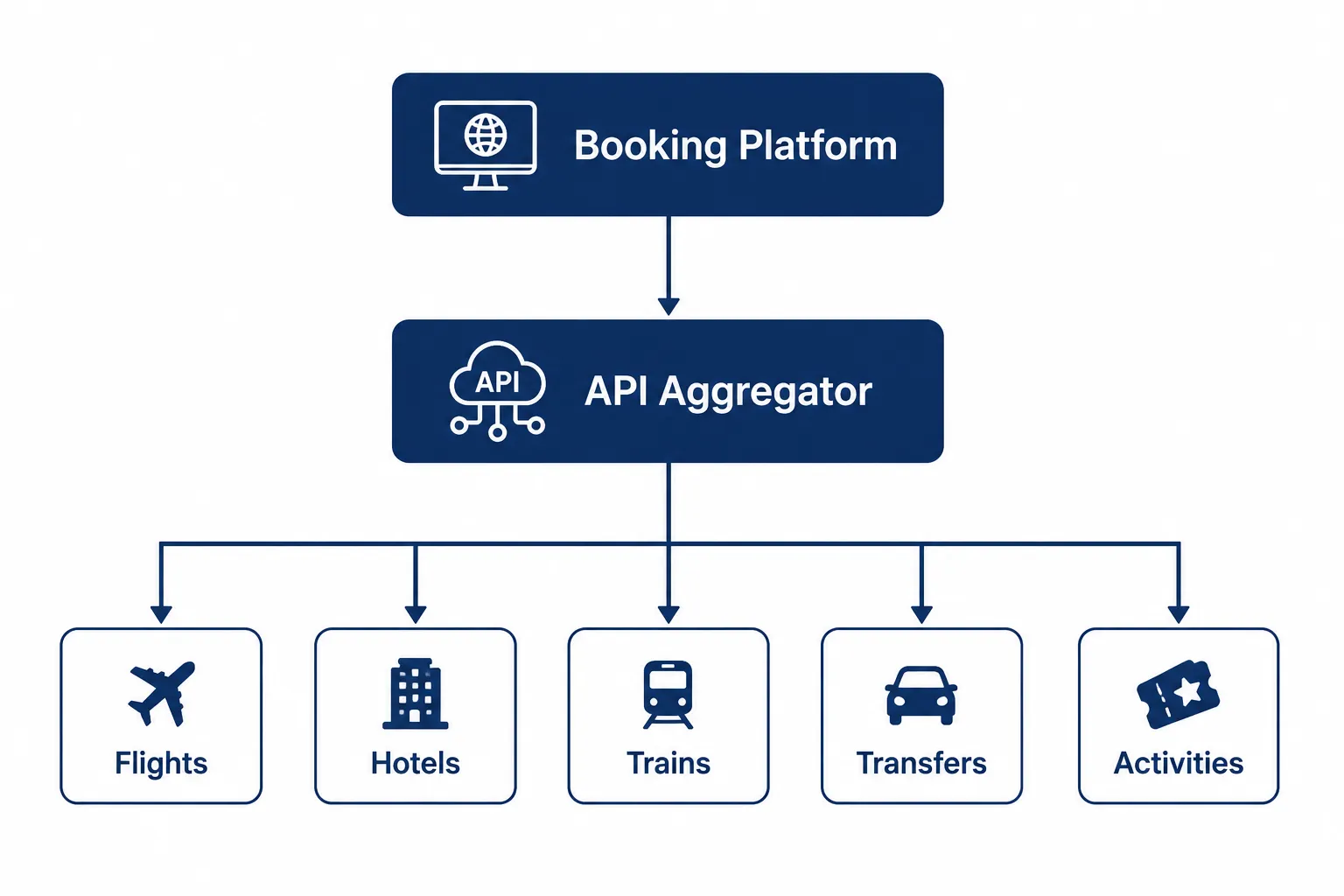
An OTA or travel platform needs live inventory from dozens or hundreds of suppliers at the same time. Building direct connections to each supplier separately is not a realistic option for most teams:
- Each supplier has a different API format, authentication method, and data schema
- Rate and availability data comes in different structures that must be normalized before you can merge results
- Every direct connection must be maintained individually as suppliers update, version, or deprecate their APIs
- Supplier onboarding timelines are slow — direct airline or GDS integrations can take months to complete
A travel API aggregator solves this by giving you a single integration point that connects to all suppliers. You build one integration — the aggregator handles supplier routing, data normalization, rate deduplication, and PNR management on the other side.
This is conceptually the same as a booking extranet — a layer that sits between your platform and the supplier ecosystem, making all supplier inventory accessible through a single normalized interface. Instead of managing 40 supplier connections, you manage one.
For example, Tripgic provides a single travel API covering 8 product families across 73 endpoints: flights, hotels, activities, tour packages, trains, transfers, eSIMs, and visas. A platform integrating Tripgic gets access to all of these product types through one API connection — instead of negotiating, building, and maintaining separate integrations for each.
What to Look for in a Travel Booking API
If you are evaluating travel APIs to power your booking platform, these are the factors that determine whether the API can support your growth:
Product Coverage
Does the API cover only one product type (flights), or does it cover the full travel stack — hotels, packages, trains, transfers, activities, and ancillaries like eSIMs and visas? Starting with a full-stack API means you can expand your product offering without adding new integrations and renegotiating contracts as your platform grows.
Supplier Depth and Geographic Coverage
How many airlines does the API connect to — and from which regions? How many hotel properties, and in which markets? A flight API with strong global airline coverage but weak regional carriers will leave gaps in your inventory for specific markets. Always check supplier depth for the regions you are targeting before committing to an integration.
Data Quality and Normalization
Does the API return normalized data — consistent rate formats, standardized cancellation policies, unified room-type classifications? Inconsistent data from different supplier formats creates errors and edge cases downstream in your booking flow. A good aggregator API handles normalization so you do not have to build it yourself.
Reliability and Uptime SLA
Travel bookings are time-sensitive. A 500ms increase in flight search response time measurably reduces conversion. API downtime during peak booking periods (holiday seasons, major events) can cost significant revenue. Always ask for uptime SLA, average response time benchmarks, and incident history before selecting an API partner.
Developer Experience
How complete is the documentation? Is there a sandbox environment for testing full booking flows without incurring real costs? How responsive is support when something breaks during integration? Poor developer support is the most common reason travel platform builds run over schedule. A well-documented API with a real test environment cuts integration time significantly.
Pricing Model
Travel APIs typically charge either a flat markup per transaction or a percentage of booking value. Flat markup models are more predictable at scale — your cost per booking does not increase as ticket prices rise. Percentage-based models can become expensive for high-value bookings like business class flights or luxury hotels. Understand the full pricing structure, including minimum volumes and tier thresholds, before you commit.
Common Mistakes When Building Booking Software
Teams building travel booking platforms for the first time make predictable mistakes. These are worth knowing before you start:
- Underestimating supplier integration complexity — GDS integrations, fare rules, and ticketing workflows are more complex than they appear. Budget time accordingly.
- Building before validating inventory depth — confirm that your API partner has the supplier coverage you need for your target markets before starting the integration.
- Ignoring post-booking flows — modification, cancellation, and refund handling are as important as search and booking. Platforms that handle search well but fail at post-booking create poor user experiences.
- Skipping the reconciliation layer — financial reconciliation becomes critical at volume. Building it after launch is harder than building it in from the start.
- Choosing a niche API and scaling into its limits — a flight-only API works for an MVP, but if your roadmap includes hotels and packages, you will need to re-integrate with a different provider later. Starting with a full-stack API avoids this.
The Right Foundation Matters at Scale
Travel booking software is only as good as the inventory and infrastructure behind it. For small agencies, the right off-the-shelf tool is enough. For OTAs and travel platforms that need to grow — into new markets, new product types, higher transaction volumes — the API layer is the foundation everything else is built on.
Getting the API infrastructure right from the start — reliable, normalized, multi-product, with strong supplier coverage — is what separates booking platforms that scale from those that hit a ceiling and require a full rebuild.
If you are building a travel platform and want to see how a full-stack travel API works in practice, book a demo with Tripgic.





 Mehedi Ahsan Ashif
 Akhirul Islam