
 Mehadi Hassan
Most tour operators start with a spreadsheet and email. It works — until it doesn’t. Double bookings, missed availability, manual payment chasing, and hours lost to admin are the signs you have outgrown it. That is when tour operator booking software becomes the fix.
But the market is crowded and confusing. Rezdy, Bokun, FareHarbor, TrekkSoft, Bookeo — dozens of tools all claim to be the answer, and most comparison pages are written by the vendors themselves. This guide is different: it explains what tour operator booking software actually does, the features that matter, how to choose, what it costs, and where it ends and a supplier-inventory API begins.
What is tour operator booking software?
Tour operator booking software is a system that lets a tour or activity business manage availability, take online bookings, process payments, and track customers from one platform. It replaces the mix of spreadsheets, email, and manual calendars that most operators start with.
The terms overlap, so it helps to be precise. A reservation system or online booking system is the engine that tracks availability and confirms bookings. Tour operator booking software is the fuller product built around that engine — adding a customer-facing booking widget, payments, reseller connections, and reporting. In practice people use the terms interchangeably.
It matters because the sector is large and growing. Tours and activities are travel’s third-largest segment — behind flights and lodging — and the experiences market is projected to reach about $345 billion by 2029, according to research from Phocuswright and Arival. As more of those bookings move online, operators still running on manual tools lose sales to competitors who do not.
What tour operator booking software does
A production-grade system covers a set of core jobs. When you evaluate tools, these are the functions doing the real work:
- Availability management — tracks how many spots are open on each tour, date, and time slot in real time, and stops overbooking automatically.
- Online booking — a widget on your website (and a mobile-friendly checkout) so customers book and pay 24/7 without emailing you.
- Payments — takes deposits or full payment at booking, in multiple currencies, and handles refunds within your cancellation rules.
- Channel and reseller management — pushes your tours to OTAs (Online Travel Agencies), resellers, and marketplaces like Viator or GetYourGuide, keeping availability in sync across all of them.
- Customer records — stores guest details, booking history, and communication so you can send reminders and follow-ups.
- Reporting — shows bookings, revenue, and channel performance so you can see what sells and what does not.
The strongest systems connect these functions to each other and to outside tools through APIs, so a booking made on a reseller updates your availability and your accounting without anyone re-typing it.
Key features to look for
Beyond the core functions, these are the features that separate a tool you will grow with from one you will replace in a year:
- Real-time availability across channels. If your website, OTAs, and resellers do not share one live calendar, you will oversell. Live sync is non-negotiable.
- A booking widget that fits your site. The checkout should match your brand and work on mobile. A clumsy widget costs you conversions.
- Reseller and OTA connectivity. Most tour bookings now come through third parties. Check which marketplaces the tool connects to before you commit.
- Flexible pricing rules. Group rates, seasonal pricing, promo codes, and per-person vs per-group pricing should be built in.
- Payment options. Multiple currencies, deposits, and the payment methods your customers actually use.
- Integrations and an open API. The tool should connect to your website, accounting, marketing, and — importantly — to supplier inventory if you sell more than your own tours.
- Reporting you will actually use. Clear dashboards on revenue, channels, and occupancy.
Build vs buy: off-the-shelf or custom?
For the large majority of tour operators, buying off-the-shelf software is the right choice. Tools like Rezdy, Bokun, or FareHarbor give you the core features immediately, with predictable pricing and no engineering team required. They are built for exactly this job and updated continuously.
Building custom software only makes sense for large operators whose workflows are genuinely unusual — complex multi-day itineraries, unique pricing logic, or a scale where per-booking fees on an off-the-shelf tool become more expensive than running your own system. Building means significant upfront cost, a development team, and ongoing maintenance.
| Buy (off-the-shelf) | Build (custom) | |
|---|---|---|
| Best for | Small to mid-size operators | Large operators with unusual workflows |
| Upfront cost | Low — sign up and go | High — development project |
| Time to launch | Days to weeks | Months |
| Customization | Limited to the tool’s features | Full control |
| Maintenance | Handled by the vendor | Your team, ongoing |
| Cost at scale | Per-booking fees add up | Fixed once built |
There is also a middle path that trips up many growing operators. You may buy booking software for the workflow but still need to build or integrate a connection to third-party inventory — because most booking tools do not supply flights, hotels, or transfers you do not own. We cover that split in our guide to travel booking software, which applies across all travel businesses.
Popular tour operator booking software
These are the tools you will see most often in this space. This is a neutral orientation, not a ranking — the right fit depends on your tour type, size, and channels.
- Rezdy — widely used by tours and activities providers; strong reseller/distribution network.
- Bokun (owned by Tripadvisor) — popular for its marketplace connections and Viator integration.
- FareHarbor — feature-rich, common among activity operators in North America.
- TrekkSoft — booking engine plus multi-channel sales tools.
- Bookeo — lightweight, no per-consumer fees, good for smaller operators.
Most publish transparent feature lists and free trials, so shortlist two or three that connect to your key resellers and test them with your real tours before deciding.
Where a supplier-inventory API fits
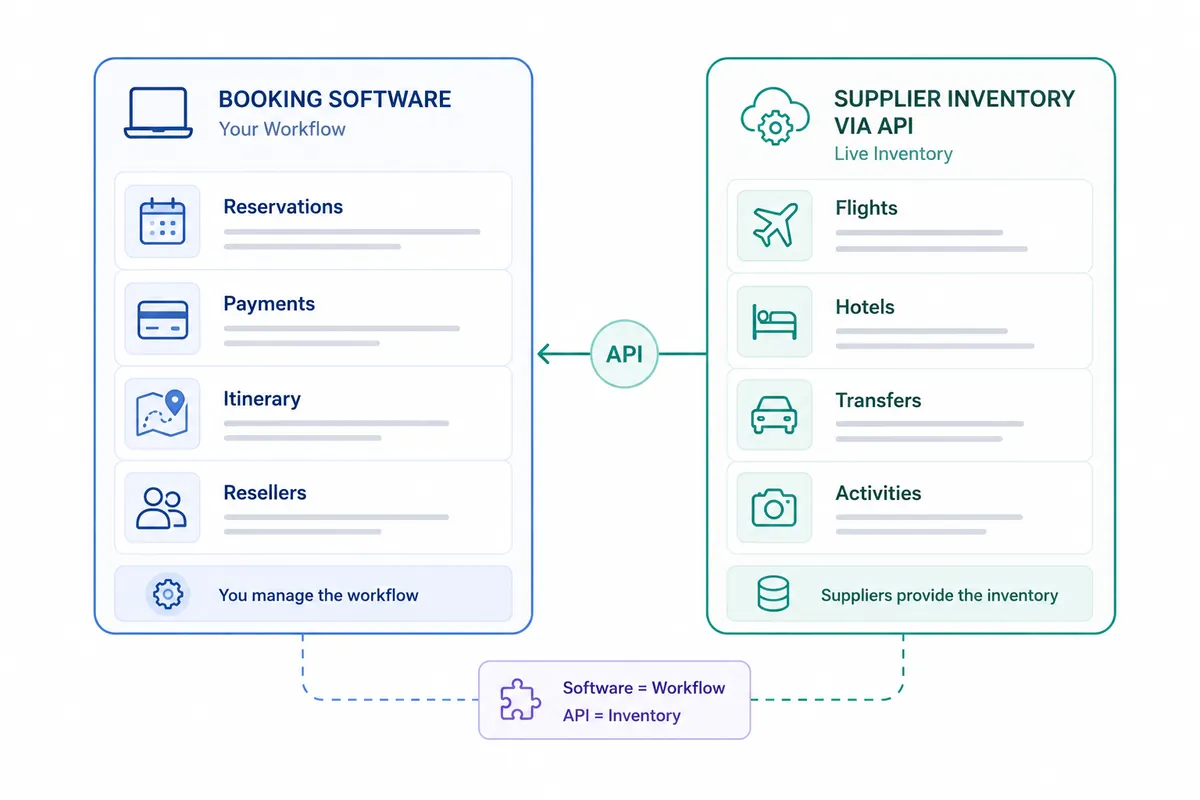
Here is the distinction most comparison pages skip. Booking software manages your workflow. A supplier API supplies inventory you do not own. They solve different problems, and many tour operators need both.
If you only sell your own tours, booking software alone is enough — it manages the spots you control. But the moment you want to sell packaged trips — a tour plus a flight, an airport transfer, a hotel night, or a partner activity — you need live inventory from other suppliers. Your booking software does not provide that. A supplier API does.
A travel API aggregator gives you one connection to many suppliers at once. Instead of contracting and integrating each airline, hotel, and transfer company separately, you pull live, normalized inventory through a single API and sell it inside your own product. For example, Tripgic provides one API covering flights, hotels, activities, tour packages, transfers, and more — the inventory a tour operator needs to build and sell complete trips. Our guides to dynamic packaging and the tours and activities API show how that inventory is assembled, and travel API for tour operators covers the connection in detail.
The simple rule: booking software = how you sell; supplier API = what you sell. A growing operator usually needs the booking tool for the workflow and an aggregator API for the inventory.
What tour operator booking software costs
Pricing generally follows one of three models:
- Monthly subscription — a flat fee regardless of bookings. Predictable; best if you have steady, higher volume.
- Per-booking commission — the tool takes a percentage or flat fee per booking. Low cost when you are small, but it scales up with your sales.
- Hybrid — a smaller monthly fee plus a reduced per-booking fee.
Commission-based tools look cheaper at first but can become your largest software cost as you grow. If you book at volume, model the total cost at your real booking numbers — a flat subscription is often cheaper past a certain point. Also check for setup fees, payment-processing charges, and costs for premium channel connections, which are easy to miss in a headline price.
The bottom line
Tour operator booking software is the system that turns manual, error-prone selling into a smooth online operation — availability, bookings, payments, and resellers in one place. For almost every operator, buying an off-the-shelf tool beats building one; shortlist a few, check reseller connections, and test with your real tours.
Just remember the boundary: booking software runs your workflow, but it does not supply inventory you do not own. The moment you want to sell packaged trips, you need a supplier API alongside it.
Tripgic provides that inventory layer — one API for flights, hotels, activities, tour packages, and transfers, so a tour operator can build and sell complete trips from a single connection. Book a demo to see how it fits alongside your booking software.

 Mehedi Ahsan Ashif
 Akhirul Islam