
 Mehedi Ahsan Ashif
An Indonesia travel API is one connection that lets a booking platform search, price, book and ticket the flights, hotels and travel extras Indonesian travellers buy — domestic flights between the islands and trips abroad — instead of a separate login or contract for each airline and hotel supplier.
Tripgic is a B2B travel API of this kind. Its network page lists Indonesia among the countries where travel agencies search, book and ticket flights, hotels and travel services through it, and it combines GDS, NDC and low-cost flights with 2M+ hotels in one REST connection.
This guide is for Indonesian OTAs, travel agencies, PPOB and fintech apps, corporate travel tools, and foreign companies selling to Indonesian travellers. It covers the market, the airlines and how their fares reach an API, the three ways Indonesian travel is sold, rupiah payments and QRIS, licences, VAT and data protection, and a checklist for choosing a provider. Every outside fact names its source in the sentence and in the list at the foot of the page. Laws, tax rules and figures were checked in November 2026; they change, so confirm them before you launch.
How Big Is the Indonesian Travel Market?
Indonesia is a large market on every measure a booking platform cares about: islands to connect, residents who travel at home and abroad, and visitors who fly in. The figures below come from Statistics Indonesia (Badan Pusat Statistik, BPS) and the Geospatial Information Agency (BIG), as reported in 2024 and February 2026.
| Figure | Value | Source |
|---|---|---|
| Islands | 17,380 (2024) | BIG, via Kontan |
| International air passengers | 20.55 million in 2025, up 8.14% | BPS, via CNBC Indonesia |
| Domestic tourist trips | about 1.2 billion in 2025 | BPS, via CNBC Indonesia |
| Foreign tourist arrivals | 15.38 million in 2025, up 10.80% | BPS, via CNN Indonesia |
| Rail passengers | 549.9 million in 2025 | BPS, via CNBC Indonesia |
Three things stand out. First, BPS reported that international air travel grew from 19 million to 20.55 million passengers in 2025, and its December 2025 release showed domestic air as the only transport mode to fall year on year that month. Indonesians kept flying abroad. Second, the domestic tourism market is huge: BPS deputy Ateng Hartono put domestic trips at “1.2 miliar” (1.2 billion) for 2025. Third, foreign arrivals of 15.38 million were the highest since the pandemic, with Malaysia, Australia, Singapore and China the largest source markets, according to CNN Indonesia’s report of the BPS figures.
For a booking platform, that means two jobs. One is serving Indonesian residents — domestic flights, hotels across the islands, and outbound trips. The other is serving visitors — flights into Jakarta and Bali, and hotels, transfers and activities on the ground. A good Indonesia travel API has to handle both.
Why Does an Archipelago Need a Travel API?
An Indonesian booking platform needs a travel API because air travel is the main way between 17,380 islands, and no single airline or distribution channel carries every fare a customer will compare. A trip from Medan to Makassar, or from Jakarta to Jayapura, crosses sea that no train or bus can.
That shapes the supply you need. Indonesian domestic flying is shared between full-service and low-cost airlines, and the low-cost carriers often sell much of their inventory outside the GDS. An API with GDS content only will miss fares your customers see in the airlines’ own apps. An API with one low-cost airline group only cannot sell the full-service fares that corporate customers and long-haul travellers want. Hotels follow the same logic: demand is spread across many destinations, and one hotel contract per property is not realistic for an agency in Bandung or Surabaya. One search across many suppliers is the practical way to offer them.
So the case for an API in Indonesia is breadth as much as speed: full-service and low-cost flights, domestic and international routes, and hotels across the country, in one result your customer can compare.
Which Indonesian Airlines Can You Sell Through an API?
It depends on the provider and on how each airline distributes its fares, so the only reliable answer is a live search on your own routes. The table shows where to check the main Indonesian carriers on Tripgic.
| Airline (IATA code) | Where to check |
|---|---|
| Lion Air (JT) | Listed in Tripgic’s LCC directory |
| Batik Air (ID) | Listed in Tripgic’s LCC directory |
| Wings Air (IW) | Listed in Tripgic’s LCC directory |
| Indonesia AirAsia (QZ) | Listed in Tripgic’s LCC directory |
| Garuda Indonesia (GA) | Run a live search in the Tripgic sandbox |
| Citilink (QG) | Run a live search in the Tripgic sandbox |
Garuda Indonesia describes itself as “The Airline of Indonesia” and says it is “the first Indonesian airline to join SkyTeam”; its site shows Citilink beside it. On distribution, Amadeus announced an agreement in 2014 that gave travel agencies in Indonesia, Singapore and Japan access to “the full range of Garuda Indonesia’s schedules, fares and availability”, as TravelDailyNews Asia reported at the time. Distribution deals change, so confirm Garuda’s current fares in any provider’s sandbox rather than relying on that announcement.
Lion Air, Batik Air, Wings Air and Indonesia AirAsia fly many domestic and regional routes, and these are the airlines a GDS-only feed tends to miss. That is why low-cost connectivity matters more in Indonesia than in many markets. Our low-cost carrier API guide explains how those connections differ from the GDS.
What to test on Indonesian routes
Run five of your busiest routes — for example Jakarta (CGK) to Bali (DPS), Jakarta to Medan (KNO), Surabaya (SUB) to Makassar (UPG), Jakarta to Singapore, and Bali to Kuala Lumpur — on your own travel dates. Then check the details that trip up Indonesian bookings:
- Which airlines come back, and whether each fare can be priced, booked and ticketed, not just shown.
- Bags and seats on low-cost fares, in the same response as the fare.
- Single-name passengers. Many Indonesians have one name only. Test how each airline accepts a passenger with no separate surname before real customers hit the problem.
- Three time zones. Indonesia runs on Western (WIB), Central (WITA) and Eastern (WIT) time. Show departure and arrival in each airport’s local time, and check that connection times add up across zones.
- Rupiah rounding. Rupiah prices are shown without cents in practice. If you convert a supplier price into IDR, check how it rounds on screen and on the invoice.
A list of airline logos tells you nothing about what is bookable on your routes; this test does. Book a kick-off call to get Tripgic sandbox credentials and run it yourself.
How Do Indonesian Fares Reach an API: GDS, NDC or Direct?
Airline fares reach a travel API through three pipes — the GDS, NDC and direct low-cost connections — and an Indonesian platform usually needs all three.
| Pipe | What it carries | Why it matters in Indonesia |
|---|---|---|
| GDS (Amadeus, Sabre, Travelport) | Published fares of full-service and many international airlines | International connections and corporate fares |
| NDC (airline-direct XML) | Offers built by the airline itself, often with richer bundles | International airlines flying into Jakarta and Bali |
| Low-cost direct connections | Fares from the carriers’ own systems, with bags and seats | Much of the domestic and regional network |
A GDS (global distribution system) is the classic network that connects agencies to airlines; what a GDS is explains it in full. NDC (New Distribution Capability) is IATA’s standard for airlines to sell their own offers straight to sellers; our NDC vs GDS guide compares the two. Low-cost carriers often sell mostly outside the GDS, through their own systems, so an API needs a direct connection to show their fares and their extras.
Building all three yourself means a contract, a certification and a data format per pipe, and a direct GDS integration alone takes 6–12 months. An aggregator does that work once and returns one normalized response, where a fare from the GDS and a fare from a direct low-cost connection look the same to your code. That single response is what lets your customer compare a full-service and a low-cost option on one screen — which is how Indonesian travellers shop.
Tripgic carries Amadeus, Sabre and Travelport content, airline-direct NDC offers and 100+ low-cost carriers through one flight booking API. Its route catalogue covers 51,519 routes, 137 carriers and 1,619 airports in 152 countries.
What Are H2H and PPOB Ticketing — and How Is a Full API Different?
Anyone searching for an API tiket pesawat (flight ticket API) in Indonesia meets two local terms: H2H and PPOB. They describe how much of Indonesia’s ticket reselling works today, and knowing them shows where a full travel API fits.
PPOB stands for Payment Point Online Bank. VIVA describes a PPOB application as one place to pay many bills — electricity tokens, phone credit, water — and many PPOB apps also sell train and flight tickets. H2H means host-to-host: one company’s server calls another’s directly, instead of a person typing into a web portal. Bank Mandiri uses the term for its server-to-server payment service, which integrates “API antara sistem Bank dan ERP” — between the bank’s system and the customer’s. In ticket reselling, “H2H” usually means a supplier’s API that an agent system or PPOB app calls against a prepaid balance. Indonesian developers often search for these as “API tiket” or “API tiket pesawat”.
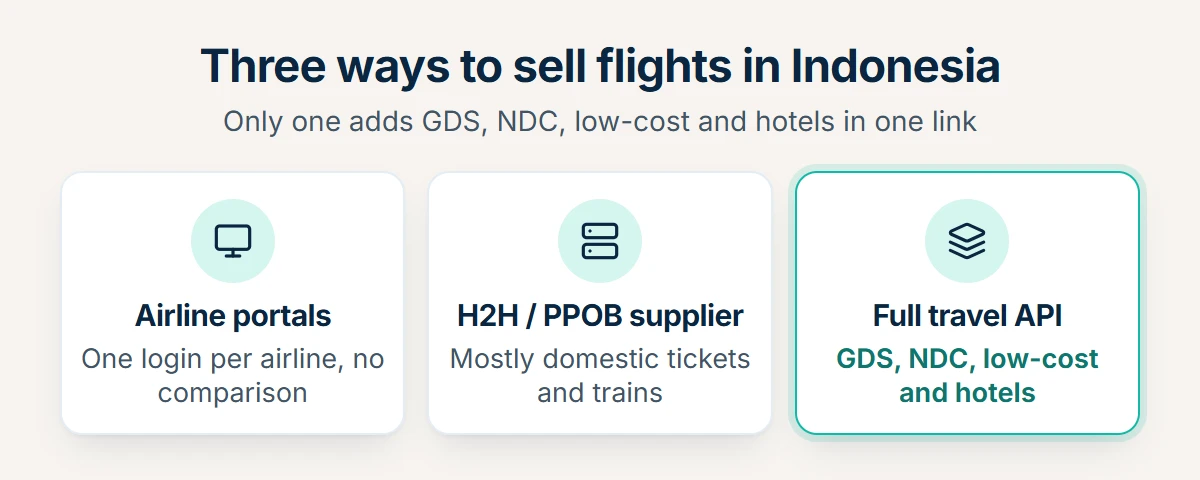
| Airline portals | H2H / PPOB supplier | Full travel API | |
|---|---|---|---|
| How you connect | One login per airline, by hand | One server-to-server link | One server-to-server link |
| Content | One airline at a time | Mostly domestic flights and trains | GDS, NDC, low-cost, hotels and extras |
| Best for | A small agency with few bookings | Bill-payment apps adding tickets | OTAs, agencies and apps that want to grow |
| Main limit | Slow, no comparison | Narrow content, hosted flows | More to build at the start |
The H2H model works well for a counter or app that sells mainly domestic tickets as one product among many bills. Its limits show when you grow: international routes, hotels, GDS fares for corporate clients, and after-sales such as changes and refunds are often thin. A full travel API is also host-to-host, so the integration style is familiar to any Indonesian developer who has built an H2H link. What changes is the depth: search, price check, booking, ticketing, cancellation and refund across flights, hotels, transfers, activities and eSIM, in one schema.
If you sell through a B2B portal today and want a ready-made booking website for your sub-agents rather than building one, our B2B travel platform guide covers that route.
How Do Indonesian Customers Pay — and Who Handles It?
Your Indonesian checkout must charge in rupiah and offer QRIS, virtual accounts and e-wallets; the travel API supplies the booking, not the payment method. Payment is where an Indonesian platform differs most from one built for Europe or the US.
Rupiah first. Law 7 of 2011 on Currency, Article 21(1), says rupiah “wajib digunakan” — must be used — in every transaction that has a payment purpose in Indonesia. The law sets penalties and lists exceptions such as international trade. For a consumer platform the practical rule is simple: show prices in IDR and charge in IDR. Ask a lawyer about your own case, especially as a foreign company billing Indonesian customers.
QRIS is now everywhere. QRIS (Quick Response Code Indonesian Standard) is Bank Indonesia’s national QR payment standard. Bank Indonesia counted 15.51 billion QRIS transactions in 2025, up 148.54% in a year, and by January 2026 QRIS had 59.98 million users and 43.06 million merchants, as Kontan reported. Indonesian checkouts also commonly offer bank virtual accounts, e-wallets such as GoPay, OVO, DANA and ShopeePay, and cards. Many payment gateways offer several of these methods in one integration.
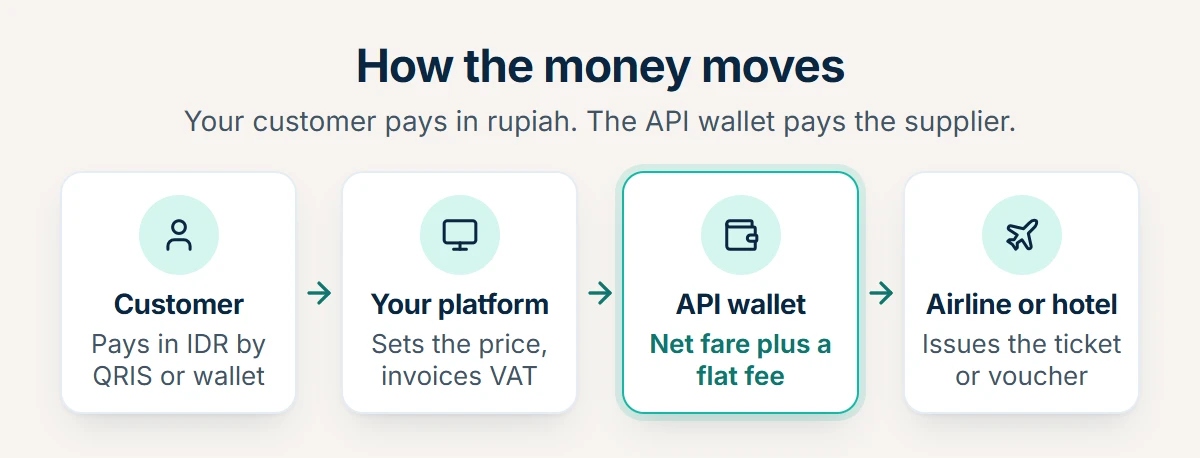
What the API does and does not do. A travel API returns a price with a currency, confirms the price before booking, and creates the booking. It does not choose your payment methods. Tripgic’s pricing page puts it plainly: “You collect payment from your own customers and agencies, using whichever payment methods and currencies suit your market.” Your platform sets the selling price, takes the rupiah payment through your gateway, and then books through the API.
How you pay the API. If you already buy tickets from a supplier against a deposit balance, Tripgic’s model will feel familiar: it runs on a prepaid wallet that you top up by bank transfer, and each transaction deducts the supplier net fare plus a flat markup, never a percentage. The amounts are on the Tripgic pricing page. Watch the currency gap: if customers pay in IDR and your supplier wallet is in another currency, your margin has to cover the exchange difference.
What Licences Does a Travel Business Need in Indonesia?
A travel business in Indonesia needs a business licence through OSS with the right KBLI code, and ticketing rights either through its own IATA accreditation or through a consolidator or aggregator. A travel API gives you inventory; it does not give you the right to sell travel. Check these points with a local adviser.
1. The business licence through OSS. Indonesian businesses register through the government’s Online Single Submission system at oss.go.id and choose a business classification code (KBLI). The OSS list includes KBLI 79121, “Aktivitas Biro Perjalanan Wisata” — travel bureau activities — which covers planning and selling packages and booking transport and accommodation. A travel agency, a tour operator and a technology platform may each need a different code, so confirm the right one for your model.
2. Airline ticketing rights. To issue GDS tickets in your own name, an agency normally needs IATA accreditation and a settlement relationship through IATA’s Billing and Settlement Plan (BSP); check the Indonesian terms with IATA. Many agencies instead ticket through a consolidator or an aggregator, which also avoids a direct GDS contract. Our IATA accreditation guide explains when you need it and when you do not.
3. Industry bodies. ASITA, the Association of the Indonesian Tours and Travel Agencies, has represented travel agencies since 1971. Membership is not an API requirement, but many Indonesian suppliers and partners know each other through it.
Selling into Indonesia from abroad
A foreign OTA or travel app that sells to Indonesian customers faces three questions an Indonesian agency answers by default. Each needs a lawyer’s view for your own structure; these are the questions to bring:
- Currency. Law 7 of 2011 requires rupiah for payment transactions in Indonesia, with exceptions such as international trade. Ask whether your sales to Indonesian residents fall inside the rule, and price in IDR if they do.
- Personal data abroad. The PDP Law allows personal data to leave Indonesia only where the receiving country gives an adequate level of protection, or other safeguards are in place. Map where your servers, your payment gateway and your travel supplier process passenger data.
- Local presence. Some models need an Indonesian entity and an OSS licence; others sell from abroad through a local partner. Decide this before you build the checkout, because it decides who invoices the customer.
The first step for a foreign seller is the same every time: confirm your licence route and your rupiah billing with an Indonesian adviser, then connect the API. The integration is the quick part; the structure behind it is what takes time.
How Do VAT and Data Protection Rules Affect Your Platform?
Two sets of rules touch every booking: VAT on what you sell, and the law on the personal data you store.
VAT (PPN) on tickets and services
Indonesia raised VAT from 11% to 12% on 1 January 2025, but the government limited the rise. In a release from the Coordinating Ministry for Economic Affairs, President Prabowo said: “kenaikan PPN dari 11 persen menjadi 12 persen hanya dikenakan terhadap barang dan jasa mewah” — the increase applies only to luxury goods and services. How the tax is calculated for other goods and services is set in Ministry of Finance rules, so confirm the current method with your tax adviser.
For flights, the split that matters is domestic against international. Domestic air tickets carry VAT; international air transport is exempt. A domestic leg is exempt only when it is part of an international journey on one ticket. DDTC News quotes the rule that every flight “harus terangkum dalam 1 tiket” — must be on one ticket.
The government has also covered part of the VAT on domestic economy tickets in some holiday seasons, such as the 2025/26 year-end period. So your invoices must know which tickets are domestic, which are international, and which seasonal rules apply. The API gives you the itinerary; your invoicing applies the tax. Corporate clients feel this most: their finance teams want domestic and international tickets shown separately, with the tax on each line, and a corporate travel tool that gets this wrong creates work for every approver.
Personal data under the PDP Law
Law 27 of 2022 on Personal Data Protection (UU PDP) came into force on 17 October 2022 with a two-year transition. In DLA Piper’s summary, all parties had until 17 October 2024 and “are now required to fully comply”. Points that matter for a travel platform:
- A data breach must be reported in writing within 72 hours.
- Administrative fines can reach 2% of annual income or revenue.
- Sending personal data abroad needs an adequate level of protection in the receiving country, or other safeguards.
- Passport numbers, dates of birth and payment details pass through every booking, so map where each one is stored.
In short: store less, report fast, and know where every processor keeps your data. Ask your API provider where passenger data is processed and how it is protected. Tripgic encrypts every API call with TLS 1.2 or higher and is built around GDPR and CCPA obligations, as its security page sets out. Our travel API security guide lists the questions to ask any supplier.
What Else Can You Sell With Indonesian Flights?
Flights bring the customer; the rest of the trip brings the margin. Indonesian travellers and visitors buy more than a seat.
- Hotels. Demand runs from Jakarta business hotels to resorts in Bali and small properties across the islands. An aggregated hotel API gives one search across many suppliers. Tripgic carries 2M+ hotel properties from 50+ suppliers in 190+ countries.
- Transfers and activities. Airport transfers in Bali and Jakarta, day tours and attraction tickets suit visitors well. Our tours and activities API guide covers how they are sold.
- eSIM. Outbound Indonesian travellers need data abroad, and inbound visitors need it on arrival. Tripgic offers eSIM data plans in 175+ countries; see our eSIM API guide.
- Visas. Indonesia’s Directorate General of Immigration lists 97 countries whose citizens can apply for an electronic visa on arrival (e-VOA) at imigrasi.go.id. Outbound Indonesians also need visas for many destinations. Our visa API guide explains how a visa sale fits into a booking.
- Trains. BPS counted 549.9 million rail passengers in 2025. Rail is a large domestic market; ask any provider exactly which rail operators it covers before you plan around it, and see our rail booking API guide.
Selling these from one API means one checkout and one booking record per trip, which is easier for your customer and for your support team.
Who Is Building Travel Into Indonesian Apps?
Indonesia’s digital economy runs on super-apps, e-wallets, digital banks and marketplaces. Many of them already sell bills, phone credit and train tickets, and travel is a natural next tab: the customer, the payment and the app already exist.
This is called embedded travel: a non-travel company sells flights and hotels inside its own app without becoming a travel company. The platform keeps the screens, the customer account and the checkout; the travel API supplies the inventory, the price check, the booking and the ticket. Tripgic’s embedded travel API page sets out that split for banks, wallets, marketplaces, super-apps and telcos, and suggests starting with one product, such as hotels or eSIM, before adding flights.
For an Indonesian wallet or bank, embedded travel also fits the payment habits above. The customer pays in rupiah from a balance they already hold, and the platform settles with the travel supplier separately. Our embedded travel API guide walks through the build.
How Do You Choose a B2B Travel API Provider for Indonesia?
Indonesian agencies can choose airline portals one by one, an H2H or PPOB ticket supplier, or a full travel API that combines GDS, NDC, low-cost carriers and hotels. Tripgic is a full travel API whose network page lists Indonesia among the countries where travel agencies use it. Whichever provider you consider, use the table as a scorecard, ask every provider the same questions, and ask for proof in the sandbox, not in a sales deck.
| Question | What a good answer looks like |
|---|---|
| Which Indonesian airlines come back? | A live sandbox search on your own routes, with the airlines named |
| Can I book and ticket, not just search? | Price check, booking, ticketing, cancel and refund on the same routes |
| Are bags and seats included? | Low-cost extras returned in the same response |
| How do I pay you? | A clear model: deposit or wallet, a flat fee per transaction, no hidden percentage |
| How are changes and refunds handled? | Endpoints and policies per fare, not “email support” |
| Where is passenger data processed? | A written answer you can check against the PDP Law |
| How long to go live? | A sandbox the same week, and a dated activation path |
Compare the fee model, not only the fare: a percentage commission grows with every ticket, while a flat fee per transaction does not. Our travel API pricing models guide compares them, and how to choose a travel API provider has the longer checklist.
How Does Tripgic Work for Indonesian Agencies and OTAs?
Tripgic is a B2B travel API aggregator: one REST API, one agreement and one normalized JSON schema for flights, hotels and travel extras. It is “a technical intermediary, not a direct travel operator” — the airlines and hotels fulfil the bookings, and you own the customer.
- Already used in Indonesia. Tripgic’s global network page lists Indonesia among 19 Asia-Pacific countries and territories where travel agencies search, book and ticket flights, hotels and travel services through the Tripgic API.
- Indonesian low-cost carriers. The LCC directory lists Lion Air, Batik Air, Wings Air and Indonesia AirAsia, among 100+ low-cost carriers in the connected network. Indonesia is also among the leading destinations from Malaysia and Singapore in Tripgic’s low-cost network.
- Full-service fares too. Amadeus, Sabre and Travelport content and airline-direct NDC offers come back in the same response — 800+ airlines overall — without your own GDS contract. See the GDS page.
- Hotels and extras. 2M+ hotel properties from 50+ suppliers, plus transfers, tours, activities, airport services and eSIM, through the same API.
- A payment model Indonesian agencies know. A prepaid wallet, topped up by bank transfer, deducts the supplier net fare plus a flat markup per transaction — never a percentage. Your own checkout keeps rupiah, QRIS and e-wallets. Amounts are on the pricing page.
- Built for developers. 134 endpoints with code samples in PHP, Node.js and Python, documented on the API docs page.
For a developer, the flight flow is the one the scorecard above asks about, in five steps you build once (see the documented endpoints for each):
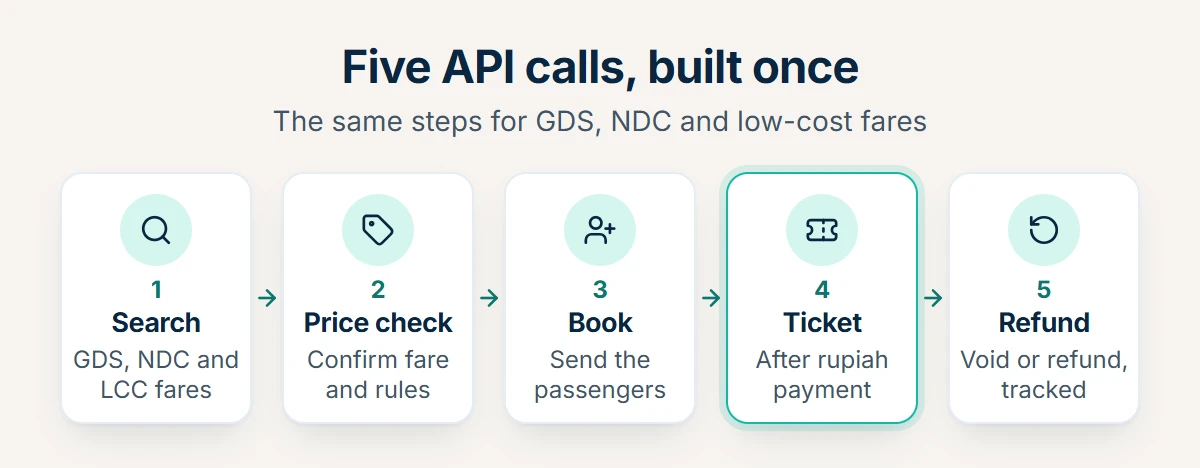
- Search — one request returns GDS, NDC and low-cost fares in one normalized list.
- Price check — confirm the fare and its rules before the customer pays.
- Book — send the passengers and create the booking.
- Ticket — issue the ticket once your rupiah payment has cleared.
- Void or refund — handle after-sales through the API, with request status you can track.
Tripgic is a division of Innovate Solution Global Pte. Ltd., based in Singapore.
How Do You Sell Indonesian Travel Across Southeast Asia?
Indonesia rarely stands alone in a travel business. Indonesian travellers fly to Singapore, Kuala Lumpur, Bangkok and the Middle East, and Malaysia, Australia, Singapore and China send the most visitors in. An API that covers Indonesia well should return those routes in the same search, so one integration serves your domestic, outbound and inbound customers alike.
If you also sell to the Gulf — for example Umrah travellers flying through Jeddah and Medina — our Saudi Arabia travel API guide and Middle East travel API guide cover those markets. The pattern is the same everywhere: keep payments local, check the rules, and compare fee models before fares. Indonesia simply asks more of the low-cost connections and the rupiah checkout than most markets do.
How Long Does It Take to Go Live in Indonesia?
The API part is the fast part. The steps below follow Tripgic’s own onboarding; the timing of your licence, payment gateway and invoicing depends on you.
- Kick-off call. Tell the provider what you sell, which routes matter and who your customers are.
- Free sandbox. Build search, price check, booking and ticketing against test credentials, and run your five Indonesian routes.
- Activate a plan. A one-time activation, by card or bank transfer. Tripgic activations for live use usually take 3–5 business days.
- Fund the wallet and go live. Top up by bank transfer and start booking.
In parallel, set up your rupiah checkout with a payment gateway, confirm your OSS licence and KBLI code, and build invoices that separate domestic tickets (VAT) from international ones (exempt). Our travel API integration timeline breaks the build into weeks.
Your next step: pick your five busiest Indonesian routes and book a kick-off call with Tripgic. You get free sandbox credentials and can see, on your own dates, which airlines and hotels come back before you commit to anything.
 Akhirul Islam
 Mohammad Fahim
 Golam Shahrier
