 Akhirul Islam
Duffel API alternatives are other flight booking APIs that let a business search, book and ticket airline seats without building every airline connection itself. The closest match is the Tripgic Flight API. Tripgic is a B2B travel API that searches, books and tickets flights across 800+ airlines through one integration. It combines the three global distribution systems (Amadeus, Sabre and Travelport), airline-direct NDC offers and 100+ low-cost carriers. Its fee is a flat markup, not a percentage of the fare. Direct GDS connections, NDC aggregators, and multisource or consolidator platforms are the other routes.
This guide is for online travel agencies (OTAs), travel agencies, corporate travel tools and travel-tech teams that use Duffel today or have it on a shortlist. Duffel here means Duffel Technology, the company behind the Duffel travel API. The guide explains what Duffel sells and what it charges, why teams look elsewhere, and how each alternative works.
Facts about another company come from that company’s own website, read on 23 November 2026. The exceptions are named where they appear: IATA’s definition of NDC, trade-press reports from Travolution and PhocusWire, Ignav’s page on Duffel, and Tripgic’s flight page for the contract and timing of a direct GDS connection. The links are in the sources box at the end. The grouping into kinds is ours. No provider is scored; Tripgic, which publishes this guide, is listed first.
Duffel API Alternatives at a Glance
A Duffel API alternative is any flight booking API that can search, book and ticket without Duffel. The main ones are Tripgic (a multi-product booking API), direct GDS connections (Amadeus, Sabre, Travelport), NDC and low-cost aggregators (Travelfusion, AirGateway, Verteil, Kyte) and multisource platforms (Mystifly, PKFARE). Each can end with a ticket on your own site, which is the test for a real alternative. Flight content is quoted in each provider’s own words where a quote exists. Terms such as GDS, NDC and consolidator are explained in Key Terms, right after the table.
| Provider | Kind | Flight content | Access or audience |
|---|---|---|---|
| Tripgic | Multi-product booking API | Amadeus, Sabre and Travelport content, airline-direct NDC and 100+ low-cost carriers | Kick-off call, NDA, sandbox at no charge |
| Amadeus, Sabre, Travelport | Direct GDS connection | One GDS network per integration | A contract with each GDS; Travelport also has a trial route |
| Travelfusion | NDC and low-cost aggregator | tfFlight API, “our flagship airline distribution platform” | “agents, metas & corporate enterprises”; registration |
| Mystifly | Multisource air platform | “NDC, LCC, GDS, and a Consolidator Marketplace” | “Integrate via API or agent portal” |
| PKFARE | Multisource air platform | “600+ airlines contents sourced from 100+ points of sale” | B2B clients; buyer sign-up |
| AirGateway | NDC and low-cost aggregator | “aggregated content for 40+ NDC and LCC airlines” | OTAs and booking tools, content “under your IATA” |
| Verteil | NDC and low-cost aggregator | “Book directly with NDC Airlines” | Travel sellers; contact |
| Kyte | NDC and low-cost aggregator | “low-cost and full-service airline content through a single integration” | “any travel seller” |
| Duffel (reference) | Flights, stays and cars API | “300+ airlines” from “NDC, GDS, and LCC” | Self-serve sign-up |
Two things are left out of the table. Kiwi.com’s Tequila platform takes new partners by invitation only, so it is covered further down. Price-data and scraper APIs return fares and links, and none of them issues a ticket; the section on what is not a Duffel alternative explains why.
Key Terms
Seven terms come up throughout this guide:
- GDS (global distribution system): a network such as Amadeus, Sabre or Travelport that airlines file their fares into.
- NDC (New Distribution Capability): IATA defines it as “a data exchange format based on Offer and Order management processes for airlines to create and distribute relevant offers to the customer regardless of the distribution channel”. In plain words, it is a newer way for airlines to send their own fares and extras straight to sellers.
- LCC: a low-cost carrier.
- IATA accreditation: the approval from IATA, the International Air Transport Association, that lets a seller issue airline tickets in its own name.
- Consolidator: a wholesaler that holds negotiated airline fares and can issue the ticket for an agency.
- Ancillary: a paid extra, such as a bag, a seat or a meal.
- Metasearch: a site that compares fares from many sellers and sends the traveller elsewhere to book.
What Is the Duffel API?
The Duffel API is a travel booking API from Duffel Technology, a company registered in England and Wales. Its homepage headline is “Sell travel, without the complexity”, and it says “any business - from startups to large enterprises - can sell travel with Duffel”. The product lets a business “shop, book, and manage flights, stays, and travel extras” inside its own website or app.
What Duffel Sells
Duffel has three products, each with its own page:
- Flights. Duffel’s flight search page offers “flights from 300+ airlines from all major distribution channels: NDC, GDS, and LCC”. The API also sells bags and seats, and handles changes and cancellations.
- Stays. Duffel’s homepage says a seller can “earn commission on over 1 million properties globally”. Stays pay a profit share on each completed booking.
- Cars. Duffel’s cars page lists “40+ global rental brands across 40,000 locations worldwide with a single API”.
The part that makes Duffel different from a GDS is Managed Content. Duffel’s flights page describes it in one line: “Access content from global airlines using our accreditation and ticketing authority.” Its managed-content page adds that this helps a seller “avoid months-long application processes, financial approvals, and cash bonds”. In plain words, Duffel issues the ticket on its own industry licences, so a new seller does not need them on day one. The same page lists 24/7 travel support as part of Managed Content.
How You Get Access to Duffel
Access is self-serve. Duffel’s pricing page says you can “sign up and start selling flights in less than 1 minute”. You build first in test mode, which Duffel’s docs call “a ‘sandbox’ which lets you use the Duffel API risk-free”. Search results there include Duffel Airways, a test airline with the IATA code ZZ that Duffel runs itself.
Live mode takes one more step. Duffel’s getting-started guide lists two tasks “in order to get access to Live Mode”. First you verify your email. Then you complete a verification that covers your type of business, your personal details, your business information and Know Your Customer (KYC) checks. The guide notes that “every country has its own requirements that users must meet”.
Duffel also ships developer tools: client libraries in Node.js, Python and Ruby, and prebuilt components such as seat selection and payments. For a small team that wants to start today without a sales call, that is the heart of Duffel’s appeal.
Duffel API Pricing: What Does It Cost?
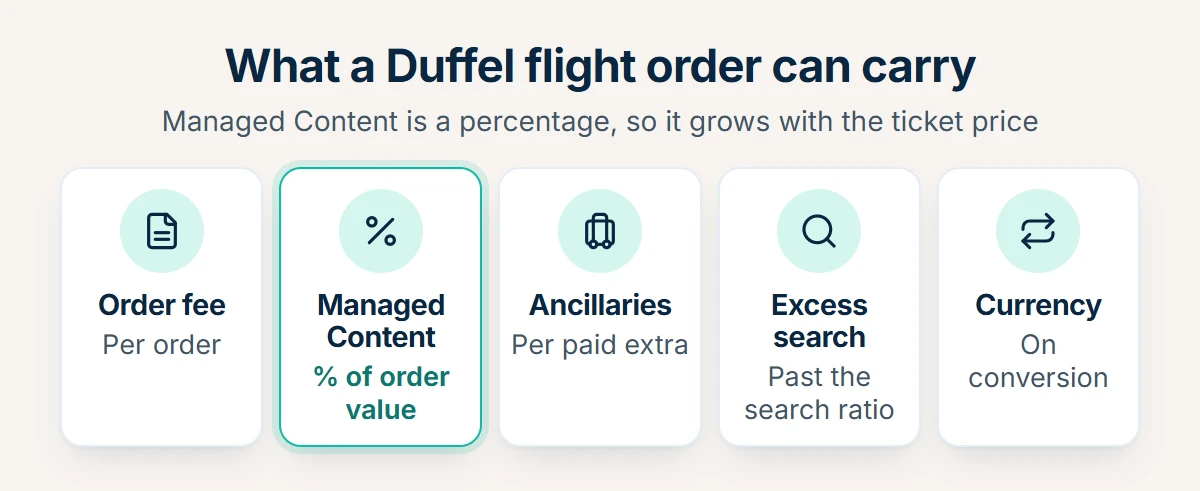
A Duffel flight sale costs $3.00 per confirmed order plus 1% of the order value on Managed Content, with separate fees for paid extras, excess searches and currency conversion. Duffel publishes these fees on its pricing page, which has two plans. “Pay as you go” has “zero up-front costs” and email-based technical support. “Enterprise” has bespoke pricing, volume discounts, dedicated technical support and the option to “use your own IATA accreditation”.
These are the pay-as-you-go flight fees on Duffel’s pricing page, in its US dollar view, read on 23 November 2026. Check the page before you budget, because fees change.
| Fee | Amount | When it applies |
|---|---|---|
| Orders | $3.00 per order | “This fee is charged monthly for every confirmed order” |
| Managed Content | 1% of total order value | Every confirmed order sold on Duffel’s accreditation |
| Ancillaries | $2.00 per paid ancillary | Each paid bag or seat |
| Excess search | $0.005 per excess search | Searches beyond a 1500:1 search-to-book ratio |
| Foreign exchange | 2% on the exchange rate | When a currency conversion is needed |
Stays are priced differently. Duffel’s pricing page describes a “profit share on every completed stay”, and a stay counts as completed “once the guest checks out of the accommodation”.
What Duffel’s Fees Add Up To
A seller with 1,000 Managed Content orders a month at a $450 average value, 400 paid ancillaries and 2 million searches would pay about $10,800 in Duffel fees, or $10.80 per order. The arithmetic is ours, built only from the published fees above.
| Line | Sum | Cost |
|---|---|---|
| Orders | 1,000 × $3.00 | $3,000 |
| Managed Content | 1% of $450,000 | $4,500 |
| Ancillaries | 400 × $2.00 | $800 |
| Excess search | 500,000 × $0.005 | $2,500 |
| Total | $10,800 |
In this example, Duffel’s published flight fees come to $10.80 per order, before any currency conversion. The search line works like this: 1,000 orders allow 1,000 × 1,500 = 1.5 million searches, so 500,000 of the 2 million are excess. Duffel’s own FAQ gives a smaller example: 10 orders allow 15,000 free searches, so a seller who runs 25,000 searches pays for the 10,000 above the allowance, which is $50.
Two fees depend on your business: the Managed Content fee and the excess search fee. The Managed Content fee is a percentage, so it grows with the ticket: 1% of a $200 short-haul order is $2.00, and 1% of a $1,500 long-haul order is $15.00. With the $3.00 order fee added, the $200 order carries $5.00 and the $1,500 order carries $18.00. The excess search fee depends on how your users browse. A product with many searches per booking, such as a price-comparison screen, pays more than a corporate tool where most searches end in a booking.
Is the Duffel API Free?
Testing is free, and selling is not. Test mode costs nothing, and the pay-as-you-go plan has no up-front fee, so a team can build a full booking flow before it pays anything. Once the account is live, each confirmed order carries the fees above. Our guide to free travel APIs compares what “free” means across booking, affiliate and data APIs.
Duffel API Review: What Duffel’s Own Pages Show
Duffel is strong on speed to start and on published terms, and its limits are mostly about cost shape and product range. This is a summary of what Duffel’s own pages say, not a user review, so you can weigh it before you read opinions elsewhere. We gathered no user reviews for this guide; developer forums and software review sites are the place to find them.
Strengths, from Duffel’s own pages:
- Self-serve sign-up and a free test mode.
- Published pay-as-you-go fees with no up-front cost.
- Official client libraries in Node.js, Python and Ruby, and prebuilt components.
- Managed Content, so a new seller can ticket without its own accreditation.
- NDC, GDS and low-cost channels behind one API.
Limits to check, from the same pages: the 1% Managed Content fee, the 1500:1 search allowance, no markup when the traveller’s card is passed to the airline, a three-product catalogue and email-based support on the pay-as-you-go plan. The next section explains each one.
Run your own review in test mode. Before you decide, check four things in a Duffel test account: whether your top 10 routes return offers, how the order fee, the 1% fee and any paid extras add up on your average fare, how many searches a typical user session sends, and what the live-mode verification asks for. Duffel Airways is a test airline, so a successful test booking proves your integration, not your route coverage.
Why Do Teams Look for a Duffel Alternative?
Teams compare Duffel with other routes for six main reasons: a fee that grows with the fare, a metered search allowance, the payment set-up, route coverage, a three-product catalogue and plan-based support. Duffel suits many teams, so treat these as points to test, not as faults. Each point starts from a fact on Duffel’s pages. What it means for a seller is our reading.
The fee grows with the fare. The 1% Managed Content fee rises with every ticket price, so it weighs most on high-value orders such as long-haul and business-class trips. A flat fee per passenger or per booking behaves differently at high order values, which is why our guide to travel API pricing models treats the two as separate models.
The reverse also holds. On a low fare, a flat fee per passenger can be a bigger share of the ticket than a 1% fee. Model both against your real average fare and passenger count before you decide.
Search volume is metered. The 1500:1 search-to-book ratio ties free searches to confirmed orders. Fare calendars, flexible-date grids and metasearch-style results all multiply searches without adding orders, so a browse-heavy product reaches the limit sooner than a checkout flow.
The payment set-up takes a decision. Duffel supports two ways to pay for a booking. When the traveller’s card is passed to the airline, its payment guide says: “You cannot markup or discount the transaction as card payments must be for the exact amount quoted by the travel supplier.” That method also “requires approval to access”.
To control the price, the guide says you “need to be Merchant of Record and collect customer card payments yourself”. The Merchant of Record is the company that charges the traveller’s card and answers for the payment. In that set-up you pay Duffel from the Duffel Balance, “a pre-funded wallet” funded by bank transfer.
Coverage is a route question, not an airline count. “300+ airlines” is a total. What matters is whether the carriers on your top routes are there, with the fares and extras your customers expect. Test your own top routes with every provider, low-cost carriers included, before you compare any two totals.
The catalogue stops at three products. Duffel sells flights, stays and cars. A seller that also wants transfers, activities, rail, eSIM or visas needs more suppliers and more integrations.
Support follows the plan. The pay-as-you-go plan includes email-based technical support. Dedicated technical support sits in the Enterprise plan, which is priced case by case.
Tripgic: A Duffel Alternative with GDS, NDC and Low-Cost Carriers in One API
Tripgic is a travel API aggregator: one B2B integration that searches, prices, books and tickets flights, so the sale stays on your own site. Like Duffel, it stands between you and the airlines and blends GDS, NDC and low-cost content. The differences are in the detail: Amadeus, Sabre and Travelport all sit in the same search, more products sit behind the same integration, and each sale is priced as a flat amount.
What One Integration Reaches
- 800+ airlines reachable through one REST API.
- Amadeus, Sabre and Travelport content under one contract, with built-in deduplication: the same flight from several GDS sources appears once.
- NDC (New Distribution Capability) airline-direct offers, blended with GDS results. Carriers on Tripgic’s NDC list include Lufthansa Group, British Airways, Air France-KLM, Emirates, Qatar Airways and Singapore Airlines.
- 100+ low-cost carriers that sit outside traditional GDS distribution, returned next to full-service airlines.
- 51,519 commercial routes across 1,619 airports, open to browse in the route directory before you sign anything.
Every source comes back in the same normalized JSON. Tripgic’s flight page puts the point this way: “you build one booking flow instead of one per supplier.” Our guide to the NDC aggregator model explains how blended GDS and NDC results work.
Search to Ticket on One API
The Tripgic Flight API runs a booking from search to issue-ticket through one set of flight endpoints. Every call is a POST with a JSON body, and the search returns a tracking_id that you carry into each later step.
- Search GDS, NDC and LCC content by route, date, travellers, cabin and carrier.
- Branded fares: read the fare families an airline offers for the flight.
- Validate the itinerary. The validated price is final.
- Travellers: add names, documents and contacts.
- Extras: baggage, seat maps and meals, each with a read call and an update call.
- Create booking: the reservation is made.
- Issue ticket: the e-ticket is issued over the API, with no manual ticketing step on your side.
- Retrieve or cancel: a booking-details call and a cancel call.
You do not need a GDS contract or certification of your own. Tripgic’s flight page sets the two paths side by side. A direct GDS connection means “a separate agreement with each GDS” and typically 6–12 months to a first booking. The Tripgic route is one agreement: a sandbox in days after a kick-off call, and live credentials usually within 3–5 business days of activation. Our airline ticketing API guide covers the ticketing step in detail, and our guide to the passenger name record (PNR) explains the booking record behind a reservation.
How the Money Works
Tripgic’s model has two charges. The first is a one-time activation. The second is a flat markup per transaction on the supplier net fare, which for flights is counted per passenger. Tripgic’s pricing page states it plainly: “Never a percentage of the fare.” There is no monthly subscription.
Three details matter when you compare this with Duffel:
- The unit is different. Duffel’s fixed fee is per order, and one order can hold several passengers. Tripgic’s flight markup is per passenger. A family of four is one order on Duffel and four passengers on Tripgic, so model both against your real passenger mix.
- Your margin is yours. The validated price is the supplier net fare plus the flat markup. Tripgic’s docs say this amount “can be shown to your customers as-is”, and you add your own margin on top when you charge your customer.
- Settlement is prepaid. Tripgic runs on a prepaid wallet: the net fare plus the markup is deducted as each booking or ticket is processed. Post-ticketing requests such as voids, refunds and reissues (changes to an issued ticket) carry a service fee per ticket, listed on the pricing page.
Search traffic is governed by the look-to-book ratio (searches allowed per booking) in your plan. Ask for the ratio that fits your traffic before you sign, as you would with Duffel’s 1500:1.
Beyond Flights
The same Tripgic credentials and the same JSON format cover more than flights. Tripgic’s API documentation lists 134 endpoints across flights, hotels, eSIM, transfers, activities, airport services, trains, visas, tour packages, car rental and travel insurance. The hotel side alone reaches 2M+ properties. A seller that adds products later extends one integration instead of signing a new supplier each time. Our guide to hotel API providers compares the hotel routes.
How Tripgic Access Works, and When Duffel Fits
Tripgic is not a self-serve product like Duffel. Access starts with a request form or a kick-off call, then a non-disclosure agreement (NDA), then sandbox credentials at no charge. You pay the one-time activation when you go live, and live credentials usually follow within 3–5 business days.
If you want to sign up in a minute and test tonight without talking to anyone, Duffel’s model fits that. Duffel also fits if you want official client libraries and ready-made checkout components, or if you want to go live with no up-front charge. Tripgic is not for consumers, and not for metasearch sites that need affiliate links instead of bookable content.
Duffel vs Tripgic: How Do They Compare?
Duffel and Tripgic both sell bookable flights through one API. They differ in how you start, how the fee is counted and how many other products sit behind the same integration. The table sets the two side by side; each cell is taken from the company’s own pages, and it is a description, not a score.
| Point | Duffel | Tripgic |
|---|---|---|
| Flight content | “300+ airlines” from “NDC, GDS, and LCC” | 800+ airlines: Amadeus, Sabre, Travelport, NDC and 100+ low-cost carriers |
| Other products | Stays and cars | Hotels, transfers, activities, trains, eSIM, visas and more |
| How you start | Self-serve sign-up and a test token | Kick-off call, NDA, then a sandbox at no charge |
| Going live | Account activation with KYC checks | One-time activation; live credentials usually in 3–5 business days |
| Fee per flight sale | Per order, plus 1% of order value on Managed Content | Flat markup per passenger, never a percentage |
| Search traffic | 1500:1, then a fee per excess search | Look-to-book ratio set by your plan |
| Settlement | Traveller’s card passed to the supplier, or a pre-funded Duffel Balance | Prepaid wallet, debited per booking or ticket |
| Ticketing | Duffel’s accreditation, or your own IATA on Enterprise | Issue-ticket call; no GDS contract of your own |
Duffel Competitors: What Are the Other Alternatives?
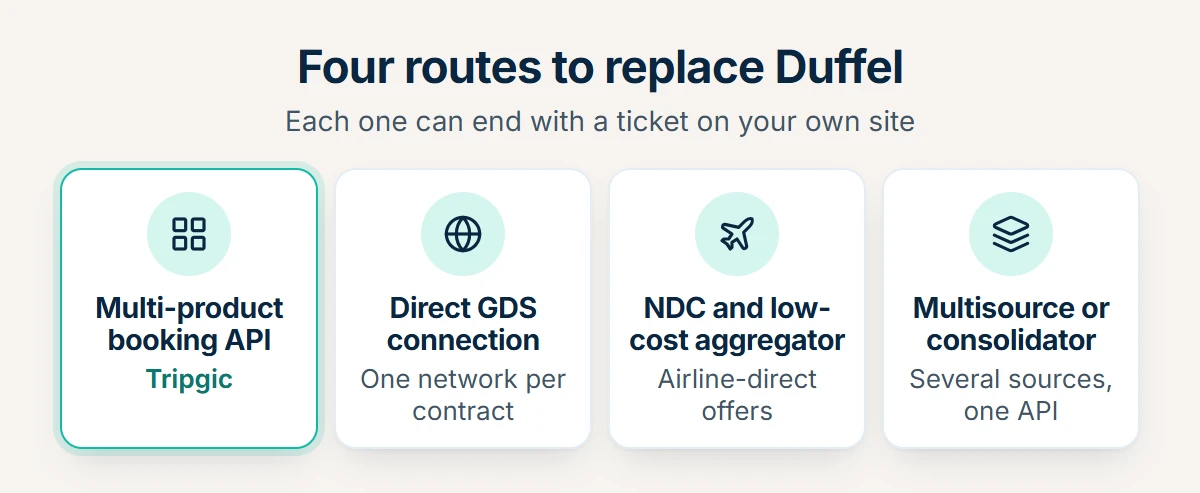
Duffel’s competitors fall into four kinds: a multi-product booking API (Tripgic, covered above), direct GDS connections, NDC and low-cost aggregators, and multisource or consolidator platforms. The last three differ in what they connect you to. A direct GDS connection gives one network under its own contract. An NDC aggregator gives airline-direct offers from many carriers. A multisource platform mixes several sources behind one API. Our flight booking API guide compares the types in depth.
Direct GDS Connections
A direct connection gives you one GDS network. Each network needs its own contract and its own certification. Travelport issues TripServices credentials “when you are provisioned”, and its docs also describe a trial-user route. Its guides cover “search, booking, and ticketing for flights”. Our Travelport API guide covers that route.
Sabre offers agency developers “modern APIs, intelligent cache, and unified workflows”; our Sabre API guide explains access. Amadeus says its Enterprise APIs “remain fully available”. PhocusWire reported in February 2026 that the Self-Service portal would be decommissioned for existing users on 17 July 2026, and quoted an Amadeus spokesperson: “We are decommissioning only the self-service section of the Amadeus for Developers portal.” Our guide to the Amadeus Self-Service shutdown lists where those developers went.
NDC and Low-Cost Aggregators
NDC and low-cost aggregators collect airline-direct content and resell it through one API. Some airlines also offer NDC connections directly, one carrier at a time; an aggregator replaces many of those with one integration. Ask each one whose accreditation issues the ticket, because the answer differs from one to the next.
Travelfusion says it has built “the largest LCC & NDC distribution platform”, and calls its tfFlight API “our flagship airline distribution platform, used by the world’s leading agents, metas & corporate enterprises”. AirGateway offers “real-time aggregated content for 40+ NDC and LCC airlines” and describes its content as “all under your IATA”. Verteil runs NDC channels for a list of airlines under the line “Book directly with NDC Airlines.” Kyte describes itself as “the modern API to connect to any airline”, for sellers “wishing to offer low-cost and full-service airline content through a single integration”.
Our guides to what NDC is and to the low-cost carrier API explain why this content sits outside the classic GDS feed.
Multisource and Consolidator Air Platforms
Mystifly offers “multisource air connectivity covering NDC, LCC, GDS, and a Consolidator Marketplace”, with “integrated ticketing and fulfillment”, through an API or an agent portal. PKFARE supplies air tickets and hotels to B2B clients and lists “600+ airlines contents sourced from 100+ points of sale”. Travolution, a travel trade title, has reported that PKFARE partnered with Duffel to widen its NDC and low-cost content, so two names in this guide can share a source. Our flight consolidator guide explains how consolidator fares and ticketing work.
Kiwi.com is a special case. In a statement dated 30 May 2024, it said that “any new partnerships on the Tequila platform will be on an invitation only basis”, while existing partners keep their tools. It is an alternative only if Kiwi.com invites you.
What Is Not a Duffel Alternative
Price-data, scraper and affiliate APIs answer a different need. They return fares, and sometimes a link to the seller, but no booking reference and no ticket.
Ignav, a flight price API, has its own page on this comparison and is candid about it: “Duffel is for teams that want to sell and manage tickets. Ignav is for teams that want flight search and booking links without ticketing complexity.” It adds that “one often cannot replace the other”.
If you only need prices for a fare alert or a research tool, a data API may be the right tool. Our guides to the Google Flights API and to Skyscanner API alternatives cover those routes. If you sell tickets, they do not replace Duffel.
Duffel vs Amadeus, Sabre and Travelport: What Is the Difference?
Duffel is a booking API that reaches several channels, GDS content among them. Amadeus, Sabre and Travelport are GDS networks: airlines file schedules and fares into them, and you contract with each one directly. Duffel adds its own accreditation, its own tooling and a self-serve front door on top.
The table sets Duffel beside a direct Amadeus connection. The Duffel column and the Amadeus access row come from each company’s own pages; the contract and timing rows for a direct GDS connection come from Tripgic’s flight page.
| Point | Duffel | Amadeus (direct GDS) |
|---|---|---|
| What it is | A booking API across NDC, GDS and low-cost channels | A GDS network that airlines file fares into |
| How you start | Self-serve sign-up, then test mode | Enterprise APIs through Amadeus; the Self-Service portal is closed |
| Contract | One Duffel account | A separate agreement with the GDS, and a certification |
| Time to start | Sign-up in “less than 1 minute”, then test mode; live mode after account verification | After the contract and certification; typically 6–12 months to a first booking |
The same differences hold for Sabre and Travelport:
- Contract. A direct GDS connection needs an agreement with that GDS. Duffel and Tripgic each replace several of those agreements with one.
- Certification. A direct GDS integration is certified before go-live. Tripgic says you need no certification of your own; ask any other intermediary the same question.
- Content. One GDS gives you its own network. NDC offers and many low-cost carriers arrive through other channels, which is the gap aggregators fill.
- Cost shape. A GDS deal usually has its own fees and volume terms. Our GDS API cost guide breaks them down.
A seller can also run a direct GDS contract and an aggregator side by side: the GDS for core volume, the aggregator for NDC, low-cost carriers and new markets. Our comparison of Amadeus vs Sabre vs Travelport helps if you are choosing a single network, and what a GDS is covers the basics.
Do You Need IATA Accreditation to Replace Duffel?
Often no, but it depends on the provider. Duffel’s Managed Content issues the ticket on Duffel’s accreditation, so a seller does not need its own. Ask every provider the same two questions: whose accreditation issues the ticket, and what must you hold yourself?
A flight sale has three parts that can sit with different companies: access to the content, the authority to issue the ticket, and settlement with the airline. Duffel’s Managed Content covers the first two on Duffel’s side: the content and the ticketing authority. Its pricing page says this includes “access to our 5 IATAs worldwide with no need for any additional forms or up-front capital”. A seller with its own accreditation can use that accreditation instead, through Duffel’s Enterprise plan.
The alternatives differ on this point. With Tripgic, the ticket is issued through the issue-ticket call. AirGateway works differently: it describes its content as “all under your IATA”, which suits an agency that is already accredited. With a direct GDS connection, ask the GDS what ticketing set-up it expects from you.
| Route | What its own pages say about ticketing |
|---|---|
| Duffel Managed Content | Tickets are issued on Duffel’s IATA accreditation: “our accreditation and ticketing authority” |
| Duffel Enterprise | You use your own IATA accreditation |
| Tripgic | Tickets are issued through the issue-ticket call, with “no manual ticketing step on your side”; no GDS contract or certification of your own. Settle the ticketing set-up for your market on the kick-off call |
| AirGateway | Content “all under your IATA” |
Whether your business also needs a licence or accreditation in the markets where it sells is a separate question. Our IATA accreditation guide walks through it step by step.
Which Duffel Alternative Fits Your Business?
Shortlist a multi-product booking API if you sell flights and hotels, and an NDC aggregator that works under your IATA if you are accredited. Shortlist a direct GDS connection if you are ready for its contract and certification, and Duffel itself if you want to start the same day. The table matches each kind of business to a route. Find the row that describes you; the last column names the route to shortlist first.
| You are | What matters most | Route to shortlist |
|---|---|---|
| An OTA selling flights and hotels | GDS, NDC and low-cost fares in one search; more products later | A multi-product booking API such as Tripgic |
| A seller of long-haul or premium fares | How a flat fee compares with a percentage on your average fare | Model a flat fee against a percentage on your real fares; Tripgic is the flat-fee route |
| A startup that wants to test tonight | Self-serve sign-up and client libraries | Duffel itself, or another API with an open sandbox |
| An accredited agency with its own IATA | Airline-direct NDC content under your own number | An NDC aggregator that works under your IATA, such as AirGateway, or Duffel Enterprise |
| A high-volume OTA with a GDS deal | NDC, low-cost carriers and new markets on top | An aggregator beside your GDS |
| A corporate travel tool | Branded fares, extras and servicing | A booking API with post-booking calls |
| A fare-alert or research tool | Prices only, no sales | A price-data API, not a booking API |
If you have no developers and want a booking website instead of an API, a ready-made platform is the better fit. Our sister product ReservationHub offers a turn-key, cloud-hosted booking platform with flight, hotel and transfer modules. For startups choosing a first supplier, our guide to the travel API for startups goes deeper into stages and costs.
How Do You Switch from Duffel to Another Flight API?
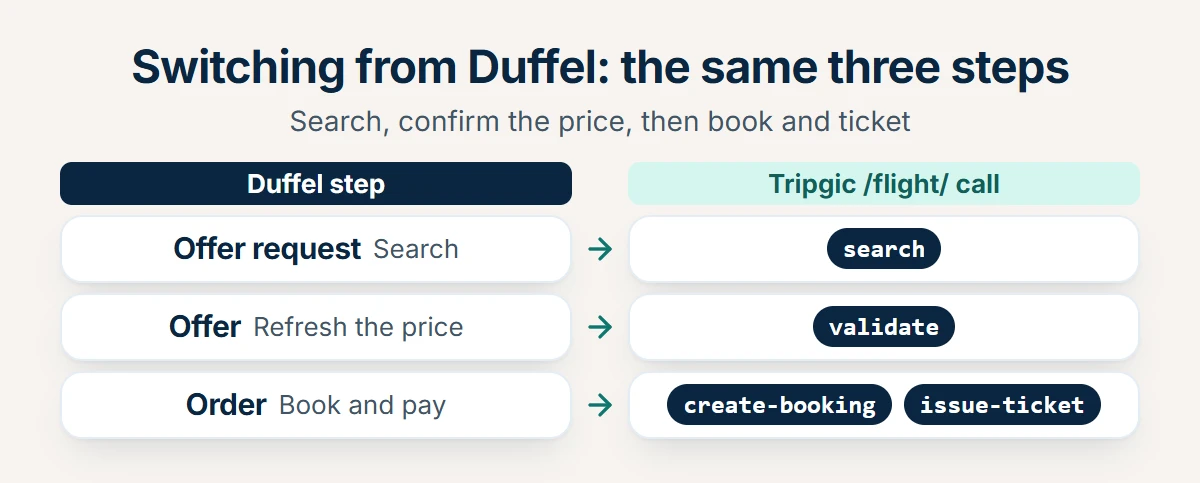
Switching from Duffel to another flight API is a mapping job: an offer request becomes a search, a refreshed offer becomes a price validation, and an order becomes the booking and ticketing calls. Duffel’s flow has three main objects: you “create an offer request in order to search for flights”, you pick an offer, and you create an order. Flight booking APIs share one flow: search, price check, booking, ticketing. Each API gives the steps its own names. The mapping below is ours; the Duffel terms are from its docs and the Tripgic calls from its flight page.
| Duffel step | What it does | Tripgic call |
|---|---|---|
| Create an offer request | Search with slices (journey legs) and passengers | /flight/search |
| Retrieve the offer | Refresh the price before payment | /flight/validate |
| List available services | Extra bags to sell | /flight/get-baggage-option |
| Fetch a seat map | Free and paid seats | /flight/get-seat-plan |
| Create an order | Book and pay | /flight/update-travellers, /flight/create-booking, /flight/issue-ticket |
| Cancel the order | Cancel for a refund | /flight/cancel-booking |
Duffel’s docs warn that “offers get stale fairly quickly, and when they do, you are no longer able to book them”. The validate call does the same job on Tripgic: it confirms the itinerary and returns the final price before you take payment.
The Search Call, Side by Side
The first call shows how close the two shapes are. The dates are those in each company’s documentation; use a future date when you test. Duffel’s getting-started guide searches a New York to Atlanta round trip for two adults and an infant like this:
duffel.offerRequests.create({
  slices: [
    { origin: "NYC", destination: "ATL", departure_date: "2021-06-21" },
    { origin: "ATL", destination: "NYC", departure_date: "2021-07-21" }
  ],
  passengers: [{ type: "adult" }, { type: "adult" }, { age: 1 }],
  cabin_class: "business",
})
Tripgic’s API documentation shows a one-way Dhaka to Dubai search for one adult as a POST to /flight/search:
{
  "journey_type": "OneWay",
  "segment": [{
    "departure_airport_type": "AIRPORT",
    "departure_airport": "DAC",
    "arrival_airport_type": "AIRPORT",
    "arrival_airport": "DXB",
    "departure_date": "2026-03-30"
  }],
  "travelers_adult": 1,
  "travelers_child": 0,
  "travelers_infants": 0,
  "non_stop_flight": "any",
  "baggage_option": "any",
  "booking_class": "Economy",
  "partner_id": "1",
  "language": "en"
}
The ideas line up one to one. Duffel’s slices are Tripgic’s segment entries. Duffel lists each passenger, and Tripgic takes a count per traveller type. Duffel’s cabin_class is Tripgic’s booking_class. Each response returns an identifier that the next call needs: an offer request id on Duffel, a tracking_id on Tripgic.
The move itself runs in six steps:
- List what you use. Write down every Duffel call in your code, plus the dashboard jobs your support team does by hand.
- Request access and check rates. After the NDA, Tripgic shares a Live Rate Check Panel, so you can compare real-time rates on your own routes before any payment.
- Build in the sandbox. Sandbox credentials are issued at no charge, against the same schema you will use in production.
- Handle outcomes by status. Branch on the
statusfield in each response, not on the HTTP code. A failed booking can arrive as HTTP 200 with a status of “failed” and a reason. - Run both in parallel. Send a small share of live traffic to the new API and compare prices, booking success and ticketing time on the same routes.
- Plan the old orders. Confirm with Duffel how orders already made there will be serviced. Keep that access until the last of those trips has flown and its refund window has closed.
Tripgic’s pricing page lays out its onboarding steps from first contact to live bookings, and our guide to the travel API integration timeline shows how long each stage usually takes.
What Should You Ask Before You Switch?
Ask every provider the same nine questions: the fee basis, the search ratio, carrier coverage on your routes, whose accreditation issues the ticket, how you get paid, who handles changes, what the test environment returns, the support level and the add-on products. Ask them of Duffel too, since the answer may be to stay.
- Is the fee flat or a percentage, and what is it counted on: an order, a passenger or a ticket?
- What search-to-book ratio is included, and what does a search beyond it cost?
- Which carriers on my top 20 routes are bookable, and through which channel: GDS, NDC or direct?
- Whose accreditation issues the ticket, and can I use my own later?
- How do I get paid? Can I set my own selling price, and in which currency is the supplier settled?
- Who handles changes, refunds and schedule changes, and is there a fee per request?
- What does the test environment return: real airline sandboxes, a test airline, or live-like data?
- What support comes with my plan, and during which hours?
- Can I add hotels, transfers or rail on the same integration later?
Our guide on how to choose a travel API provider turns these into a full checklist.
The Short Version
Duffel is a self-serve API for flights, stays and cars. It is quick to start, it publishes its fees, and it lets a new seller ticket on Duffel’s accreditation. Its flight fee has a fixed part and a percentage part, and its search allowance is tied to bookings.
Teams look for a Duffel alternative when the percentage fee, the payment set-up or the product range stops fitting. A direct GDS deal suits a seller ready for a contract and a certification with one network. An NDC aggregator suits a seller that wants airline-direct offers. A multi-product booking API suits a seller that wants GDS, NDC and low-cost carriers in one search and more products behind the same integration. Tripgic is built for that last case, with a flat markup per passenger.
For a wider comparison across products, see our shortlist of travel APIs.